
Investing in real estate appeals to a lot of people. A rental property diversifies your portfolio and can pay steady cash, but becoming a landlord is a deal-breaker when a day job already takes 40-plus hours a week.
Arrived (formerly Arrived Homes) is built for that reader. You buy shares of a rental home or a fund for as little as $100, Arrived handles tenants and repairs, and you collect your share of the rent as dividends. It's a good fit for non-accredited investors who want real estate exposure in small amounts and can leave the money alone for five years or more. It's a poor fit for money you may need soon, or for anyone counting on steady income from a single home.
Our list of passive income ideas covers other ways to get there.

Quick Summary
- Start collecting property dividends immediately
- Avoid the hassles of being a landlord
- Get started with as little as $100
What Is Arrived?
Arrived is a real estate crowdfunding platform that sells shares of individual rental homes and real estate funds to everyday investors. Its early backers included Jeff Bezos, and it now reports $121 million distributed to investors and more than one million registered users on its homepage. Those figures aren't dated, so treat them as current as of this update.
Each home sits in its own LLC, and you buy shares of that LLC through an SEC-qualified Regulation A offering. That's why accredited investor status isn't required. Arrived is open to U.S. citizens and green card holders who are 18 or older and live in one of the 50 states.
Ryan Fraizer, the CEO and co-founder, says, “Our goal is to make the wealth-building potential of owning rental homes more accessible. We believe we can do that by simplifying the process and lowering the cost to get started.”
Essentially, you can start your real estate investment journey with just $100 through Arrived. As an investor, you'll collect dividends from the properties and your share of the appreciation without handling the details like finding tenants or handling maintenance requests.

Screenshot of how Arrived works. Source: The College Investor
What Does It Offer?
Arrived offers four ways to invest: individual single-family homes, individual vacation rentals, diversified funds, and a real estate debt fund. Each has a different fee, payout pattern and way out, so the product you pick matters more than the platform. Our real estate investing ideas compare this approach with owning property directly.
Consistent Passive Income Without The Hassle
The main draw is rental income without being a landlord. Arrived and its property managers deal with tenants and maintenance, and you receive your share of the net rent as a monthly dividend. Our passive income ideas show how this compares with other hands-off income sources.
The income isn't guaranteed. A home with a vacancy or a big repair can pay nothing for months, so most investors spread money across several homes or use one of the funds, as we show in the performance section below and our real estate investing ideas.
Benefit From Property Appreciation
As a part-owner of an actual home, you share in any gain when it sells. Arrived expects a five- to seven-year hold, and when the home sells you receive your share of the proceeds after costs. A home can also sell for less than it cost. Our real estate vs. stocks comparison covers how the two asset classes fit together in a portfolio.
Low Investment Minimum
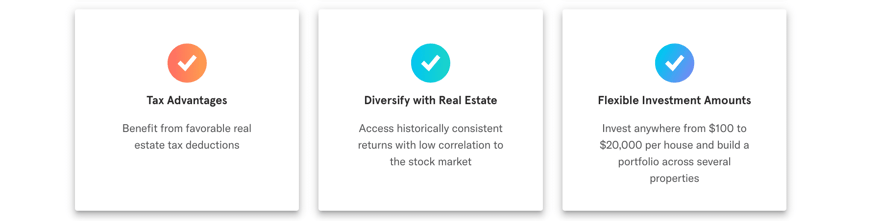
You can start with Arrived for $100 and build a portfolio home by home. That low minimum is the platform's biggest advantage over buying a rental yourself, which usually means a down payment in the tens of thousands. Our ways to become a real estate investor with $5,000 show where Arrived fits on that ladder.
Screenshot of Arrived Investment minimums. Source: The College Investor
Rigorous Property Requirements
Arrived uses market data to pick homes and handles the paperwork from research to closing, so you don't have to hunt for properties. Each offering page shows the purchase price, financing, projected expenses, and the offering circular filed with the SEC. Read those documents before you buy, the same way you'd research an ETF before adding it to a portfolio.
No Personal Liability
As they build their real estate assets, some investors begin to worry about the personal liability associated with managing rentals. But this isn't something that you'll need to worry about when you invest through Arrived.
The company will place all new properties into an LLC. That means there is no personal liability involved in your investment.
Related: How To Set Up An LLC For Investing
Arrived Single Family Residential Fund
The Single Family Residential Fund holds many homes across several markets, so one vacancy doesn't wipe out your dividend. It's always open for new money, and you can request a redemption after six months.
The fund paid a 4.1% annualized dividend in August 2026, and its occupancy fell to 86.3% in Q2 from 95.7% the quarter before. Arrived also runs a Seattle City Fund, which paid the same 4.1% in August. Compare that payout with the best high-yield savings accounts before you lock money up.
Arrived Private Credit Fund
The Real Estate Income Fund, which Arrived used to call the Private Credit Fund, lends money short term to real estate projects and passes the interest to investors, much like the loan-based approach in our Groundfloor review. It paid an 8.7% average annualized dividend in Q2 2026 and 7.3% in August 2026, with about $90.9 million invested across 45 active loans at the end of June. It charges 0.3% of net assets per quarter.
That yield beats a savings account, but it isn't savings. The fund isn't FDIC insured, the loans can default, and you can't redeem for the first six months. If you might need the money within a few years, keep it in an emergency fund instead.
Arrived Historical Performance
Arrived publishes performance for every property, including the ones losing money, on its returns page. We like that. It doesn't hide the risk of rental real estate, and you can check a home's record before buying more of it. Hold other alternative investments to the same standard before you buy.
Here's what Arrived's August 2026 report shows, with yields you can set against the best high-yield savings accounts:
| Product | Annualized Dividend Yield | Properties That Paid |
|---|---|---|
| Single-Family Homes (All Funded) | 3.2% | 351 of 471 |
| Single-Family Homes (Only Those That Paid) | 4.3% | 351 |
| Vacation Rentals (All Funded) | 0.5% | 7 of 40 |
| Single Family Residential Fund | 4.1% | Fund |
| Seattle City Fund | 4.1% | Fund |
| Real Estate Income Fund | 7.3% | Loan fund |
The averages hide a wide spread. In Q2 2026, individual homes paid annualized dividends ranging from 1.06% to 14.4%. In August, 120 of 471 funded single-family homes and 33 of 40 vacation rentals paid nothing. Spreading money across several homes or using the funds smooths that out, the same way an ETF smooths out single-stock risk.
Here's what that means in dollars. $1,000 spread across Arrived's single-family homes at August's 3.2% average across all homes would pay about $32 a year in dividends. The rest of the return depends on what the homes sell for in five to seven years, and selling early on the secondary market can cost up to $25 in broker fees on that $1,000. Our real estate investing ideas show how that compares with other ways in.
Are There Any Fees?
Arrived does come with a few fees that you should be aware of. First, the company charges an assets under management (AUM) fee of between 0.10% - 0.30% per quarter.
According to Arrived, additional fees may be incurred at the asset or fund level when acquiring and managing real estate investments. This may include costs already worked into the original offering price, such as closing costs, escrow fees, and a sourcing fee, which is a one-time cost.
If you're curious about these fees, you can find them by viewing the offering details section for each listed property. Lastly, ongoing operating expenses are paid from future rental income.
How Do You Get Your Money Out Of Arrived?
You can sell individual home shares to other investors on Arrived's secondary market, or ask the funds to redeem your shares. Either way, plan on at least six months before you can touch the money and years before it's easy. Our real estate crowdfunding list compares liquidity across platforms.
Secondary market (individual homes). Arrived launched its secondary market in February 2025. It opens for a one-week trading window each month. Homes become eligible once they're fully funded and held at least six months. You set your own price with a limit order, and a trade happens only when a buyer and seller match. The executing broker can charge up to 2.5% on each side. There's no guarantee anyone will buy at your price.
Redemption program (funds). The Single Family Residential Fund and the Real Estate Income Fund let you request a redemption after six months. Requests are processed at the end of each quarter and paid within 10 business days of approval. A redemption fee applies based on how long you've held the shares, and requests are subject to fund-level limits. Other platforms have frozen redemptions entirely, as RealtyMogul did in April 2026, so read "subject to limits" as a real risk.
How Are Arrived Investments Taxed?
Arrived reports your dividends on a Form 1099-DIV by the end of January, not a K-1. Each property is taxed as a REIT, or as a corporation for vacation rentals, and you don't file returns in the states where the homes sit. Our explainer on the Schedule K-1 covers what you avoid.
That simplicity has a cost, which one reader raised in the comments. When you own a rental directly, you can deduct depreciation and expenses against the rent, and sometimes against other income. With Arrived, the LLC takes those deductions and you just receive dividends. For an investor who owns a large portfolio, direct ownership often wins on taxes. For someone investing $100 at a time, the 1099-DIV is far easier, and our LLC investing explainer covers what changes when you hold property in your own entity.
You can also invest through a retirement account. Arrived accepts checkbook IRAs and Solo 401(k)s and works with Rocket Dollar to set them up. IRA accounts don't receive a 1099-DIV. Compare custodians in our best self-directed IRA providers.
[EDITOR: Robert, add one first-hand line from your own rental ownership on how the tax side compares, since that's the point the commenter raised.]
How Does Arrived Compare?
Arrived Homes offers investors the chance to dive into real estate investing with minimal capital. However, the company isn't the only one to provide this option to budding real estate investors.
Roofstock offers investors a similar style of investment through Roofstock One. Roofstock One is currently closed to new investors. But when it relaunches, accredited investors will be able to buy whole or fractional shares of a managed investment property.
Fundrise doesn't allow investors to pick and choose individual properties. But, through its eREITs. it does make it easy to invest in many cash-flowing properties (residential and commercial) starting with as little as $10. Here's a closer look at how Arrived compares:
Header |  |  |  |
|---|---|---|---|
Rating | |||
Product Name | Arrived | Roofstock One | Starter Portfolio |
AUM Fees | 1.00% | 0.50% | 1.00% |
Min Investment | $100 | $5,000 | $10 |
Open To Non-Accredited Investors | |||
Cell |
How Do I Open An Account?
Ready to dive in with Arrived? You'll need to start by creating an account with your email and a password. Next, you’ll have to provide your legal name and agree to Arrived’s terms of service.
At that point, you can explore the potential properties in greater detail and link your bank account when you're ready to invest in an offering. When I explored the platform, none of the properties were ready for investment. Instead, I had the option to reserve shares and be notified when I would need to put up my investment.
Is It Safe And Secure?
Arrived offers an opportunity to invest in real estate, which comes with inherent risks. It's possible that you could lose money on a deal. But so far, that hasn’t been the case.
In terms of liability protection, Arrived keeps you safe from any personal liability. Each property is placed in an LLC. As an investor in any home, you will invest in the LLC. With that, you won’t be personally on the hook if any lawsuits come about in regard to a particular property.
With any real estate investing site, it's important to discuss liquidity. The anticipated holding period for the investments listed on its site is an estimated 5-7 years. That's a long time to have your money tied up, especially compared to stocks and ETFs which can be sold at any time. That being said, the Funds have quarterly liquidity after 6 months.
How Do I Contact Arrived?
Want to reach out to Arrived? You can get in contact through the Live Chat feature on their site or email their customer support team at [email protected].
Additionally, you can connect via Facebook, Twitter, YouTube, Instagram, and LinkedIn @ArrivedHomes.
Who Is This For And Is It Worth It?
We love the concept behind Arrived for those who want to invest in real estate without taking on the responsibility of being a landlord.
Over time, Arrived could develop into a serious contender in the real estate investing world. They've consistently been increasing their inventory on the platform, and new users will usually find anywhere from 4 to 10 different investment options available.
Check out our favorite real estate crowdfunding sites here >>>
Frequently Asked Questions
Is Arrived Legit?
Yes. Arrived sells shares through SEC-qualified Regulation A offerings, holds each home in its own LLC, and publishes property-level returns, including the losers. Being legitimate doesn't mean low risk, and our real estate crowdfunding comparison shows how the platforms differ on that.
Can You Lose Money On Arrived?
Yes. A home can sit vacant, cost more to repair than planned, or sell for less than it cost, and Arrived's returns page shows homes with negative returns. Spreading money across several homes or a fund lowers the risk, as with any alternative investment.
How Long Do You Have To Hold Arrived Shares?
At least six months before you can sell or redeem. Arrived expects five to seven years for individual homes. After six months you can try the monthly secondary market, but a buyer isn't guaranteed. Our crowdfunding comparison shows how other platforms handle exits.
Does Arrived Send A K-1?
No. Arrived sends a Form 1099-DIV by the end of January because each property is taxed as a REIT or a corporation. You also won't file returns in the states where the homes are located. Our Schedule K-1 explainer covers the investments that do send one.
Can I Invest In Arrived With An IRA?
Yes, through a checkbook IRA or Solo 401(k). Arrived works with Rocket Dollar to set those up, and you'll need a separate Arrived account for it. Compare options in our self-directed IRA providers list.
Is Arrived Better Than Fundrise?
It depends on what you want. Arrived lets you pick individual homes for $100, while Fundrise spreads $10 or more across a diversified portfolio for about 1% a year. Most beginners who want one hands-off holding are better served by Fundrise or Arrived's own Single Family Residential Fund.
Arrived Homes Features
Account Types |
|
Minimum Investment | $100 |
Sourcing Fee | Varies by property |
Annual Management Fee | 1% |
Property Management Fee | 8% |
Open To Non-Accredited Investors | Yes |
Investment Options |
|
Transparency | High. Historical financials and offering circulars provided for each property |
Anticipated Investment Term | 5-7 years |
Early Share Redemption | Can be requested after 6 months |
Secondary Market | Intended, but not guaranteed |
Customer Service Options | Phone, email, chat, social media |
Customer Service Email Address | |
Web/Desktop Account Access | Yes |
Mobile App Availability | None |
Promotions | None |
Arrived Review
-
Pricing and Fees
-
Ease of Use
-
Customer Service
-
Property Inventory
-
Liquidity
-
Investor Accessibility
Overall
Summary
Arrived allows individual investors to buy shares of rental properties and earn quarterly dividends and capital appreciation.
Pros
- Passive dividend income paid out monthly
- Professional property management
- Minimum investment is just $100
- Series LLC structure protects shareholders from personal liability
Cons
- Investment fees can eat into your returns
- Investments are illiquid (5-7 year timelines and no guaranteed share redemption program)
Editor: Clint Proctor Reviewed by: Colin Graves

Get the latest financial news and actionable insights.
How it works:
- 1Enter your email and subscribe.
- 2Get the latest personal finance and education news delivered every week.
- 3Take control of your finances with real insights.
- 4We won't spam you, ever!

Robert Farrington is the founder of The College Investor and is widely recognized as one of the nation’s leading voices on student loan debt and saving for college. He holds an MBA from UC San Diego Rady School of Management and has spent over 15 years researching, writing, and advising on student loans, 529 plans, financial aid programs, and saving and investing for young professionals.
Robert has been featured in the The New York Times, The Wall Street Journal, The Washington Post, NBC News, and Forbes, where he has been a regular personal finance contributor for over a decade. His work combines both professional expertise and personal experience – he successfully navigated his own student loan repayment journey and has helped thousands of readers do the same.
He is committed to making the intersection of personal finance and education transparent and accessible. You can learn more about Robert on the About Page or on his personal site RobertFarrington.com.