
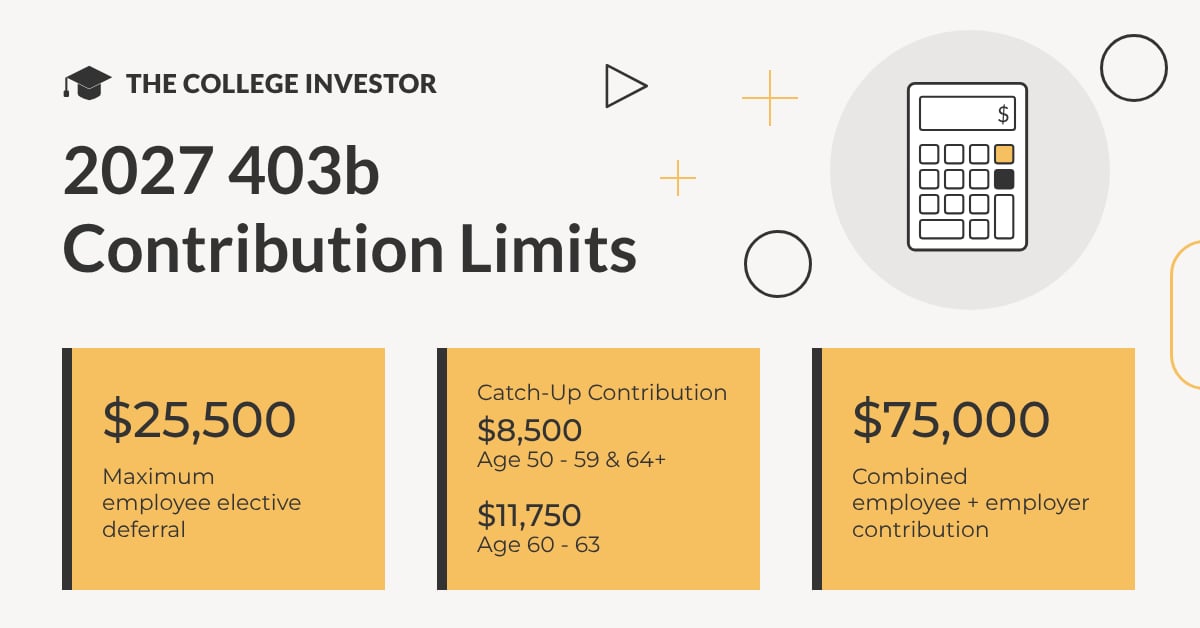
- The 2027 403(b) contribution limit is $25,500, up from $24,500 in 2026. Workers 50 and older can add $8,500, and workers aged 60 to 63 can add $11,750.
- Long-time employees of schools, hospitals and churches may qualify for an extra $3,000 a year through the 403(b) 15-year catch-up, on top of the age 50 catch-up.
- A 403(b) and a governmental 457(b) have separate limits, so a public school employee with both plans could defer $51,000 in 2027 before any catch-ups.
The 2027 403(b) contribution limit is $25,500, the same as the 401(k) limit. A 403(b) is the workplace retirement plan for public school employees, nonprofit workers, hospital staff and some ministers. Our news story on the 2027 IRS limit changes covers every account type that changed.
This page shows the 2027 and 2026 403(b) limits side by side, since 2026 contributions run through your last paycheck of the year. It also covers the 15-year catch-up that only 403(b) plans offer and how a 403(b) stacks with a 457(b) plan.
Would you like to save this?
What Are The 2027 403(b) Contribution Limits?
The 2027 403(b) limit is $25,500 for employee contributions, including Roth 403(b) contributions. Workers 50 and older can add $8,500, and workers who turn 60 to 63 in 2027 can add $11,750 instead. Total contributions from you and your employer can reach $75,000 or 100% of your includible compensation, whichever is less, per IRS Notice 2026-66 (PDF File). These are the same limits as a 401(k).
| Limit | 2026 | 2027 |
|---|---|---|
| Employee Contribution Limit | $24,500 | $25,500 |
| Catch-Up, Age 50 To 59 And 64+ | $8,000 | $8,500 |
| Catch-Up, Age 60 To 63 | $11,250 | $11,750 |
| 15-Year Service Catch-Up | $3,000 | $3,000 |
| Employee Plus Employer Limit | $72,000 | $75,000 |
| Roth Catch-Up Wage Threshold | $150,000 | $155,000 |
Employer contributions, such as a match or a nonelective contribution, count only toward the $75,000 total. Your own catch-up contributions sit outside that cap. If your school district or hospital offers a match, contributing enough to collect it comes first in our retirement savings order of operations.
What Are The 2026 403(b) Contribution Limits?
The 2026 403(b) limit is $24,500, with an $8,000 catch-up at age 50 and an $11,250 catch-up at ages 60 to 63. Employee contributions for 2026 must come out of paychecks dated by December 31, 2026, and you can’t add more after the year ends. Teachers on a 10-month schedule should check whether summer paychecks are already spread across the year, and our list of year-end money moves covers what else to finish.
How Much Can You Put In A 403(b) By Age?
Your 403(b) limit depends on your age at the end of the year and, for some workers, your years of service. In 2027, a worker under 50 can contribute $25,500, a worker 50 to 59 can contribute $34,000 and a worker 60 to 63 can contribute $37,250. Workers who also qualify for the 15-year catch-up can add up to $3,000 more, as our 403(b) plan definition explains.
| Age At Year-End | Standard Max | With 15-Year Catch-Up |
|---|---|---|
| Under 50 | $25,500 | $28,500 |
| 50 To 59 | $34,000 | $37,000 |
| 60 To 63 | $37,250 | $40,250 |
| 64 And Older | $34,000 | $37,000 |
How Does The 403(b) 15-Year Catch-Up Work?
The 15-year catch-up lets employees with at least 15 years at the same qualifying employer contribute up to $3,000 more per year, with a $15,000 lifetime maximum. Qualifying employers are public schools, hospitals, home health agencies, health and welfare service agencies and churches. Your plan has to offer it, so check your plan documents or ask your 403(b) provider.
You only qualify if your past 403(b) contributions averaged $5,000 a year or less with that employer. The yearly extra is the smallest of $3,000, $15,000 minus the 15-year catch-ups you’ve already used or $5,000 times your years of service minus your past deferrals. Contributions above the $25,500 limit count toward the 15-year catch-up first and the age 50 catch-up second, so a worker 50 or older can use both. Long-time public employees should also confirm their public service job counts for PSLF, since many 403(b) employers qualify.
Who Must Make Roth Catch-Up Contributions?
If you earned more than $155,000 in FICA wages from your employer in 2026, your 2027 catch-up contributions must go in as Roth 403(b) contributions. The 2026 threshold was $150,000 of 2025 wages. Our coverage of the Roth catch-up rule explains how it works under SECURE 2.0.
If your 403(b) doesn’t offer a Roth option, workers above the threshold can’t make catch-up contributions at all. Roth catch-ups don’t lower your taxable income, but they grow tax-free, which suits savers who expect a high tax bracket in retirement, as our breakdown of the pros and cons of a Roth 401(k) explains for workplace Roth accounts.
Can You Contribute To A 403(b) And A 457(b)?
Yes. A 403(b) and a governmental 457(b) have separate employee limits, so a public school employee with both could contribute $25,500 to each in 2027, or $51,000 before catch-ups. A 403(b) and a 401(k) share one $25,500 limit, since both fall under the same IRS rule for elective deferrals. Our comparison of 403(b) and 457 plans covers the withdrawal differences too.
| Plan Combination | Employee Limit | Under 50 Total |
|---|---|---|
| 403(b) Only | $25,500 | $25,500 |
| 403(b) And 401(k) | $25,500 Shared | $25,500 |
| 403(b) And Governmental 457(b) | $25,500 Each | $51,000 |
| 403(b), 457(b) And IRA | $25,500 + $25,500 + $7,500 | $58,500 |
A 457(b) also has its own special catch-up in the three years before your plan’s normal retirement age, but you can’t use it in the same year as the age 50 catch-up in that plan. If you go over the 403(b) limit across two employers, ask a plan to return the excess by April 15 of the next year. The 457 plan definition explains how that plan’s catch-up works.
How Much Should You Contribute Per Paycheck?
To max out a 403(b) in 2027, contribute $980.77 per paycheck if you’re paid every two weeks, or $2,125 a month if you’re paid monthly. Workers 50 and older need $1,307.69 every two weeks. Public school employees paid only during the school year should divide by their actual number of paychecks, which our income tax calculator can help you check against take-home pay.
| Pay Schedule | Under 50 | Age 50+ | Age 60 To 63 |
|---|---|---|---|
| Every Two Weeks (26) | $980.77 | $1,307.69 | $1,432.69 |
| Twice A Month (24) | $1,062.50 | $1,416.67 | $1,552.08 |
| Monthly (12) | $2,125.00 | $2,833.33 | $3,104.17 |
| 10 Monthly Paychecks | $2,550.00 | $3,400.00 | $3,725.00 |
Repaying Student Loans On A School Salary?
Pre-tax 403(b) contributions lower your adjusted gross income, which lowers payments on an income-driven repayment plan. Our list of pre-tax moves that lower your student loan payment shows how much, and teachers should also check the student loan forgiveness options for teachers.
Who Can Use A 403(b)?
A 403(b) is offered by public schools and colleges, 501(c)(3) nonprofits like hospitals and charities and certain churches and ministers. Under the universal availability rule, if an employer offers employee contributions to anyone, it generally has to offer them to nearly all employees. Many of these employers also qualify for PSLF, which our PSLF qualification breakdown walks through.
Some 403(b) plans offer annuity products with high fees, and many school districts list several approved vendors. Compare expense ratios before you choose, and favor low-cost index funds or target date funds when your plan offers them.
403(b) Contribution Limit History
Select a year to see its 403(b) limits. The employee limit has tracked the 401(k) limit every year, while the 15-year catch-up is set by law at $3,000 a year. Use these when you check a prior-year W-2 or the history of your 403(b) account.
2025 403(b) Contribution Limits
| Limit | 2025 |
|---|---|
| Employee Contribution Limit | $23,500 |
| Catch-Up, Age 50+ | $7,500 |
| Catch-Up, Age 60 To 63 | $11,250 |
| 15-Year Service Catch-Up | $3,000 |
| Employee Plus Employer Limit | $70,000 |
2024 403(b) Contribution Limits
| Limit | 2024 |
|---|---|
| Employee Contribution Limit | $23,000 |
| Catch-Up, Age 50+ | $7,500 |
| 15-Year Service Catch-Up | $3,000 |
| Employee Plus Employer Limit | $69,000 |
2023 403(b) Contribution Limits
| Limit | 2023 |
|---|---|
| Employee Contribution Limit | $22,500 |
| Catch-Up, Age 50+ | $7,500 |
| 15-Year Service Catch-Up | $3,000 |
| Employee Plus Employer Limit | $66,000 |
2022 403(b) Contribution Limits
| Limit | 2022 |
|---|---|
| Employee Contribution Limit | $20,500 |
| Catch-Up, Age 50+ | $6,500 |
| 15-Year Service Catch-Up | $3,000 |
| Employee Plus Employer Limit | $61,000 |
2021 403(b) Contribution Limits
| Limit | 2021 |
|---|---|
| Employee Contribution Limit | $19,500 |
| Catch-Up, Age 50+ | $6,500 |
| 15-Year Service Catch-Up | $3,000 |
| Employee Plus Employer Limit | $58,000 |
2020 403(b) Contribution Limits
| Limit | 2020 |
|---|---|
| Employee Contribution Limit | $19,500 |
| Catch-Up, Age 50+ | $6,500 |
| 15-Year Service Catch-Up | $3,000 |
| Employee Plus Employer Limit | $57,000 |
2019 403(b) Contribution Limits
| Limit | 2019 |
|---|---|
| Employee Contribution Limit | $19,000 |
| Catch-Up, Age 50+ | $6,000 |
| 15-Year Service Catch-Up | $3,000 |
| Employee Plus Employer Limit | $56,000 |
2018 403(b) Contribution Limits
| Limit | 2018 |
|---|---|
| Employee Contribution Limit | $18,500 |
| Catch-Up, Age 50+ | $6,000 |
| 15-Year Service Catch-Up | $3,000 |
| Employee Plus Employer Limit | $55,000 |
All Years At A Glance (2018 To 2027)
| Year | Employee Limit | Age 50+ Catch-Up | Total Limit |
|---|---|---|---|
| 2027 | $25,500 | $8,500 | $75,000 |
| 2026 | $24,500 | $8,000 | $72,000 |
| 2025 | $23,500 | $7,500 | $70,000 |
| 2024 | $23,000 | $7,500 | $69,000 |
| 2023 | $22,500 | $7,500 | $66,000 |
| 2022 | $20,500 | $6,500 | $61,000 |
| 2021 | $19,500 | $6,500 | $58,000 |
| 2020 | $19,500 | $6,500 | $57,000 |
| 2019 | $19,000 | $6,000 | $56,000 |
| 2018 | $18,500 | $6,000 | $55,000 |
403(b) Contribution Limit FAQs
What Is The 403(b) Limit For 2027?
The 2027 403(b) employee limit is $25,500. Workers 50 and older can add $8,500, and workers aged 60 to 63 can add $11,750. Total employee and employer contributions can reach $75,000, per our story on the 2027 IRS limits.
Is The 403(b) Limit The Same As The 401(k) Limit?
Yes. Both plans share the same $25,500 employee limit and the same catch-up amounts in 2027. A 403(b) adds the 15-year catch-up, which a 401(k) doesn’t have.
Can I Use The 15-Year Catch-Up And The Age 50 Catch-Up In The Same Year?
Yes, if you qualify for both. Contributions above the regular limit count toward the 15-year catch-up first and then the age 50 catch-up. A 55-year-old who qualifies could contribute $37,000 in 2027, and the 403(b) definition page explains the eligibility rules.
Can I Contribute To A 403(b) And An IRA?
Yes. IRA limits are separate, so you could add $7,500 to an IRA in 2027 on top of your 403(b). Your workplace plan may limit your traditional IRA deduction, which our IRA income limits page covers.
Can I Still Contribute To My 403(b) For 2026?
Only through payroll by December 31, 2026. Unlike an IRA, a 403(b) can’t take 2026 employee contributions after the year ends. If you want to add more for 2026 after that, an IRA is your option until April 15, 2027, and our best IRA accounts list shows where to open one.
Sources
Editor: Chris Muller Reviewed by: Ohan Kayikchyan Ph.D., CFP®

Robert Farrington is the founder of The College Investor and is widely recognized as one of the nation’s leading voices on student loan debt and saving for college. He holds an MBA from UC San Diego Rady School of Management and has spent over 15 years researching, writing, and advising on student loans, 529 plans, financial aid programs, and saving and investing for young professionals.
Robert has been featured in the The New York Times, The Wall Street Journal, The Washington Post, NBC News, and Forbes, where he has been a regular personal finance contributor for over a decade. His work combines both professional expertise and personal experience – he successfully navigated his own student loan repayment journey and has helped thousands of readers do the same.
He is committed to making the intersection of personal finance and education transparent and accessible. You can learn more about Robert on the About Page or on his personal site RobertFarrington.com.