
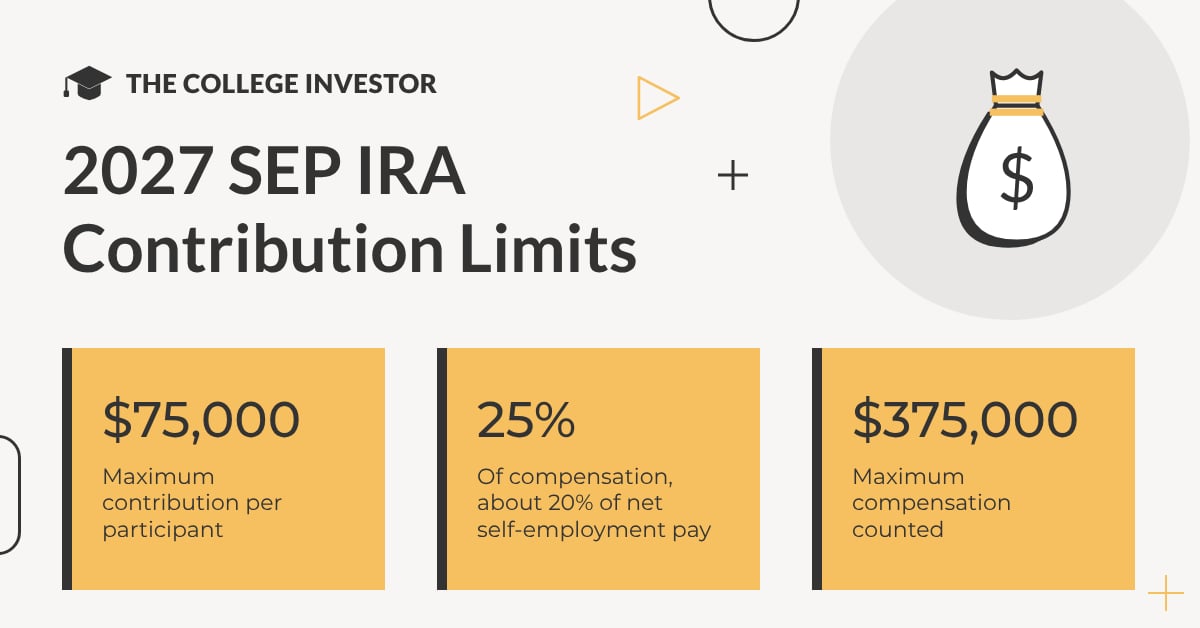
- The 2027 SEP IRA limit is 25% of compensation, up to $75,000, up from $72,000 in 2026. Only the first $375,000 of pay counts toward the calculation.
- Self-employed owners can contribute about 20% of net self-employment earnings, since the 25% applies after deducting half of self-employment tax and the contribution itself.
- You can still fund a 2026 SEP IRA until your 2026 tax filing deadline, including extensions, so both years’ limits apply right now.
The SEP IRA contribution limit for 2027 is the lesser of 25% of compensation or $75,000. A SEP IRA, short for Simplified Employee Pension, is a retirement plan for self-employed workers and small business owners. Our news story on the 2027 IRS limit changes covers every account type that changed.
This page shows the 2027 and 2026 SEP limits side by side, since 2026 contributions stay open until you file. It also walks through the self-employed calculation step by step and compares a SEP with a solo 401(k) at several income levels.
Would you like to save this?
What Are The 2027 SEP IRA Contribution Limits?
In 2027, an employer can contribute up to 25% of each eligible employee’s compensation to a SEP IRA, with a $75,000 cap per person. Only the first $375,000 of compensation counts, up from $360,000 in 2026. Employees qualify after earning at least $800 from the business, per IRS Notice 2026-66 (PDF File). Our list of the best self-employed retirement plans shows how a SEP fits with other options.
| Limit | 2026 | 2027 |
|---|---|---|
| Maximum Contribution Per Person | $72,000 | $75,000 |
| Percent Of Compensation | 25% | 25% |
| Compensation Limit | $360,000 | $375,000 |
| Pay Needed To Be Eligible | $800 | $800 |
| Catch-Up Contributions | None | None |
| Contribution Deadline | 2026 Filing Deadline, Including Extensions | 2027 Filing Deadline, Including Extensions |
A SEP has no catch-up contributions, so the $75,000 cap is the same at every age. Workers 50 and older who want to save more often choose a solo 401(k), which our page on 401(k) contribution limits covers in detail.
What Are The 2026 SEP IRA Contribution Limits?
The 2026 SEP IRA limit is 25% of compensation, up to $72,000, with a $360,000 compensation cap. You can make 2026 contributions until your 2026 tax return is due, including extensions, so a sole proprietor who extends has until October 15, 2027. Our calendar of tax due dates lists the filing deadlines for each business type.
You can even open a new SEP IRA for 2026 up to that deadline. That makes a SEP one of the few retirement plans you can set up after the year ends and still deduct on your return, which our list of last-minute tax moves points out.
How Do You Calculate A SEP IRA Contribution If You’re Self-Employed?
If you’re self-employed, your SEP contribution works out to about 20% of net self-employment earnings, not 25% of profit. Start with your Schedule C profit, subtract half of your self-employment tax, then multiply by 20%. The 20% rate is the 25% employer rate adjusted for the fact that your own contribution also reduces the pay it’s based on. Our breakdown of Schedule SE shows where the self-employment tax figure comes from.
| Step | Amount |
|---|---|
| Net Profit From Schedule C | $150,000.00 |
| Self-Employment Tax (15.3% Of 92.35% Of Profit) | $21,194.32 |
| Minus Half Of Self-Employment Tax | -$10,597.16 |
| Net Earnings From Self-Employment | $139,402.84 |
| Times 20% | x 20% |
| Maximum SEP IRA Contribution | $27,880.57 |
The 25% rate applies directly to W-2 wages. An S corporation owner paying a $100,000 salary can contribute $25,000, while profit paid out as distributions doesn’t count. IRS Publication 560 includes a worksheet for the self-employed math, and you’ll deduct the contribution on Schedule 1 of Form 1040, which our income tax calculator can help you value.
SEP IRA Vs. Solo 401(k): Which Lets You Save More?
A solo 401(k) lets most self-employed people save more than a SEP IRA at the same income. Both allow the same employer contribution, but a solo 401(k) adds an employee contribution of up to $25,500 in 2027, plus catch-ups at age 50. A SEP only matches it once net earnings are high enough for 20% to reach the $75,000 cap. Our walkthrough of how to open a solo 401(k) covers the setup.
| Schedule C Net Profit | SEP IRA | Solo 401(k) | Solo 401(k) At 50 To 59 |
|---|---|---|---|
| $50,000 | $9,293.52 | $34,793.52 | $43,293.52 |
| $100,000 | $18,587.05 | $44,087.05 | $52,587.05 |
| $150,000 | $27,880.57 | $53,380.57 | $61,880.57 |
| $250,000 | $46,945.94 | $72,445.94 | $80,945.94 |
| $400,000 | $75,000.00 | $75,000.00 | $83,500.00 |
These figures use the 2027 Social Security wage base of $192,300 and assume no other wages, so a reader with a day job will see a different number. A SEP still wins on simplicity, since a solo 401(k) needs a Form 5500-EZ once assets pass $250,000, as our instructions for filing Form 5500-EZ explain. A SEP also works if you have employees, while a solo 401(k) is limited to owners and their spouses.
Who Is Eligible For A SEP IRA?
Any business can set up a SEP IRA, including sole proprietors, freelancers, partnerships and corporations. If you have employees, you must contribute the same percentage of pay for every eligible employee as you do for yourself. Gig workers and freelancers paid on a 1099-NEC can open one for their side income.
An employer can require that employees be at least 21, have worked for the business in three of the last five years and have earned at least $800 in 2027. You can use looser rules, but not stricter ones. Contributions are optional each year, so you can skip a slow year, which helps when you’re also paying quarterly estimated taxes.
What Is The SEP IRA Contribution Deadline?
The SEP IRA deadline is your business’s tax filing deadline for that year, including extensions. That’s later than the IRA deadline, which doesn’t allow extensions. Our full list of tax filing deadlines shows the other dates that fall in the same window.
| Business Type | Without Extension | With Extension |
|---|---|---|
| Sole Proprietor Or Single-Member LLC | April 15, 2027 | October 15, 2027 |
| S Corporation Or Partnership | March 15, 2027 | September 15, 2027 |
| C Corporation (Calendar Year) | April 15, 2027 | October 15, 2027 |
Can You Have A SEP IRA And Other Retirement Accounts?
Yes. A SEP from your own business doesn’t reduce the $25,500 you can put in a workplace 401(k) at an unrelated employer, since the $75,000 total limit applies per employer. Employer SEP contributions also don’t reduce your $7,500 IRA limit. Regular contributions you make yourself to a SEP-IRA account do count against it, as our page on IRA contribution limits explains.
A SEP-IRA is a traditional IRA, so withdrawals are taxed as income and a 10% penalty usually applies before age 59½. SECURE 2.0 allows Roth SEP contributions, but not every provider offers them. Compare providers in our list of the best online stock brokers, many of which offer SEP accounts with no minimum.
SEP IRA Contribution Limit History
Select a year to see that year’s SEP IRA limits. The maximum moves with the IRS limit for all defined contribution plans, so it matches the total 401(k) limit each year. Prior-year limits matter if you’re amending a return, and your deduction saves tax at your top rate in the federal tax brackets for that year.
2025 SEP IRA Contribution Limits
| Limit | 2025 |
|---|---|
| Maximum Contribution | $70,000 |
| Percent Of Compensation | 25% |
| Compensation Limit | $350,000 |
| Pay Needed To Be Eligible | $750 |
2024 SEP IRA Contribution Limits
| Limit | 2024 |
|---|---|
| Maximum Contribution | $69,000 |
| Percent Of Compensation | 25% |
| Compensation Limit | $345,000 |
| Pay Needed To Be Eligible | $750 |
2023 SEP IRA Contribution Limits
| Limit | 2023 |
|---|---|
| Maximum Contribution | $66,000 |
| Percent Of Compensation | 25% |
| Compensation Limit | $330,000 |
| Pay Needed To Be Eligible | $750 |
2022 SEP IRA Contribution Limits
| Limit | 2022 |
|---|---|
| Maximum Contribution | $61,000 |
| Percent Of Compensation | 25% |
| Compensation Limit | $305,000 |
| Pay Needed To Be Eligible | $650 |
2021 SEP IRA Contribution Limits
| Limit | 2021 |
|---|---|
| Maximum Contribution | $58,000 |
| Percent Of Compensation | 25% |
| Compensation Limit | $290,000 |
| Pay Needed To Be Eligible | $650 |
2020 SEP IRA Contribution Limits
| Limit | 2020 |
|---|---|
| Maximum Contribution | $57,000 |
| Percent Of Compensation | 25% |
| Compensation Limit | $285,000 |
| Pay Needed To Be Eligible | $600 |
2019 SEP IRA Contribution Limits
| Limit | 2019 |
|---|---|
| Maximum Contribution | $56,000 |
| Percent Of Compensation | 25% |
| Compensation Limit | $280,000 |
| Pay Needed To Be Eligible | $600 |
2018 SEP IRA Contribution Limits
| Limit | 2018 |
|---|---|
| Maximum Contribution | $55,000 |
| Percent Of Compensation | 25% |
| Compensation Limit | $275,000 |
| Pay Needed To Be Eligible | $600 |
All Years At A Glance (2018 To 2027)
| Year | Maximum | Compensation Limit | Eligibility Pay |
|---|---|---|---|
| 2027 | $75,000 | $375,000 | $800 |
| 2026 | $72,000 | $360,000 | $800 |
| 2025 | $70,000 | $350,000 | $750 |
| 2024 | $69,000 | $345,000 | $750 |
| 2023 | $66,000 | $330,000 | $750 |
| 2022 | $61,000 | $305,000 | $650 |
| 2021 | $58,000 | $290,000 | $650 |
| 2020 | $57,000 | $285,000 | $600 |
| 2019 | $56,000 | $280,000 | $600 |
| 2018 | $55,000 | $275,000 | $600 |
SEP IRA Contribution Limit FAQs
What Is The SEP IRA Limit For 2027?
The 2027 SEP IRA limit is 25% of compensation, up to $75,000 per person. For self-employed owners, that’s about 20% of net self-employment earnings. The IRS raised it from $72,000, as our 2027 limit story reports.
Can I Still Contribute To A SEP IRA For 2026?
Yes. You have until your 2026 tax filing deadline, including extensions, to fund a 2026 SEP IRA. You can even open the account that late. Our last-minute tax reminders list other moves before you file.
Do SEP IRAs Have Catch-Up Contributions?
No. A SEP IRA has no age-based catch-up, so the limit is the same at every age. A solo 401(k) allows an $8,500 catch-up at 50 and $11,750 at ages 60 to 63 in 2027.
Can I Have A SEP IRA And A 401(k) At Work?
Yes. Your workplace 401(k) and your own business’s SEP have separate $75,000 caps, since they’re sponsored by unrelated employers. Your 401(k) employee limit isn’t reduced by SEP contributions.
Do SEP IRAs Allow Roth Contributions?
Yes, SECURE 2.0 allows Roth SEP contributions, but your provider has to offer them. Roth SEP money is taxed as income in the year it goes in. If yours doesn’t offer a Roth option, a backdoor Roth IRA is another route for high earners.
Sources
Editor: Claire Tak Reviewed by: Robert Farrington

Hannah Rounds is a data-driven personal finance writer with over a decade of experience helping readers understand how to make smarter money decisions. She specializes in breaking down complex financial topics (from student loans to investing tools) using a practical, analytical approach rooted in real-world data.
She holds a B.A. in Economics from Furman University (Summa Cum Laude), where she received the Arthur Magill Economics Award and the J. Carlyle Ellet Economics Prize. She has written extensively on taxes, investing, student loans, and financial technology, focusing on how data shapes smarter financial decisions.
When she’s not writing or analyzing spreadsheets, Hannah enjoys exploring new budgeting tools and finding fresh ways to make finance easier for families.