
Want to cash in on a hunch that a stock is going to fall? Short selling may sound like a compelling option.
Shorting is one of the few ways to make money even when a stock, or the market as a whole, is declining. For this reason, short selling is a popular strategy for hedge funds that aim to earn positive returns in all market environments.
But before you jump into this active trading strategy, it’s important to understand how short selling works and why it's a high-risk way to try to make money in the stock market. Here's what you need to know.
What Is Short Selling?
Short selling is a short-term stock trading strategy that involves making money when a stock drops in price. This happens when an investor borrows shares of stock from another investor who owns the shares.
The borrower (i.e. short seller) pays a fee as well as interest until the shares are returned. The borrower then immediately sells the stock to another buyer.
To close the position, the short seller buys back the shares and returns them to the lender. Short sellers make money if the stock price dropped during the holding period. But they lose money if the stock price increased during the holding period.
Short Selling Example
In a theoretical example, Borrower Bjorn borrows 100 shares of XYZ stock from Lender Lucy. He borrows the stock at $10 per share and sells them on the open market to Buyer Bob who pays $10 per share.
Three days later, the price of XYZ has fallen to $7 per share. Borrower Bjorn buys 100 shares of XYZ from Seller Scott for $7 a share. Bjorn returns the 100 shares to Lucy. In that transaction, Bjorn earned $3 per share for a profit of $300 (less whatever fees and interest he paid to Lucy).
Of course, this example has been stylized to show how stock and money flow in a short sale. In reality, Bjorn, Lucy, Bob, and Scott don’t know each other’s names, and all transactions happen electronically.
Is Shorting A Stock Risky?
Shorting stock has an asymmetric risk profile. In other words, it offers a good chance at a small upside and a small chance at an infinite downside. Unlike most forms of investing, short selling can leave investors with negative money.
If the price of a stock falls after borrowing it, the person shorting the stock can make a profit. In the best-case scenario, the stock's share price would drop to $0. In this case, the person shorting the stock can buy shares for $0 and keep all the money from the original sale of the stock. But in a worst-case scenario, the investor could end up bankrupt.
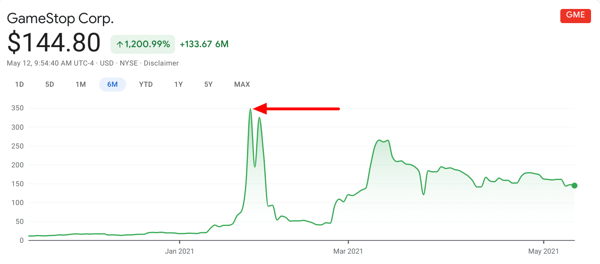
For an example of how risky short selling be, consider the recent Gamestop (GME) stock drama. Back in January of 2021, several prominent hedge funds shorted Gamestop (GME). At the time, shares of the stock were trading at around $40 per share.
But to “save Gamestop” and thwart investment bankers, retail investors banded together to raise the price of GME. As the price rose, some short sellers bought back their shares to limit their losses. But this only served to drive the price even higher, causing even steeper losses for short sellers who were stubbornly hanging on to their short positions. In the investing world, this phenomenon is known as a "short squeeze."
At its peak, GME traded for $347.51 per share. That means that the investors that shorted the stock could have lost as much as $307.51 per share. If the price had gone higher, they would have lost more still.
Who Should Participate In Short Selling?
The Gamestop frenzy is one popular example of shorting gone awry. It clarifies just how risky it is to bet on something with an unlimited downside. The typical investor should not consider short selling as a way to make money because it involves significant downside risk with limited upside risk.
This type of "investing" is typically reserved for hedge funds that are aiming to make money even when the stock market declines. It's rarely a good idea to compete against the most sophisticated investors in a game with an infinite downside.
Since short selling involves asymmetric risk, it's difficult to evaluate using averages and standard deviations which are the tools of conventional risk metrics. For great reading on this topic, check out Skin in the Game by Nassim Taleb.
What Tools Can I Use To Practice Short Selling?
Several companies have free paper trading apps that allow retail investors to practice all manner of advanced trading strategies including short selling. ThinkOrSwim by Charles Schwab may be the best option for aspiring traders. In addition to offering “Paper Money” accounts, its learning center has detailed articles on how to execute the trades.
WeBull also offers free stock market simulators. Its free virtual trading platform allows users to explore different strategies and learn to profit from downside risks.
Both of these tools give users clear ideas of how risky short selling can be. However, they also give users the option to upgrade to real accounts where users can put real money at risk. WeBull only requires $2,000 to access its margin accounts with a 6.99% interest rate. ThinkOrSwim requires $2,000 and has additional requirements depending on stock prices.
Related: Find The Best Margin Rates Here >>
How Can I Short A Stock On My Own?
To short stocks, you must have a margin account. Most major brokerages and several investment apps allow retail investors who have reached a certain minimum balance to have margin accounts.
Remember, margin involves paying interest. And if a position declines, the broker can make a margin call which means that you'll need to deposit more money to cover potential losses. Thus, short selling (and margin trading in general) is not something you want to do if you’re short on cash.
Both ThinkOrSwim and WeBull allow clients to trade on margin. Likewise Robinhood and other major brokers give users the option to trade inside margin accounts. Compare all of our favorite trading and investing apps here >>>
Editor: Clint Proctor Reviewed by: Chris Muller

Get the latest financial news and actionable insights.
How it works:
- 1Enter your email and subscribe.
- 2Get the latest personal finance and education news delivered every week.
- 3Take control of your finances with real insights.
- 4We won't spam you, ever!

Robert Farrington is the founder of The College Investor and is widely recognized as one of the nation’s leading voices on student loan debt and saving for college. He holds an MBA from UC San Diego Rady School of Management and has spent over 15 years researching, writing, and advising on student loans, 529 plans, financial aid programs, and saving and investing for young professionals.
Robert has been featured in the The New York Times, The Wall Street Journal, The Washington Post, NBC News, and Forbes, where he has been a regular personal finance contributor for over a decade. His work combines both professional expertise and personal experience – he successfully navigated his own student loan repayment journey and has helped thousands of readers do the same.
He is committed to making the intersection of personal finance and education transparent and accessible. You can learn more about Robert on the About Page or on his personal site RobertFarrington.com.