At this point, you probably know that investing is a good idea. Well, maybe you don't buy it?
If you're like a lot of millennials, you might not. In fact, a recent UBS study indicates that most millennials are very risk-averse. But that's not very smart. Everyone needs to learn how to invest — it's the best way to build wealth over time.
The key factor to remember is time — yes, you could lose money in the short-term, but you will build wealth over the long-term. And the long-term is 20 to 30 years!
Okay, so maybe that's not enough. Here are 10 reasons that everyone, including millennials, should learn how to invest.
1. Investing Can Deliver Great Returns
Investing provides much higher returns than just holding money in a savings account (which is pretty equivalent to U.S. Treasury bills).
Yes, there will be ups and downs in the stock market. But over time, the returns are much greater than savings, and you're barely escaping inflation (which we will talk about below).

2. Diversification of Assets
You've probably heard the saying that you shouldn't keep all your eggs in one basket. The same is true with investing — but investing should be just part of your basket. You shouldn't keep all your money in cash, or in your house, or in your car.
You need to diversify your assets.
Investing should make up one part of your financial picture — not all of it. You should have a nice pile of cash (your emergency fund), real estate (your house), hard assets (your car and other stuff), and then you should have your investments. It just makes financial sense.

3. The Power of Compounding
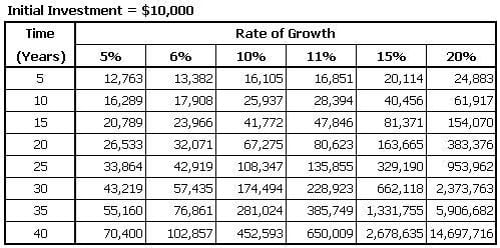
We've talked a lot about the power of compounding — but it's an important reason you should learn to invest. Compound interest is what supercharges your returns. Just look at this chart:
As you can see, it starts slow, but after year 10, it really starts picking up pace. Just imagine if you were investing consistently over time — not just making a one-time investment. You'll increase your wealth substantially.
4. Failing to Learn to Invest Increases Your Risk of Making a Mistake
If you never learn the basics of investing, you run the risk of making huge mistakes with your money — potentially causing you to lose it all. Do you want to potentially lose tens of thousands of dollars? I don't think so.
We've talked a lot about investing mistakes because so many people make them:
The important thing to remember is that it is simple to learn to invest, so that you can avoid making these costly mistakes.
5. Famous People Do It
Sorry to include this, but you probably already copy a bunch of famous people for their style, or maybe their sayings, or more? The bottom line is that we look up to others as role models — so why don't we do it financially as well?
Just look at the top 10 investors of all time — most of them are well-known, like Warren Buffett. And most of them didn't start with much. Warren Buffett started investing when he was young with just a few hundred dollars. Yes, that would be equivalent to around $1,000 today, but that's still not much money to turn into $50 billion!
6. Great Tax Benefits
Did you know that, from a tax standpoint, it's much better to make your money investing than to make it working? It's the secret of the rich, and they try to exploit this fact as much as possible.
If you work, you have to pay Federal income taxes, State income tax, Social Security, Medicare, and maybe even more local taxes depending on where you live.
When you invest for the long-term, your long-term capital gains tax is either 15% or 20% (if you fall in the top tax bracket). Either way, that's much less (about half) of what you pay from working.
Then, you need to consider special tax-advantaged accounts, like IRAs or 401(k)s, where you can contribute pretax money and let the money in the account grow tax-free over time! Or, you could do a Roth IRA, which allows you to withdraw the money in retirement tax-free.
If you hate taxes, you should learn to invest!
7. It Helps You Stop Exchanging Hours for Dollars
At some point in time (hopefully sooner rather than later), you'll want to retire and stop exchanging hours for dollars. The only way this will ever happen is if you invest over your working lifetime. Yes, you'll have some money from Social Security, but it will not be enough to pay for your needs in retirement.
The only way you'll have enough is if you invest over your life and build up a nice nest egg so that you can start using that money to live off of. The goal, of course, is to turn your nest egg into investments that you can use for a monthly income. That way, you're not working for your dollars, your investments are giving you your dollars! Jackpot!
8. Inflation
Have you heard of inflation? Basically, inflation is a fancy name for the fact that prices rise over time. In fact, if you look at the chart in the first reason, inflation has been making prices rise by about 3 percent per year. How much interest are you earning in your savings account right now? Maybe 1 percent if you're lucky?
That means, if you just save, you're losing 2 percent per year in purchasing power. In other words, say you $1,000 per month in rent. If you do nothing else, on average, your rent will be $1,030 next year. However, if you put that same $1,000 into a savings account, you'll only have $1,010 next year. You're short $20.
Inflation eats away at your ability to pay for things in the future.
If you invest, however, you can earn around 8 percent annual returns or more, on average. Now, you're beating inflation by 5 percent or more. That allows you to keep up over time.
9. You Will Have to Invest Sometime in Your Life Anyway
I guarantee you that at some point in time you will be faced with a choice about investing anyway, so you might as well learn how to invest.
Whether you get a job that offers you a 401(k), or you receive a pension you need to roll over, at some point in time you're going to have a sum of money that will require your investing attention.
If you don't learn how to invest, see the fourth reason — you're going to make mistakes with this money that could cost you.
Since investing is inevitable, you might as well learn how!
10. Nobody Else Will Help You Anyway
A favorite saying of mine is, "You can get a loan for just about anything, but you can't get a loan for retirement." Nobody is going to help you when you're old (well, maybe your kids, but do you really want to be a burden on them?).
You need to save for yourself. You also need to invest for yourself. Savings isn't going to cut it. Social Security isn't going to cut it. If you want to have a life when you're no longer working — you have to learn how to invest!
If you're ready to learn how to invest, check out our free video training series below! If you already know how to invest, what inspired you to learn?
Editor: Clint Proctor Reviewed by: Chris Muller

Get the latest financial news and actionable insights.
How it works:
- 1Enter your email and subscribe.
- 2Get the latest personal finance and education news delivered every week.
- 3Take control of your finances with real insights.
- 4We won't spam you, ever!

Robert Farrington is the founder of The College Investor and is widely recognized as one of the nation’s leading voices on student loan debt and saving for college. He holds an MBA from UC San Diego Rady School of Management and has spent over 15 years researching, writing, and advising on student loans, 529 plans, financial aid programs, and saving and investing for young professionals.
Robert has been featured in the The New York Times, The Wall Street Journal, The Washington Post, NBC News, and Forbes, where he has been a regular personal finance contributor for over a decade. His work combines both professional expertise and personal experience – he successfully navigated his own student loan repayment journey and has helped thousands of readers do the same.
He is committed to making the intersection of personal finance and education transparent and accessible. You can learn more about Robert on the About Page or on his personal site RobertFarrington.com.