
Key Points
- The Rule of 72 helps you quickly estimate how long it takes for money to double at a fixed annual return.
- Fees and inflation can sharply extend that timeline - your “real” doubling rate is often lower than you think.
- It’s a shortcut, not a substitute for a financial calculator - accuracy declines at very high or very low rates.
The Rule of 72 is a mental-math shortcut that tells you how long it takes for an investment to double.
Take 72 and divide it by your annual percentage return. The result is the approximate number of years required for your money to double.
Example:
- If you expect an 8 % annual return, 72 ÷ 8 = 9 years.
- At 6 %, it takes 12 years.
It’s quick, practical, and surprisingly close to reality for moderate rates of return (between 4 % and 15 %).

The Rule of 72 Applied to Investing
Now that you know the basics of the Rule of 72, you might ask why you should care? I mean, how does that help with investing? We all want our money to double as quickly as possible.
I use the Rule of 72 in two scenarios when it comes to investing:
1. The Impact of Fees: If you want to know how much money your fees are going to take out of your investments, you can take the Rule 0f 72 and divide it by the fee rate. This will show you how many years it will take for fees to eat up half of your investments. For example, if you have a mutual fund that charges 2%, it will take 36 years for fees to reduce the principal by half if the money doesn't grow. How about that for scary?
2. The Impact of Inflation: You can also use the Rule of 72 to quickly estimate the impact of inflation on your portfolio (or better, the buying power of the earnings of your portfolio). For example, if inflation is 3%, it will take 24 years for the value of $1 to be worth $0.50. You can use this to help you plan your retirement spending. If you plan on retiring in 24 years, you're going to need about double your current expenses to live off of based on inflation.
Related: Would You Rather Have A Penny That Doubles Each Day Or $1,000,000?
@thecollegeinvestor The Rule of 72 is a quick way to know how long it will take for an investment to double based on certain rate of return. #personalfinance #tiktoklearningcampaign #investing #stockmarket ♬ original sound - The College Investor
The Other Rules
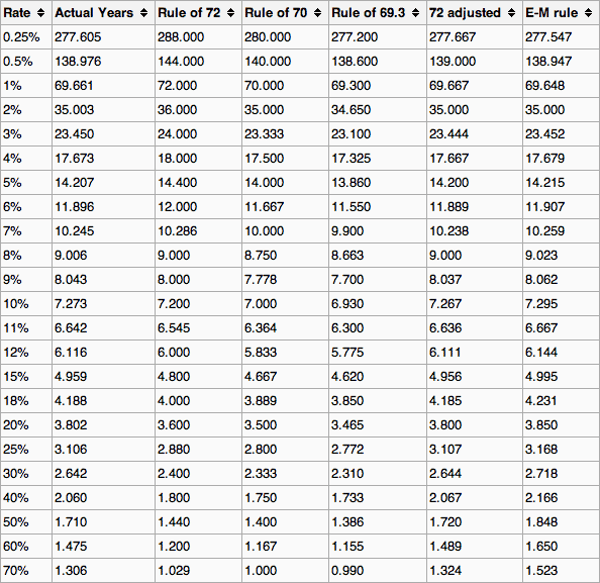
It's important to note that the Rule of 72 is only an estimate. In fact, using my 2% example from above, your money will actually double in 35.003 years. That is why some people prefer to use the Rule of 70 or Rule of 69. In fact, if you have continuous compounding, the Rule of 69 in the rule you want to use.
To make things easy, we found this great chart from Wikipedia that highlights the rules in action:
FAQ
Q: Does the Rule of 72 work for negative returns?
No. It only applies to positive growth rates. A –2 % return means you’re shrinking, not compounding.
Q: Can I use it for inflation?
Yes. Divide 72 by the inflation rate to see how long it takes for purchasing power to halve. For 3 % inflation, 72 ÷ 3 = 24 years—prices roughly double in 24 years.
Q: Is it accurate for savings accounts?
It’s close for savings accounts, but at very low rates (under 2 %), the Rule of 70 is slightly better.
Q: What’s the Rule of 69 and Rule of 70?
They’re minor variations that better fit continuous compounding (Rule of 69) or low-rate scenarios (Rule of 70).
Q: Can the Rule help compare investments?
Yes. Use it to estimate how fees, inflation, or yield changes alter doubling time—helping you focus on after-fee, after-inflation growth.
Final Thoughts
The formula works because it approximates the compound interest formula. At everyday growth rates, 72 is an easy-to-remember constant that makes mental estimates simple.
It’s especially useful for long-term savers who want to gauge how rate changes or fees affect results without pulling up a spreadsheet.
Don't Miss These Other Stories:
Editor: Clint Proctor Reviewed by: Chris Muller

Get the latest financial news and actionable insights.
How it works:
- 1Enter your email and subscribe.
- 2Get the latest personal finance and education news delivered every week.
- 3Take control of your finances with real insights.
- 4We won't spam you, ever!

Robert Farrington is the founder of The College Investor and is widely recognized as one of the nation’s leading voices on student loan debt and saving for college. He holds an MBA from UC San Diego Rady School of Management and has spent over 15 years researching, writing, and advising on student loans, 529 plans, financial aid programs, and saving and investing for young professionals.
Robert has been featured in the The New York Times, The Wall Street Journal, The Washington Post, NBC News, and Forbes, where he has been a regular personal finance contributor for over a decade. His work combines both professional expertise and personal experience – he successfully navigated his own student loan repayment journey and has helped thousands of readers do the same.
He is committed to making the intersection of personal finance and education transparent and accessible. You can learn more about Robert on the About Page or on his personal site RobertFarrington.com.