
Key Points
- RAP is usually the cheaper monthly payment for borrowers earning under about $80,000 or with dependents. IBR usually wins above roughly $90,000, and it forgives in 20 or 25 years instead of RAP's 30.
- If you borrowed before July 1, 2026, you can choose either plan until July 1, 2028, when IBR closes to new enrollments and PAYE, ICR, and SAVE disappear. New borrowers only get RAP or the Tiered Standard Plan.
- For PSLF pick whichever plan gives you the lowest qualifying payment. Balance and interest don't matter.
The short answer to IBR vs. RAP: run your income through our Student Loan Calculator, because the winner flips around $80,000 to $90,000 of AGI.
Below that, the Repayment Assistance Plan (RAP) tends to cost less per month.
Above it, Income-Based Repayment (IBR) tends to cost less and forgives a decade sooner. Everything else on this page explains why, and where the exceptions are.
The One Big Beautiful Bill rebuilt federal student loan repayment. Since July 1, 2026, new borrowers have two choices: the Tiered Standard Plan or RAP. Existing borrowers on SAVE, PAYE, or ICR are being moved into RAP or amended IBR, and that window closes July 1, 2028, under the Department of Education's final rule.
Would you like to save this?
How RAP Calculates Your Payment
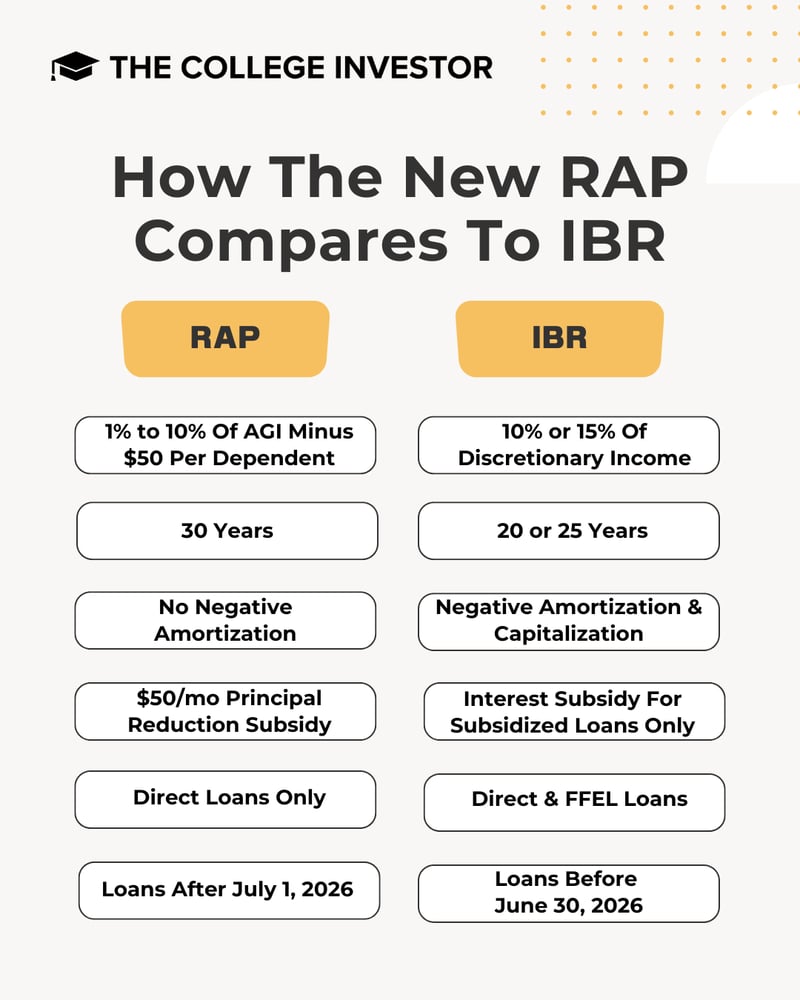
RAP charges a sliding percentage of adjusted gross income: 1% at $10,001–$20,000 rising one point per $10,000 bracket to 10% above $100,000, with a flat $120 a year for AGI of $10,000 or less. Divide by 12, subtract $50 per dependent, floor of $10 a month. Unpaid interest is waived and the government matches up to $50 of principal every month you pay in full and on time. Forgiveness comes after 360 payments (30 years). Here's the full breakdown of how RAP works.
How IBR (And PAYE) Calculate Your Payment
Amended IBR keeps the old two-track structure. If you had any federal loan before July 1, 2014, you're an "old IBR" borrower: 15% of discretionary income, forgiveness after 25 years. If all of your loans came after July 1, 2014, you're "new IBR": 10% of discretionary income, forgiveness after 20 years. Discretionary income is AGI above 150% of the federal poverty line. IBR payments are capped at what you'd pay on the 10-year Standard plan, so they can't run away if your income jumps. The financial-hardship test that used to gate IBR is gone.
PAYE borrowers get the same 10% formula today, but PAYE is closing. If you're on PAYE, your realistic choices are amended IBR (which will feel identical month to month) or RAP. Time already spent on PAYE counts toward either plan's forgiveness clock.
IBR has no interest waiver and no principal match. Your balance can grow if your payment doesn't cover interest, though the 2023 rule change means that interest generally no longer capitalizes when you switch plans.
Sample Scenarios: IBR vs. RAP
To better understand the differences between RAP and IBR, consider three typical borrower profiles.We're assuming the borrowers all have $40,000 in student loans and live in the lower 48 states.
1. Single borrower, $50,000 income, no children
- IBR: $228/month
- RAP: $167/month
In this scenario, the RAP plan offers a lower monthly payment.
2. Married borrower, $100,000 income, two children
- IBR: $443/month
- RAP: $650/month
In this scenario, the IBR plan would be a better option.
3. Single borrower, $80,000 income, one child
- IBR: $411/month
- RAP: $417/month
In this scenario, the monthly payments are nearly identical, but IBR is slightly lower (and since it would also offer 20 year forgiveness, versus 30, it's a better option).
Other Scenarios
We ran some other scenarios as well, and you can see that RAP typically has a lower monthly payment for borrowers earning less than $80,000 per year. However, once you cross about $90,000 in AGI, IBR starts to generally become the lowest monthly payment plan.
But every situation is different: marriage status, dependents, income. You need to run the RAP calculator and see your payment to know for sure.

If You're Going For PSLF
Most of the questions we get on this page are from borrowers pursuing Public Service Loan Forgiveness, and for them the comparison is simpler than for everyone else.
PSLF is 120 qualifying payments. Both RAP and IBR qualify. Your loan balance doesn't matter and neither does accruing interest, because the balance is forgiven tax-free at 120. So the only question is: which plan gives you the lowest monthly payment? Pick that one. Don't consolidate unless you have FFEL or Perkins loans that need it to become eligible; consolidation doesn't help you here and can complicate your count.
If you're sitting in the SAVE forbearance, those months aren't earning PSLF credit. The sooner you're on RAP or IBR making payments, the sooner your clock restarts. Here's the SAVE exit timeline.
Switching Plans: What Happens To Your Payment Count
You're never locked in. Any borrower can move to the Standard plan at any time, and existing borrowers can move between RAP and IBR until July 1, 2028. The rules on payment counts are asymmetric:
- Legacy IDR → RAP: payments made on IBR, PAYE, ICR, or SAVE count toward RAP's 360.
- RAP → IBR: your RAP months do not count toward IBR's 20 or 25 years. The final rule closed the door on using a cheap RAP payment for a few years and then jumping back for faster forgiveness.
- Failing to recertify on RAP drops you to the Standard payment amount until you recertify, the same as the old IDR plans.
If you're weighing a RAP-now-IBR-later sequence, treat the IBR clock as starting on the day you switch. Our decision tree walks through the common cases.
Married Borrowers
Filing status drives both plans. File jointly and both RAP and IBR use combined AGI. File separately and each plan uses only your income and your dependents. Filing separately can cut a payment sharply when the non-borrower spouse earns more, but the tax law now penalizes married-filing-separately in several places, so the loan savings can be smaller than the tax cost. Run both numbers with a tax professional before changing how you file.
Parent PLUS Loans Left Out
Parent PLUS loans remain excluded from RAP. New Parent PLUS borrowers after July 1, 2026 get the Standard Plan only.
Existing Parent PLUS borrowers had a narrow path: consolidating before June 30, 2026 unlocked ICR and, from there, amended IBR. That window has closed. If you already consolidated (or double-consolidated) in time, you can move to IBR before July 1, 2028. If you didn't, the Standard plan is what's left, and refinancing is worth a look only if you've accepted that federal protections are already out of reach for those loans.
Final Thoughts
It's frustrating to have to navigate new student loan repayment plan options. However, the new Repayment Assistance Plan (RAP) may be better for some borrowers than the current IBR options available.
For new borrowers, the decision on repayment plans will be easier - less plans means less confusion.
But for existing borrowers, having to migrate and decide on a new repayment plan option will be confusing. It's essential that you run the numbers and see which plan may work best for you depending on your financial situation.
Common Questions
Is RAP or IBR better?
It depends on income. RAP usually has the lower payment under about $80,000 or with dependents. IBR usually has the lower payment above roughly $90,000 and always has the shorter forgiveness timeline (20 or 25 years vs. 30).
How does RAP differ from IBR?
RAP charges a percentage of AGI (1–10%) with a $10 minimum, waives unpaid interest, and matches up to $50 of principal monthly. IBR charges 10% or 15% of discretionary income with a $0 minimum, no interest waiver, no match, and a cap at the 10-year Standard amount.
Who has to move to RAP or IBR?
Anyone on ICR, PAYE, or SAVE. The legacy plans close July 1, 2028. SAVE borrowers are being moved in groups with a 90-day clock from notification.
Does IBR still cap payments at the 10-year Standard amount?
Yes. RAP has no cap.
Can I use PAYE vs. RAP as the comparison instead?
For payments, PAYE and new IBR are the same 10% formula, so the RAP vs. IBR numbers above apply. PAYE itself is closing, so your choice is really RAP or amended IBR.
Are Parent PLUS loans eligible for RAP or amended IBR?
Not for RAP. For IBR, only if the Parent PLUS loan was consolidated and on an income-driven plan by June 30, 2026.
Don't Miss These Other Stories:
Editor: Colin Graves

Robert Farrington is the founder of The College Investor and is widely recognized as one of the nation’s leading voices on student loan debt and saving for college. He holds an MBA from UC San Diego Rady School of Management and has spent over 15 years researching, writing, and advising on student loans, 529 plans, financial aid programs, and saving and investing for young professionals.
Robert has been featured in the The New York Times, The Wall Street Journal, The Washington Post, NBC News, and Forbes, where he has been a regular personal finance contributor for over a decade. His work combines both professional expertise and personal experience – he successfully navigated his own student loan repayment journey and has helped thousands of readers do the same.
He is committed to making the intersection of personal finance and education transparent and accessible. You can learn more about Robert on the About Page or on his personal site RobertFarrington.com.