
Income-Contingent Repayment (ICR) is one of the income-driven repayment plans that can potentially save you money on your student loan payment each month.
However, ICR will be ending on June 30, 2028 per the One Big Beautiful Bill Act (OBBBA).
IDR plans are student loan repayment plans that change the amount of money that you pay each month depending on the amount of income that you make (as well as some other factors). Income-driven plans differ from most standard repayment plans in that your monthly payments depend on your annual income.
Income-Contingent Repayment (ICR) plan is a unique repayment plan in that it won't be the right option for many borrowers, but could be the only option for some.
Different Types Of Income-Driven Repayment Plans
There are four main types of income-driven repayment plans:
- Income-Based Repayment (IBR)
- Pay as you Earn (PAYE)
- Income Contingent Repayment (ICR)
- Coming Soon: Repayment Assistance Plan (RAP)
With a standard or extended repayment plan, your monthly payment is determined solely by the interest rate, principal balance, and repayment period. That means that a higher interest rate, a higher balance or longer repayment period will all contribute to a higher month. With the 10-Year Standard Repayment plan, there's no thought given to whether you can afford your monthly repayment amount.
Income-driven repayment plans are the flip side of that and set your monthly payment to a specific percentage of your total income. The exact percentage depends on the specific type of income-driven repayment plan, but it will generally range from 5-20%.
What Do All Income-Driven Repayment Plans Have In Common
The 4 different income-driven repayment plans have a few unique differences but they all share a few things in common:
What Is Income-Contingent Repayment (ICR)?
Your payment under the ICR is the lesser of 20% of your discretionary income or what your payment would be on a fixed 12-year payment plan, after you adjust it for income. This is twice as high as SAVE and PAYE which cap payment at 5-10% of discretionary income.
IBR also has a 10% discretionary income cap for new borrowers. But if you borrowed your student loans before July 1, 2014, you'll pay 15% of your discretionary income on IBR.
How Is Discretionary Income Calculated On ICR?
With PAYE and IBR, discretionary income is calculated by taking your adjusted gross income and subtracting 150% of the annual federal poverty amount in your state for your size of family. But with ICR, you income only 100% of the federal poverty line will be subtracted from your income. This means that your discretionary income (and your monthly payments) will be higher with ICR than with the other three repayment plans.
The interest rate under the ICR plan is fixed for the life of the plan. It will be equal to the weighted average of the interest rates on all loans that are under the plan, rounded up to the nearest ⅛ of a percentage point.
If you’re married and file jointly, your spouse’s income is also taken into account. However if you file your tax return as married married filing separately, only your income will be used to determine payments.
Does ICR Have An Interest Subsidy?
If you're monthly payment on an IDR plan is so low that it doesn't cover all of your interest charges, your loan will begin to accrue unpaid interest.
But on the PAYE and IBR plans, the government will pay all of that unpaid interest for you on your subsidized loans for your first three years of repayments.
Unfortunately, Income-Contingent Repayment does not offer an interest subsidy. While on ICR, unpaid interest will be added to your loan balance during all periods.
Which Loans Are Eligible For ICR?
So far just about everything we've said about ICR has been negative. To recap, ICR makes you payment 20% of your discretionary income instead of 10% to 15%, it bases your income on the difference between your AGI and 100% of the poverty level instead of 150%, and doesn't provide any interest subsidy.
With all this in mind, why in the world would anyone choose ICR? Well because, for some people, it might be their only income-driven repayment plan option. And who exactly what that be? Parent PLUS borrowers.
If you have Parent PLUS Loans, Income-Contingent Repayment is the only income-driven repayment you're eligible to join. And even with ICR, you won't qualify until your loans have been consolidated via a Direct Consolidation Loan. In addition to Parent PLUS Loans, Direct Loans, FFEL Loans, and Perkins Loans can all be repaid on ICR.
ICR may also be better if you're one of the few people that benefit from the alternative calculation of what your payment would be on a fixed 12-year payment plan.
How To Apply For Income-Contingent Repayment
You apply for Income-Contingent Repayment in a similar way to applying for other student loan repayment plans. You can apply by filling out a form and mailing it to your student loan servicer. But an easier way is to go online to StudentAid.gov and log in with or create your Federal Student Aid ID.
You do have to reapply for ICR each year. This ensures that your income and family size are correctly reported as that will likely change your monthly payment. And if your life or income situation changes significantly, you can change your student loan repayment plan as often as necessary.
Calculating Your Total Cost Of Repayment On ICR
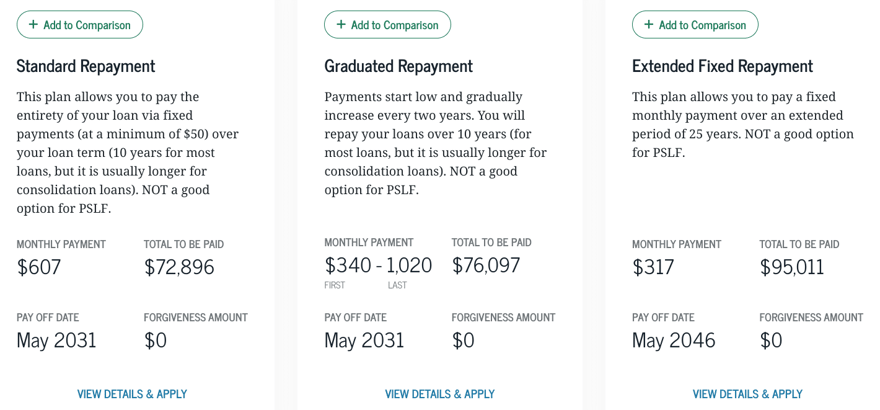
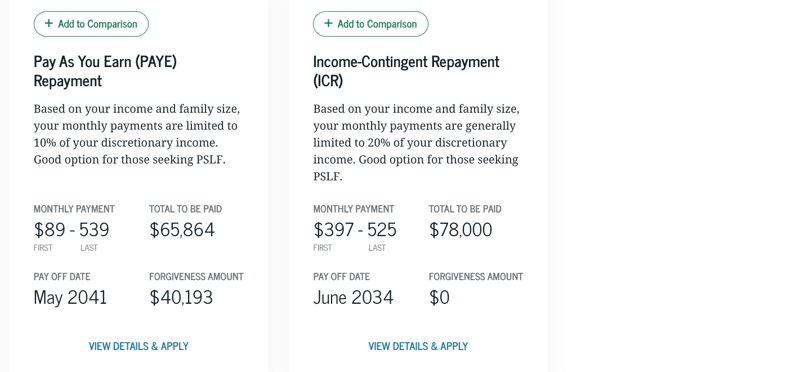
Let’s run through a scenario. We'll say you’re married with two kids (family size of four) and have $60,000 in federal subsidized loans at a 4% interest with a total adjusted gross income of $40,000 living in Florida.
When you plug in those numbers to the Repayment Estimator at StudentAid.gov, the first thing you'll see are what you'd pay on the Standard, Graduated, and Extended Fixed Repayment plans. With these plans, your monthly payment would range from $317 to $607 and you'd pay $72,896 to $95,011 overall.
Finally, we see PAYE and ICR. ICR has a starting payment that's about $300 higher. And the overall cost with ICR would be over $12,000 more.
Who Should Choose Income-Contingent Repayment?
For the vast majority of circumstances, the only group of people that might want to consider ICR today would be those who have Parent PLUS loans. As previously mentioned, ICR is the only income-driven repayment plan that allows you to include these loans.
In the past, Income-Contingent Repayment was also a good option for those who couldn't qualify for PAYE or IBR due to their income eligibility requirements.
But, since ICR is ending in 2 years, it's likely best to look at IBR or RAP today.
Editor: Clint Proctor Reviewed by: Chris Muller

Robert Farrington is the founder of The College Investor and is widely recognized as one of the nation’s leading voices on student loan debt and saving for college. He holds an MBA from UC San Diego Rady School of Management and has spent over 15 years researching, writing, and advising on student loans, 529 plans, financial aid programs, and saving and investing for young professionals.
Robert has been featured in the The New York Times, The Wall Street Journal, The Washington Post, NBC News, and Forbes, where he has been a regular personal finance contributor for over a decade. His work combines both professional expertise and personal experience – he successfully navigated his own student loan repayment journey and has helped thousands of readers do the same.
He is committed to making the intersection of personal finance and education transparent and accessible. You can learn more about Robert on the About Page or on his personal site RobertFarrington.com.