
Key Points
- U.S. investors worried about tariffs and a market slump may find value in adding international or emerging market funds for diversification.
- Developed international markets have outperformed emerging markets over the past decade, but the latter may offer more long-term growth potential—with higher risk.
- ETFs like IXUS, VEU, VEMAX, and IEMG offer accessible ways to invest overseas while keeping costs low and exposure broad.
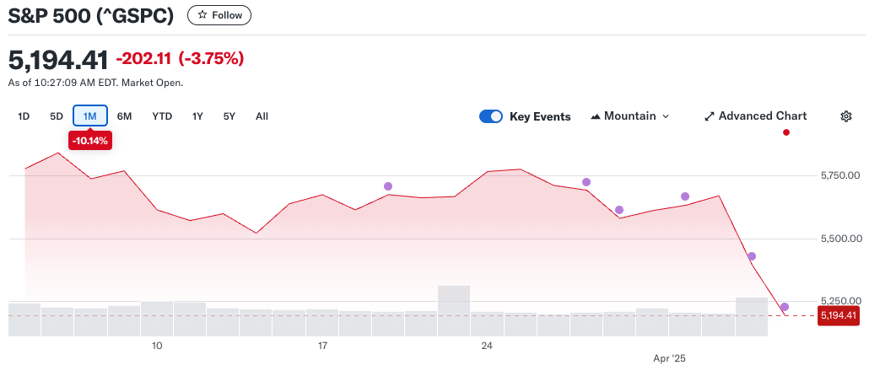
The U.S. stock market has taken a hit, with tariff announcements from the Trump administration and immediate retaliation from China unsettling investors. The S&P 500 is down over 10% over the last month.
These policy shifts, which raise the cost of goods moving across borders, can slow economic growth and disrupt global supply chains. For investors, this moment presents a key question: is it time to consider more international exposure as the United States has become more economically uncertain?
Diversifying across markets can reduce exposure to domestic risks, including trade disputes. But international investing isn’t without its own set of challenges. Here’s what to weigh before shifting your portfolio.
Related: The Best Investment Strategy By Age
Why Investors Are Eyeing International Markets
Global index funds have long been a way for investors to reduce their reliance on U.S. stocks. Recent market corrections caused by new tariffs may increase the appeal of overseas diversification.
Funds that track foreign developed markets, like the iShares Core MSCI Total International Stock ETF (IXUS) or the Vanguard FTSE All-World ex-US ETF (VEU), offer broad exposure outside the United States. These cover regions like Europe, Japan, and Australia, with relatively stable economies and regulatory systems.
Emerging market funds, like Vanguard Emerging Markets Stock Index Fund (VEMAX) and iShares Core MSCI Emerging Markets ETF (IEMG), give investors a stake in fast-growing economies such as India, China, and Brazil. These regions offer higher potential returns but come with more volatility, especially during global uncertainty.
As of April 2025, international developed market funds like VTIAX have shown a 5-year return of 7.55%, while VEMAX’s return was 4.98%. While both trail the S&P 500’s recent five-year return, they offer a useful counterbalance when U.S. equities are under pressure.
The Case For Diversification
Putting all your money in U.S. stocks can leave you exposed if policy changes hurt domestic firms. For example, retailers and manufacturers are already facing higher costs due to tariffs, and multinational companies like Apple and Nike have reported significant stock losses following recent announcements.
International exposure spreads risk across different regions, economic cycles, and currencies. If U.S. markets continue to respond poorly to trade tensions, other economies may perform better, or at least differently.
That said, emerging markets carry higher risks. Currency swings, political instability, and slower-than-expected growth can weigh on returns. Developed markets tend to be more stable, but they aren’t immune from global disruptions, either.
Another factor: U.S. investors often underestimate currency risk. When the dollar strengthens, overseas investments may lose value in dollar terms. When the dollar weakens, however, foreign stocks often become more attractive.
How To Invest Abroad
The easiest way for most people to invest internationally is through broad-market ETFs or mutual funds. These funds offer immediate diversification, often with lower fees than actively managed products.
For developed market exposure, IXUS and VEU are good options with low expense ratios and wide coverage. For emerging markets, VEMAX and IEMG are standouts. These ETFs are widely available, cost-efficient, and offer a straightforward way to add global exposure without stock picking or managing currency trades.
If you want a mix, look for funds that include both developed and emerging markets. Just check the fund’s fact sheet to see where your money is going. Many global funds lean heavily on developed markets and only include a smaller portion of emerging economies.
Investors with a long-term horizon, 10 years or more, may benefit most. Short-term swings can be steep, especially in emerging markets. If you’re nearing retirement or have a lower risk tolerance, you might stick to developed market exposure or U.S.-based funds.
Final Thoughts
Recent market shocks are a reminder that concentration in any one country carries risk. With tariffs fueling volatility, investors may want to reconsider how much of their portfolio is exposed to U.S. stocks. International index funds can help reduce that exposure while offering access to global growth.
You won’t escape market risk entirely by going overseas, but you may be better positioned if trade tensions persist. It’s not about betting against the U.S.—it’s about giving yourself more ways to stay invested through the ups and downs.
Don't Miss These Other Stories:

Robert Farrington is the founder of The College Investor and is widely recognized as one of the nation’s leading voices on student loan debt and saving for college. He holds an MBA from UC San Diego Rady School of Management and has spent over 15 years researching, writing, and advising on student loans, 529 plans, financial aid programs, and saving and investing for young professionals.
Robert has been featured in the The New York Times, The Wall Street Journal, The Washington Post, NBC News, and Forbes, where he has been a regular personal finance contributor for over a decade. His work combines both professional expertise and personal experience – he successfully navigated his own student loan repayment journey and has helped thousands of readers do the same.
He is committed to making the intersection of personal finance and education transparent and accessible. You can learn more about Robert on the About Page or on his personal site RobertFarrington.com.