
Key Points
- House Democrats, led by Rep. Lloyd Doggett of Texas, have introduced the HSA Consumer Protection Act to tighten rules on Health Savings Accounts
- The bill would impose income limits on HSA contributions, a two-year reimbursement window, stricter documentation rules, and change the definition of qualifying withdrawals.
- In the face of continually rising health care costs, these proposed reforms do nothing but harm Americans trying to save every little bit they can.
House Democrats are moving to curb the benefits of Health Savings Accounts (HSAs), arguing that the popular tax-advantaged accounts increasingly double as investment vehicles for the wealthy rather than a way for families to pay medical bills.
Rep. Lloyd Doggett, a longtime Texas Democrat and the ranking member on the House Ways and Means Health Subcommittee, has introduced the Health Savings Accounts (HSA) Consumer Protection Act.
The bill arrives just as millions of Americans are facing some of the largest health care insurance premium increases ever. While HSAs are a great tool to invest and build wealth - their key benefit is to help families afford the high cost of healthcare in America.
Democrats point to a new Government Accountability Office report (PDF File) and other analyses showing HSAs skew heavily toward higher-income, healthier, and disproportionately White and Asian account holders. They also highlight projections that HSAs will reduce federal tax revenues by roughly $180 billion over the next decade.
But it's important to note that wealthier families opt towards HSAs because they have to - not by choice. These plans are typically the cheapest option in the face of ACA penalties. And this potential fix would punish everyone due to changes in qualifying expenses and reimbursement options.
In short, this proposal is bad for everyone except the government. All it would do is increase taxes for Americans, while providing no benefit to those who are trying to pay for the excessive healthcare costs created by the current healthcare system. It's even bad for health insurance companies and HSA providers, who'll be subject to more record-keeping and potential taxes. It's actually pretty wild to see such a terrible bill proposed.
Would you like to save this?
What Are Health Savings Accounts (HSAs) and How Do They Work?
Health Savings Accounts (HSAs) were created in 2003 to pair with high-deductible health plans (HDHPs). The idea was simple: lower premiums, higher deductibles, and a tax-deferred account to help people cover the bigger out-of-pocket exposure.
They come with three tax benefits:
- Contributions are excluded from federal income tax and, if made through payroll, from payroll tax.
- Investment growth and interest are not taxed.
- Withdrawals are tax-free if used for qualified medical expenses.
That combination is rare in the tax code and powerful for people who can afford to contribute. At the end of 2023, HSAs held about $123 billion in assets, according to the GAO.
But the benefits are not evenly distributed. Doggett’s office cites numbers showing that only a small share of contribution dollars come from households under $50,000 in income, while the bulk come from those over $100,000.
Meanwhile, many lower-income families simply never get to the point of using the account as designed. A majority of HSAs hold less than $1,000, and more than one in five have no balance at all, according to the GAO.
What This Bill To Change HSAs Would Actually Do
The HSA Consumer Protection Act (PDF File) does far more than ban hidden fees or clarify eligible expenses. In tax-code language, it rewrites big pieces of section 223.
Key provisions include:
- Eliminating penalty-free non-medical withdrawals after 65. Today, once account holders turn 65, they can use HSA funds for any purpose without the tax percent penalty, though they still owe income tax on non-medical withdrawals. The bill repeals that exception so HSAs never fully “convert” into retirement-style accounts.
- Adding income limits to the tax deductibility of HSA contributions. A new modified adjusted gross income test would phase down the HSA deduction once income exceeds thresholds ranging from $150,000 (separate filers) to $300,000 (joint filers), reaching zero after an additional $40,000. Related changes would limit the payroll tax exclusion for contributions above those levels.
- Capping reimbursement at two years. Under current rules, people can reimburse themselves many years after a qualifying expense as long as they had an HSA at the time. The bill would allow tax-free reimbursement only if done within two years of paying the expense.
- Requiring real-time substantiation of distributions. HSA trustees would be required to confirm that withdrawals are for qualified medical expenses, and certain provider attestations would only count if there was a bona fide clinician-patient relationship and medically appropriate assessment.
- Narrowing what counts as medical care. The bill explicitly excludes spa and beauty treatments and limits HSA-eligible spending on exercise equipment to $500 a year.
- Penalizing “excessive” fees. A new excise tax would apply when HSA custodians charge more than a Treasury-defined “reasonable” amount for maintenance, transfer, paper statements, overdrafts, and other listed fees. Providers would also have to report fee and yield data to the IRS. It's important to note that you, as the consumer, wouldn't get reimbursed or any type of benefit from this - just a penalty on HSA providers.
On paper, those changes speak the language of waste, fraud, and consumer protection. In practice, they would fundamentally change how millions of people use HSAs.
This Bill Targets The Wrong Issues
Supporters of Rep. Lloyd Doggett’s bill say HSAs function as “tax shelters for the wealthy,” pointing to Treasury and GAO data (PDF File) showing that households above $100,000 capture roughly three-quarters of all HSA contribution dollars.
Democrats say the government is losing $180 billion in tax revenue over 10 years because of HSAs (which, given there is only $123 billion in assets in HSAs as of 2023, it's really hard to fathom where $180 billion in tax revenue would come from).
The simple truth is this bill doesn't seem to acknowledge the current economics of health care in America - particularly who can even afford HSA-eligible plans because of the Affordable Care Act.
HSA-Eligible Health Care Plans Are Too Expensive for Lower-Income Households
HSAs are available only to people enrolled in federally defined high-deductible health plans (HDHPs). In practice, those plans come with high premiums. In many states, including California, the cheapest HSA-eligible plan can exceed $1,300 - $1,800 per month for a family (a cost unreachable for households earning less than $50,000 or even $100,000 a year).
Once a family achieves roughly $150,000 in income, there are no subsidies available to lower the costs. Even families making $100,000 would still pay about $700 per month in out-of pocket premiums with the subsidies (or roughly 8% of their annual income).
Here is a screenshot of California's health insurance marketplace for 2026. Only 10 plans out of 38 are HSA-eligible, and the cheapest HSA-eligible health insurance plan for a family of four costs $1,342.94 per month - or $16,115 per year. And remember, because these are high deductible plans - families will pay for every doctor visit and prescription until that $7,200 deductible is met.
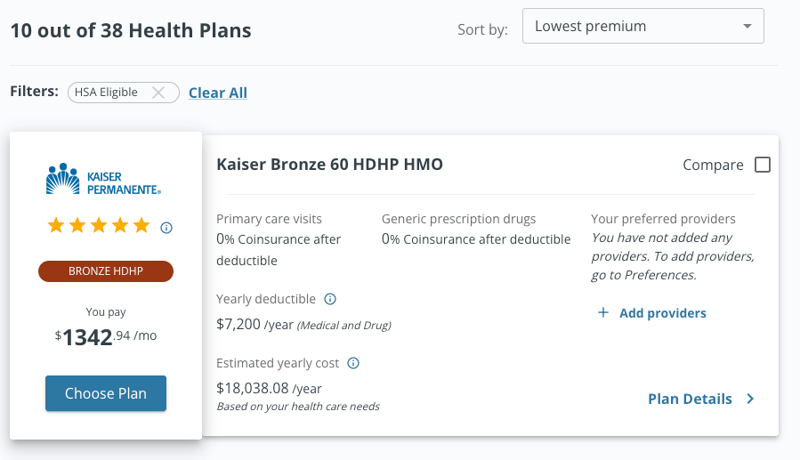
Lowest priced California HSA-Eligible health plans for a family of four.
Lower-income families are not opting out because HSAs are unattractive - they are priced out before the tax benefits are relevant. Even if they enroll in an HSA-eligible healthcare plan, they don't typically have extra savings they can use to make contributions to it. Surveys consistently show that nearly 60% of Americans cannot cover a $1,000 emergency. They're not going to put money in an HSA if they cannot afford the basics.
Deductibles Continue to Rise Faster Than Household Savings
Federal HDHP rules require sizable deductibles and out-of-pocket maximums:
2025 requirements:
• Deductibles: $1,650 (self-only) / $3,300 (family)
• OOP maximums: $8,300 (self-only) / $16,600 (family)
2026 requirements:
• Deductibles: $1,700 (self-only) / $3,400 (family)
• OOP maximums: $8,500 (self-only) / $17,000 (family)
These limits apply only to in-network care. Out-of-network spending can be substantially higher. And HSA contribution limits have not kept pace. In 2025, a family can contribute $8,550, and in 2026, up to $8,750.
It would take families at least two years to save to be able to afford something catastrophic (or even planned, like child birth). If there's a two year reimbursement window, families may not have enough money to cover the mandated out-of-pocket expenses.

To put this into context, if you contributed the maximum individual contribution from the HSA inception through 2025, the max you'd have contributed to this account over 22 years is $72,600.
If you're a family and did the same thing, the total contribution over 22 years would have been $145,050.
We're not talking large sums of money - especially if this is targeting the "wealthy".
Income Limits Introduce a Benefit Cliff
Doggett’s bill phases out the HSA deduction starting at modified AGI of $150,000 for single filers and $300,000 for joint filers.
It's important to note that households at those income levels already receive no ACA premium assistance, pay some of the highest premiums in the entire market, and often struggle to save anything beyond basic expenses. It's why making $100,000 in America still leaves you broke.
Plus, HSA contribution limits are a prime example of a marriage penalty - which is just wrong. You can see that it's mathematically better to be two single people contributing to HSAs than a family.
For many, the HSA deduction is the only remaining tax tool that individuals and families have to help with rising health costs (that's not giving money straight to health insurance companies).
What Is Actually Helpful In This Bill
The bill has one semi-positive proposal: preventing excessive HSA fees and opaque account disclosures.
The legislation would require custodians to report detailed information on maintenance charges, transfer fees, paper statement fees, and other common add-ons — costs that often erode the small balances held by lower- and middle-income users.
It's important to note that our list highlights these fees, and the best HSA accounts don't have them anyway,
It would also impose an excise tax on fees deemed “unreasonable,” giving the Treasury authority to penalize custodians who charge far above market norms. But the bill stops short of defining a clear "excessive fee cap", leaving “reasonable” fees to be determined later through regulation.
Again though - while this bill does make a pseudo-attempt to solve an actual problem, it doesn't even do that. It could have been just as easy to write a bill that says "HSA plans cannot charge monthly maintenance fees nor require customers to maintain minimum balances".
It should make you frustrated reading this that our legislators cannot do simple things...
What This Would Mean For Consumers If Passed
If the bill advances in anything like its current form, the impact on households could be significant:
- Retirees and near-retirees would lose the ability to treat HSAs as a quasi-retirement account after 65, limiting how they can tap those balances for broader financial needs.
- Planners who stockpile receipts to let funds grow tax-free would see that strategy disappear with the two-year reimbursement window.
- People near the new income thresholds could find themselves suddenly unable to use the HSA even in the face of healthcare expenses.
- Everyone with an HSA debit card could face new friction as trustees start policing receipts in real time.
- Low-balance account holders might finally get some relief from maintenance and junk fees - one of the few parts of the bill that even critics see as overdue.
For now, the proposal is not likely to go anywhere, but it should be a big red flag about what Democrats are thinking. Instead of fixing healthcare premiums, they want to punish consumers who save and invest to plan for the future.
Consumers who rely on HSAs for tax savings or future medical costs may want to watch this debate closely. And, in the meantime, make sure they understand their current plan’s fees and record-keeping rules in case Congress decides to change them.
Don't Miss These Other Stories:

Robert Farrington is the founder of The College Investor and is widely recognized as one of the nation’s leading voices on student loan debt and saving for college. He holds an MBA from UC San Diego Rady School of Management and has spent over 15 years researching, writing, and advising on student loans, 529 plans, financial aid programs, and saving and investing for young professionals.
Robert has been featured in the The New York Times, The Wall Street Journal, The Washington Post, NBC News, and Forbes, where he has been a regular personal finance contributor for over a decade. His work combines both professional expertise and personal experience – he successfully navigated his own student loan repayment journey and has helped thousands of readers do the same.
He is committed to making the intersection of personal finance and education transparent and accessible. You can learn more about Robert on the About Page or on his personal site RobertFarrington.com.