
Key Points
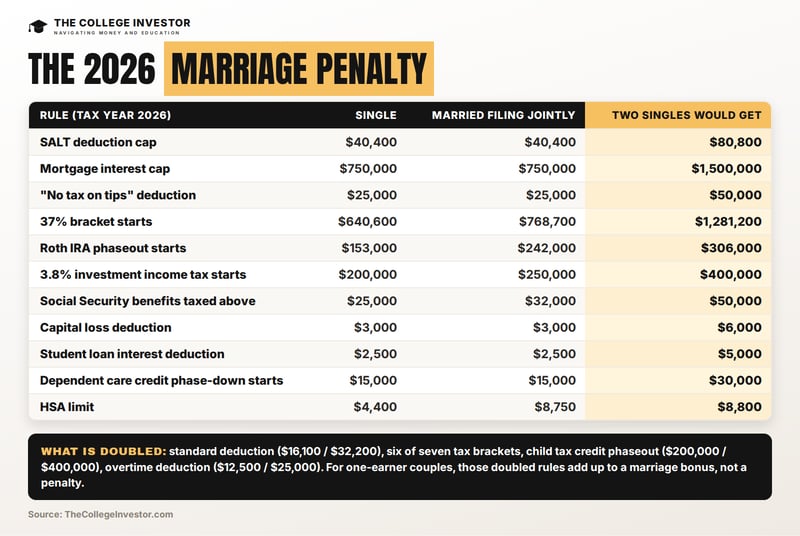
- A marriage penalty happens when a rule's threshold for a married couple is less than double the threshold for a single person.
- In 2026 that describes the top tax bracket, the SALT cap, the EITC, the new tips deduction, the Net Investment Income Tax, Social Security taxation, HSA limits, IRA limits, and the new student loan plan.
- The penalties hit two-earner couples with similar incomes. The bonuses go to couples where one spouse earns most of the income.
The short answer: getting married can raise your taxes, and whether it does depends almost entirely on how your two incomes compare. Two similar paychecks on one return trigger most of the penalties below. One big paycheck and one small one usually gets a bonus instead.
Here's every rule in the 2026 tax code (and a few outside it) where married couples get less than two singles would, with the numbers, plus the rules that go the other way and what you can do about it. If you're here because of student loans, the Repayment Assistance Plan's marriage penalty has its own section below and its own article with the filing-separately math.
Would you like to save this?
What A Marriage Penalty Is (And Isn't)
A marriage penalty is any rule where the married-filing-jointly threshold is less than twice the single threshold. Two singles each get the full single amount. A married couple shares one number. If that number isn't doubled, the couple loses.
A marriage bonus is the mirror image. When one spouse earns most of the income, filing jointly lets that income spread across the couple's wider brackets and doubled standard deduction, and the couple pays less than the earner would have paid single. That's why the Congressional Research Service finds more couples with bonuses than penalties.
Your filing status is set by whether you're married on December 31. Marry on New Year's Eve and the whole year is filed as married.
Dual-Income Tax Brackets: Why Two Paychecks Land Higher
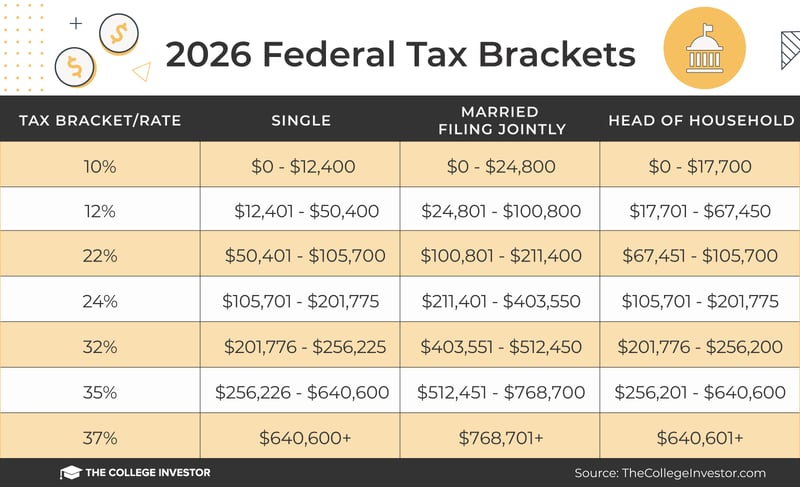
For 2026, six of the seven federal tax brackets are exactly doubled for joint filers. The 32% bracket starts at $201,775 for singles and $403,550 for couples; the 35% bracket at $256,225 and $512,450. The 2017 tax law fixed the bracket penalty for almost everyone, and the One Big Beautiful Bill Act (OBBBA) made those brackets permanent.
The exception is the top. The 37% rate starts at $640,600 of taxable income for a single filer and $768,700 for a married couple, not $1,281,200. Two unmarried high earners with $640,600 each pay no 37% tax. Married, the same two incomes pay 37% instead of 35% on the $512,500 above $768,700. That's $10,250 a year for being married.
The other bracket effect is subtler and hits far more people. When two similar incomes stack on one return, the second income starts where the first one left off. A second earner making $60,000 married to someone making $60,000 doesn't get their own 10% and 12% brackets; their whole paycheck is taxed at the couple's marginal rate. The doubled brackets mean the couple's total tax is the same as two singles', but the second earner's take-home from an extra hour of work is lower than it would be single. That's the "dual-income" penalty people feel in their withholding even when the math is neutral.
Common Marriage Penalties In The Tax Code
Here are the 2026 rules where the joint threshold is less than double the single one.
The SALT Cap (New For 2025–2029)
OBBBA raised the state and local tax deduction cap from $10,000 to $40,000 for 2025 and $40,400 for 2026, then 1% more each year through 2029. The cap is the same for single filers and married couples filing jointly. Two unmarried homeowners in New Jersey or California can each deduct up to $40,400 in property and income taxes, $80,800 between them. A married couple gets $40,400. Married filing separately gets $20,200 each.
The phaseout has the same problem. The cap starts shrinking at $505,000 of modified adjusted gross income whether you're single or a couple, and it's back to $10,000 at $606,300. Two singles could earn $1 million combined before losing any of it.
This is the largest new marriage penalty in the law, and the one Congress has already been asked to fix (more on that below). If you itemize, the most common deductions page covers what else changed.
Earned Income Tax Credit (EITC)
The EITC is where the marriage penalty is most expensive relative to income. For 2026, a single parent with one child loses the credit entirely at $51,593 of income. A married couple with one child loses it at $58,863, only $7,270 higher. Two working single parents could each earn up to $51,593 and both collect. Married, they'd collect nothing above $58,863 (or $65,899 with two children).
The CRS report's example: two unmarried parents each earning $25,000, each with one child, would owe $5,931 more in tax if they married, about 12% of their combined income. Most of that is lost EITC.
Student Loan Interest Deduction
The student loan interest deduction is capped at $2,500 per return. Two singles can deduct $5,000 between them; a married couple deducts $2,500, and married filing separately can't claim it at all. The income phaseout is roughly doubled for couples, so the penalty is the cap, not the phaseout.
Mortgage Interest Deduction
The cap on mortgage interest is $750,000 of acquisition debt for both single and married filers, and OBBBA made that cap permanent. Two unmarried people co-owning a home can each deduct interest on $750,000 of debt, $1.5 million total. A married couple can't. Married filing separately is capped at $375,000 each.
Social Security Taxation
Benefits become taxable when "combined income" (adjusted gross income plus nontaxable interest plus half your benefits) exceeds $25,000 for an individual and $32,000 for a couple. Those thresholds aren't indexed to inflation and the joint threshold isn't close to double, so two retired singles could have $50,000 of combined income between them before any benefit is taxed, while a married couple starts at $32,000.
OBBBA didn't change those thresholds. It added a separate $6,000 senior deduction per person for 2025–2028, which is doubled for couples and doesn't have a marriage penalty, though it does require married couples to file jointly to claim it.
Net Investment Income Tax And The Additional Medicare Tax
The 3.8% Medicare surtax on investment income starts at $200,000 of modified AGI for singles and $250,000 for couples ($125,000 married filing separately). The 0.9% Additional Medicare Tax on wages uses the same $200,000 / $250,000 thresholds. Neither is indexed to inflation. Two singles can earn $400,000 combined before either tax applies; a couple, $250,000.
The Tips Deduction (New For 2025–2028)
OBBBA's "no tax on tips" deduction is capped at $25,000 a year, and the cap is the same for a single filer and a married couple filing jointly. Two tipped workers who marry go from $50,000 of deductible tips to $25,000. The deduction also requires married couples to file jointly, so there's no way around it by filing separately. The income phaseout ($150,000 single, $300,000 joint) is doubled. Here are the jobs that qualify.
The companion overtime deduction is $12,500 single and $25,000 joint, so it doesn't have this problem.
Child And Dependent Care Credit
Starting in 2026 the credit covers up to 50% of eligible care expenses (on up to $3,000 for one dependent, $6,000 for two or more). The 50% rate starts phasing down to 35% at $15,000 of AGI, and that $15,000 is the same for single filers and joint filers. Two single parents each earning $15,000 get the full 50%; married at $30,000 they don't. The second phase-down (35% to 20%) is doubled for couples, starting at $75,000 single and $150,000 joint.
Capital Losses
You can deduct up to $3,000 of net capital losses against ordinary income each year, whether you're single or married filing jointly. Married filing separately gets $1,500. Two singles get $6,000 between them. Small, but it's the same pattern.
IRA Income Limits
The Roth IRA phaseout for 2026 runs from $153,000 to $168,000 for singles and $242,000 to $252,000 for couples. Doubled, the single range would start at $306,000. Two singles earning $150,000 each can both fund a Roth; married, they can't.
The deduction for a traditional IRA when you have a workplace plan phases out at $81,000–$91,000 single and $129,000–$149,000 joint, again not doubled. And married filing separately gets a $0–$10,000 phaseout on both, which is why MFS is rarely the answer to these.
Other Marriage Penalties
These are semi-tied to the tax code, but impact other areas. They can still be costly for married couples.
HSA Contributions
For 2026 the HSA contribution limit is $4,400 for self-only coverage and $8,750 for family coverage. Two spouses each on a self-only high-deductible plan can contribute $8,800 combined. Put either of them on a family plan and the couple's cap is $8,750. That's a $50 penalty for sharing a plan.
The $1,000 catch-up contribution for people 55 and older is per person, but each spouse has to make it into an HSA in their own name. A couple on one family plan with one HSA can only make one catch-up; open a second HSA and both can.

Student Loan Repayment
Income-driven repayment has always had a marriage penalty because payments are based on adjusted gross income (AGI), and a joint return has both incomes on it. The old REPAYE plan went further and required a spouse's income even when the couple filed taxes married filing separately.
The Repayment Assistance Plan (RAP), which launched July 1, 2026, doesn't do that. An early Senate draft would have counted spouse income regardless of filing status but the final law dropped it. Under both RAP and Income-Based Repayment (IBR), the Department of Education uses joint income if you file jointly and only your income if you file separately.
RAP's marriage penalty is different. RAP charges a flat 1% to 10% of your entire AGI depending on which bracket the AGI lands in, with no family-size exclusion. Two incomes on one return jump brackets. Two spouses earning $47,500 each, both with loans, pay about $317 a month combined filing separately and $713 a month filing jointly. A borrower earning $50,000 married to a $100,000 earner goes from $167 a month to $1,250. The full math, on both plans, is here. If you both have federal loans and file jointly, you get one payment split by loan balance, not two full payments.
Medicaid, SNAP, And Other Benefits
Benefit programs use household income, and the couple thresholds are less than double the single ones. In New York, the 2026 Medicaid income limit is $1,836 a month for a single applicant and $2,489 for a married couple. Two singles could each earn $1,836 ($3,672 combined) and both qualify; married, they'd be over the limit by nearly $1,200 a month. SNAP and child care subsidies work the same way in most states.
For lower-income couples, this is the marriage penalty that actually changes decisions, because the benefit cliff is larger than the tax bill.
Where The Code Treats Married Couples Fairly (Or Better)
This isn't all one direction. In 2026:
- The standard deduction is exactly doubled: $16,100 single, $32,200 joint.
- Six of seven brackets are doubled.
- The child tax credit is $2,200 per child and phases out at $200,000 single and $400,000 joint, doubled.
- The overtime deduction is $12,500 single and $25,000 joint. The senior deduction is $6,000 per person. Both are doubled for couples.
- The Saver's Credit income limit is $40,250 single and $80,500 joint.
- The estate tax exemption is $15 million per person, and married couples can combine unused exemptions.
And the marriage bonus is real. When one spouse earns most of the income, filing jointly runs that income through the doubled brackets and standard deduction, and the couple pays less than the earner would alone. CRS finds that's the majority case: 53% of couples get a bonus, averaging $4,911, versus 37% with a penalty averaging $1,820.
Is Anyone Fixing This?
Some of it, slowly. In April 2026, Rep. Josh Gottheimer proposed doubling the SALT cap to $80,800 for married couples filing jointly, calling it "ridiculous" that two people can end up worse off married than single. The Congressional Research Service published its full accounting of marriage penalties and bonuses in July 2026, which is the source for the 37% / 53% split above. Neither has become law.
The fixes are not complicated: double the joint threshold wherever it isn't doubled. The cost is the reason it doesn't happen. Every doubled threshold is revenue given back to two-earner households, and Congress has repeatedly chosen the single-filer cap instead (SALT and tips are the 2025 examples).
Until that changes, the practical rule is this: if you and your spouse earn similar amounts, assume there's a penalty somewhere on your return and go find it. If one of you earns most of the income, you're probably getting a bonus, and the smart move is to make sure you're filing jointly to collect it.
Don't Miss These Other Stories:
Editor: Colin Graves

Get the latest financial news and actionable insights.
How it works:
- 1Enter your email and subscribe.
- 2Get the latest personal finance and education news delivered every week.
- 3Take control of your finances with real insights.
- 4We won't spam you, ever!

Robert Farrington is the founder of The College Investor and is widely recognized as one of the nation’s leading voices on student loan debt and saving for college. He holds an MBA from UC San Diego Rady School of Management and has spent over 15 years researching, writing, and advising on student loans, 529 plans, financial aid programs, and saving and investing for young professionals.
Robert has been featured in the The New York Times, The Wall Street Journal, The Washington Post, NBC News, and Forbes, where he has been a regular personal finance contributor for over a decade. His work combines both professional expertise and personal experience – he successfully navigated his own student loan repayment journey and has helped thousands of readers do the same.
He is committed to making the intersection of personal finance and education transparent and accessible. You can learn more about Robert on the About Page or on his personal site RobertFarrington.com.