Source: The College Investor

Quick Summary
- Low-cost automated investing platform
- Complimentary CFP access on the free plan (Core)
- Up to 4.00% savings APY
- Premium plan ($999/year) unlocks more CFP support
Pros
Cons
Fruitful is a personal finance app that automatically divides your paycheck between your bills, day-to-day spending, savings goals, debt payments, and investments. Users can also access a Certified Financial Planner (CFP) to help along the way. Fruitful offers a free Core plan, so the big question is whether its much more expensive Premium plan ($999/year) is worth the price.
What Is Fruitful?
Fruitful is a New York City-based financial technology company co-founded by Josh McManus. In June 2022, the company announced plans for a subscription service that would give members one-on-one access to a financial planner for a flat fee. In February 2025, it added a high-yield cash account and a cash-back charge card.
What Does It Offer?
In addition to a deposit account and secured Mastercard, Fruitful offers a managed investing service and 1:1 access to a Certified Investment Planner. Here's a closer look at these primary features.
Fruitful Cash And Card
Fruitful Cash is a deposit account that you can use to save or spend your money, or both. You can earn up to 4.00% APY, although the free Core plan pays 3.00%. The account has no monthly maintenance or transaction fees.
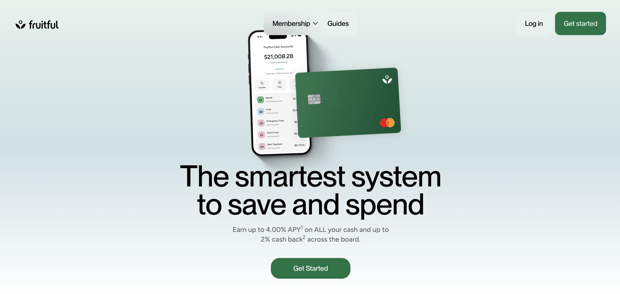
The Fruitful Card is a secured Mastercard that's linked to your cash account. It's not a credit card where you're borrowing money from an available credit limit. When you make a purchase with the card, Fruitful sets aside that amount from your Cash account to cover it. You can't spend more than the cash available in your account. You also earn 1.00% cash back on purchases made with the card on the free account, and 2.00% on the Premium plan.
Fruitful Invest
Fruitful Invest is a managed investment service that builds and manages your investment portfolio. The first step is to talk with a Fruitful Guide, a Certified Financial Planner who helps you choose the right account and decide how to invest your money.
For example, if you're saving for retirement, your Guide can help you choose a mix of stocks and bonds based on how long you have until you need the money and how comfortable you are with market ups and downs.
Like most automated investing platforms, Fruitful uses low-cost exchange-traded funds (ETFs) and index funds for its customers' portfolios, rather than individual stocks. Some portfolios also include mutual funds. Once you decide how much you want to invest, you can set up an automatic transfer so the amount moves to your investment account automatically.
There are no investment minimums, so you can start investing with as little as $1, and Fruitful automatically rebalances your portfolio to keep your investments aligned with your investment objectives.
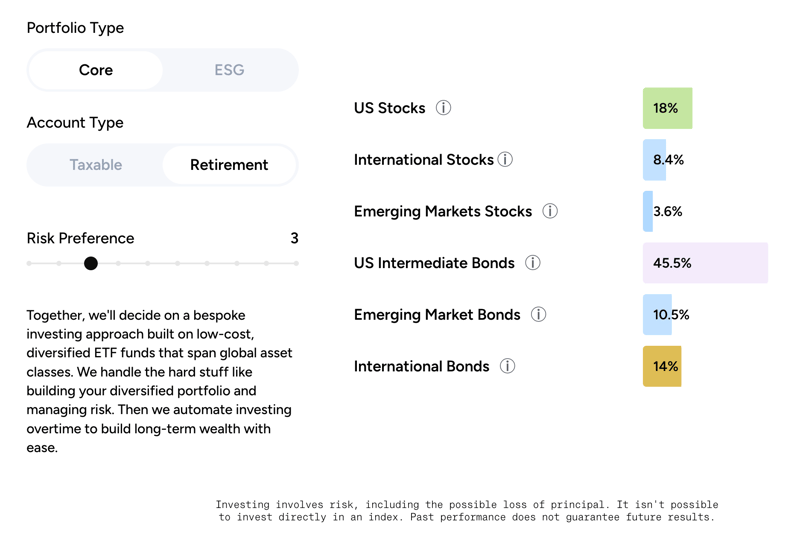
Whether you choose a core or ESG portfolio (yes, Fruitful offers both), or a taxable or retirement account, Fruitful can set your portfolio weightings to match your risk tolerance. For example, the above screenshot shows a Core retirement (tax-advantaged) portfolio with a risk preference rating of 3/10, which is considered pretty conservative. This portfolio has a 30% equity (stock) allocation, split among US, International, and Emerging Market stocks. The fixed-income portion, which includes a mix of bonds, makes up the remaining 70%.
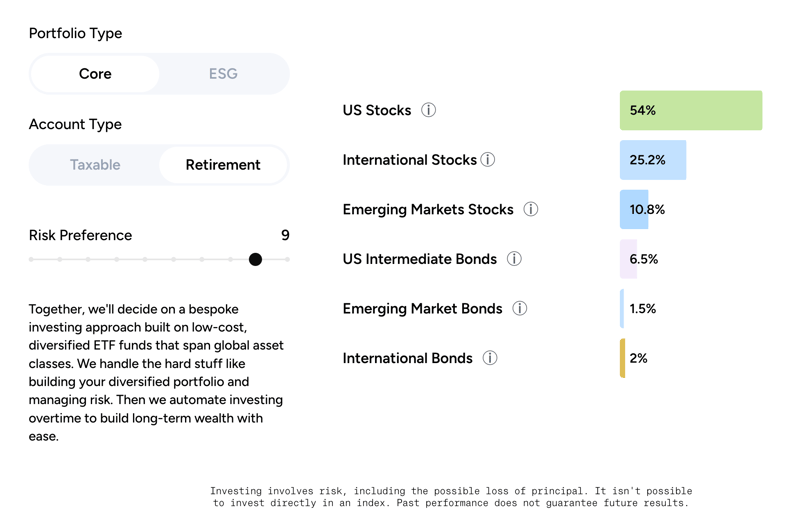
The screenshot below shows a Core retirement portfolio with a risk rating of 9/10. As a result, the equities allocation is much higher, at 90%, while the fixed-income (bond) component is only 10%. This portfolio would be more suitable for a long-term investor with a high risk tolerance.
Fruitful Guides
As mentioned, a Fruitful Guide is a Certified Financial Planner. They will meet with you one-on-one via video to review your finances, refine your Money Map (your personalized money plan), and help you set up automated contributions.

For example, if you’re trying to build an emergency fund while paying down a credit card, your Guide can help you decide how to split the money you have available. The free membership includes setup sessions with your Guide, but Premium adds three ongoing guidance sessions per year after the trial period. You can also message your guide anytime on Premium.
Are There Any Fees?
Fruitful’s Core membership is always free. That said, when you sign up, you'll get three months of free access to Premium. From there, you'll need to decide whether to continue on Premium for $250 per quarter or $999 per year, or you can opt for the free plan.
On the free plan, Fruitful charges an annual investment fee of 0.25% on the portion of your assets above $10,000. That fee is waived on the Premium plan, although there may be management fees on the underlying investments (ETFs, index funds).
Ultimately, a .25% annual fee on a $100,000 portfolio is only $250, so you'd need to use the additional Guide access and support to justify paying $999 for Premium (and waiving the investment fee).
How Does Fruitful Compare?
As a primarily automated investing platform that offers access to a high-yield deposit account, Fruitful resembles robo-advisors such as Betterment and Wealthfront.
Betterment offers human advisor support, but only to Premium clients, who pay a higher 0.65% fee on assets under management for advisor access.
Wealthfront is a fully automated advisory platform with no access to human advisors. Of the three platforms, it offers the highest potential savings APY, currently at 4.45%.
Header |  |  |  |
|---|---|---|---|
Rating | |||
Pricing | $0 or $999/year; 0.25% fee on $10,000+ (Core) | $5/month or 0.25% | 0.25% |
APY On Savings | Up to 4.00% | Up to 4.25% | Up to 4.45% |
Human Advisors | Yes | Yes | No |
Cell |
How Do I Open A Fruitful Account?
To open an account, go to the Fruitful website and select the green "Get Started" button. From there, you'll need to answer a few questions about your finances and goals. It only takes about three minutes to generate your initial Money Map, and you don't need to provide your credit card information up front.
If you decide to proceed, you can arrange a meeting with a Guide to adjust the plan, open the accounts you’ll use, and set up funding for your account.
Is It Safe And Secure?
Investment accounts managed by Fruitful are held with a custodial partner called Apex Clearing. Its deposit accounts are held at a partner bank called Emigrant Bank. By partnering with established financial organizations, Fruitful makes it easier for users to trust that their savings and investments will be held safely and securely. Funds in the high-yield savings account are FDIC-protected up to $250,000.
Overall, Fruitful uses best practices for safely and securely handling money. The company also appears to use a proprietary technology to help its clients organize their finances. Based on the legal documents, it appears to be encrypted and follows bank security standards. This is a strong step toward financial privacy and security. Many financial advisors don't handle client information safely, so it's great to see an organization take this seriously. That said, even the most careful companies could lose data in a hack or breach.
How Do I Contact Fruitful?
If you have general questions, email [email protected]. If you're an existing member, you can email [email protected] or call (833) 784 - 8050.
Is It Worth It?
Fruitful offers a compelling option for investors who want a hands-off, automated approach but could use a qualified investment professional to build their plan and get started. Consider an investor just starting out with less than $10,000.
They can choose the Core plan, meet 1:1 with an investment professional, and have their investments managed for virtually no cost (besides a small management fee on underlying investments). They also get a no-charge deposit account that currently pays 3.00% APY, plus a secured Mastercard for spending. Where else can you get all of this for free?
The value proposition gets trickier with the Premium plan. At $999 per year, you would need a very large investment portfolio, or you'd need to take advantage of the additional CFP support to make it worthwhile.
Ultimately, I think Fruitful is best suited for younger or newer investors who could use additional planning advice and will take advantage of both the automated investing and saving and spending features Fruitful offers.
Fruitful Review: Automated Investing With A Human Side
-
Commissions and Fees
-
Customer Service
-
Ease of Use
-
Tools and Resources
-
Personalization
Overall
Summary
Fruitful is a fintech that combines automated investing, human financial advice, and a high-yield account for savings and spending. Choose between a free plan (Core) and Premium, which includes higher savings APYs and more advisor support.
Pros
- No investment minimums
- 1:1 access to a CFP professional
- Earn up to 2.00% cash back on purchases
Cons
- Premium plan is pricey, at $999 per year
- Can’t purchase individual stocks
- Competing apps offer a higher savings APY
Editor: Colin Graves Reviewed by: Robert Farrington

Colin Graves is a financial writer and editor with more than 20 years of experience in banking and wealth management. Before joining The College Investor, he managed retail and commercial portfolios exceeding $1 billion, earning multiple awards for leadership and customer service. Colin holds several credentials from the Canadian Securities Institute, including the Canadian Securities Course, Professional Financial Planning Course, and the Certificate of Financial Services Advice.
Today, he applies that expertise to editing and writing about investing, credit, and money management for readers seeking practical, trustworthy financial information. Colin also writes at ColinGraves.com, where he helps people transition from traditional employment to self-employment through financial literacy and business coaching.