
Over the past decade, passive investment funds (index funds) received a total of $3.8 trillion in inflows. By contrast, actively managed funds saw net outflows of $185 billion. Passive and active funds control nearly the same amount of the market.
With so much money flowing towards passive funds, does it make sense to opt for actively managed investment funds? With less competition than in the past, a skilled investment manager (or investment algorithm) should, in theory, have a somewhat easier time beating the market.
Pave Finance, an algorithm-based, actively-managed fund company, is opening up that option to everyday consumers. But before you put your money into this actively managed robo-advisor, here’s what you need to know about it.

Quick Summary
- Investment decisions driven by machine learning
- Invests across all four major asset classes
- Seeks profits during market downturns through shorting
- Charges a 1% annual advisory fee
Pave Finance Details | |
|---|---|
Product Name | Pave Finance |
Min Invesment | $0 |
Annual Fee | 1% AUM |
Account Type | Taxable |
Promotions | None |
What Is Pave Finance?
Pave Finance is an actively-trading robo-advisor that invests and trades on behalf of clients. This “artificial intelligence” advisor uses stocks, bonds, currencies, and commodities to derive as much upside potential as possible for investors.
Pave is designed as an app-first experience which makes it easy to break down the wall between non-investor and first-time investor. Peter Corey and Pascal Cevaer are the co-founders and CEOs of Pave and are the only names listed on the company's Team page.
What Are The Fees And Terms?
Pave does not have a minimum investment nor any lockup periods. Investors can deposit and withdraw money whenever they want.
However, this is still an investment. And like most investments, users can lose money. Typically, the risk of losing money is highest for short-term investors and lowest for investors with long time horizons.
The company charges no trading fees, but it charges a 1% annual management fee. The 1% fee is slightly higher than most robo-advisors. However, it matches its closest competitor, Titan Invest (which also takes an active approach to wealth management).
Pave does not currently market the option to invest your retirement funds through the platform. If you're looking to invest for retirement, check out our top Roth and traditional IRA picks.
How Is Pave Different From Most Robo-Advisors?
Most robo-advisors use Modern Portfolio Theory to drive allocation decisions. With this model, investor funds are broadly diversified in low-cost ETFs. Robo-advisors may implement some tax-loss harvesting techniques. But aside from those, they don’t tend to actively manage their portfolios. They simply allocate your money efficiently to maximize expected returns given your stated appetite for risk.
Pave isn’t like most robo-advisors. Instead, it tries to work more like an actively-managed hedge fund. On it site home page, it proclaims boldyl that "It’s time everyone had their money managed like a billionaire." But unlike most hedge funds that serve said billionaires, Pave's fund is managed by an algorithm rather than a group of human experts.
Pave's trading models use quantitative analysis to attempt to predict market movements. It also uses shorting to give its clients a chance of even earning positive returns during market downturns. This investment style has much greater upside potential compared with other robo-advisors. However, if the quantitative analysis is wrong, investors could also lose money more quickly.
Another major differentiator is the asset classes that Pave invests in. Like most robo-advisors, Pave exposes investors to stocks and bonds. But it's somewhat unique in that it also emphasizes currencies and commodities as important asset classes. The latter two categories are typically lumped into a small “alternatives” category if they are included in a portfolio at all.
Is Pave Better Than Other Investing Options?
On its website, Pave shows a back-testing example from January 2020 to September 2020 — a single 9-month period. As you can see in the screenshot below, it dramatically outperformed the market during that time period.
Most impressive is the fact that Pave's portfolio didn't suffer a dip in March 2020 when the vast majority of stocks were declining (presumably thanks to its short positions).
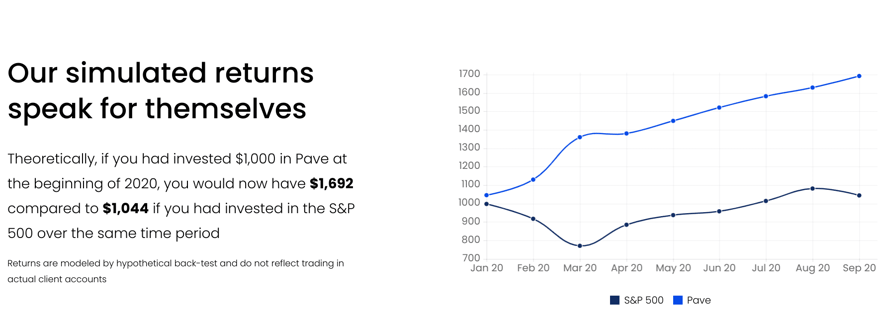
While these numbers are impressive, they also aren't very helpful toward determining Pave's long-term viability. Showing a back-tested performance for a single 9-month period is simply not enough evidence to prove the its algorithm's efficacy.
Further, the particular 9-month period it chose to highlight is a bit suspect. Not only does it begin right before a big S&P 500 downturn but it also conveniently ends right before the huge market run-up that began in November 2020 and has continued to the time of writing (April 2021).
I suspect that Pave Finance’s team of data engineers and scientists are constantly fine-tuning the model in use. And the more market data they use, the better the model will be during typical market conditions. However, the Pave Finance website focuses exclusively on upside potential without digging deep into its downside protections.
So while I would expect Pave Finance to outperform most amateur traders, I'm not confident that it's “invest like a billionaire” advertising is accurate. I strongly suspect that most billionaires would want to see more specific data regarding their downside risk.
Related: 90% Of The World's Millionaires Do This To Create Wealth
Header | |  |
|---|---|---|
Rating | ||
Min Investment | $0 | $100 |
Advisory Fee | 1% | Below $10,000: $5/month $10,000 Or Above: 1% |
IRAs | ||
Mobile App | ||
Cell | Cell |
Should I Invest With Pave Finance?
At this point, investing through Pave Finance seems risky. The company is still small, its algorithm is unproven, and its website is short on details. Not only are there no white pages to be found, but the company has yet to even publish an FAQ page.
Further, financing could become a problem for Pave down the road. As of writing, the CEO is actively looking for funding, and there is no previously raised public rounds. For these reasons, I would recommend passing on joining its investor wait list for now but keeping an eye on it if you like its investment strategy.
Remember, if the product takes off, you can always invest down the road!
If you'd like to start investing with a hedge-fund-like robo-advisor platform today, you might want to check out Titan Invest. Like Pave, Titan Invest charges a 1% advisory fee. But it also offers a resource-rich website filled with research reports and historical performance data. Read our Titan Invest review >>>
Pave Finance Features
Account Types | Taxable |
Minimum Investment | $0 |
Annual Fee | 1% AUM |
Performance Fee | 0% |
Lock-Up Period | None |
Underlying Assets |
|
Uses Short Positions | Yes |
Socially Responsible Investments | No |
Access to Human Advisor | No |
Automatic Rebalancing | No |
Tax-Loss Harvesting | No |
Customer Service Number | None published |
Customer Service Email | |
Other Customer Support Options | Social media -- Twitter, Instagram |
Mobile App Availability | None |
Promotions | None |
Pave Finance Review
-
Commissions and Fees
-
Ease of Use
-
Customer Service
-
Tools and Resources
-
Investment Options
-
Specialty Services
Overall
Summary
Pave Finance is an actively-trading robo-advisor that aims to make money for its clients regardless of how the market is moving.
Pros
- Uses machine learning to predict market movements
- Offers diversification in multiple asset categories
- No account minimums or lock-up periods
Cons
- AUM fees are significantly higher than other robo-advisor platforms
- Limited historical performance data
- Doesn’t currently offer IRA accounts
- No phone-based customer service
Editor: Clint Proctor Reviewed by: Chris Muller

Robert Farrington is the founder of The College Investor and is widely recognized as one of the nation’s leading voices on student loan debt and saving for college. He holds an MBA from UC San Diego Rady School of Management and has spent over 15 years researching, writing, and advising on student loans, 529 plans, financial aid programs, and saving and investing for young professionals.
Robert has been featured in the The New York Times, The Wall Street Journal, The Washington Post, NBC News, and Forbes, where he has been a regular personal finance contributor for over a decade. His work combines both professional expertise and personal experience – he successfully navigated his own student loan repayment journey and has helped thousands of readers do the same.
He is committed to making the intersection of personal finance and education transparent and accessible. You can learn more about Robert on the About Page or on his personal site RobertFarrington.com.