
J.P. Morgan Self-Directed Investing is Chase's competitor to Robinhood, Fidelity, and Schwab.
In today’s market free trading is table stakes,. And most of the big-name brokers have stepped up to play. This includes J.P. Morgan which has $0 trade commissions for its Self-Directed Investing app.
J.P. Morgan Self-Directed Investing (hosted through the Chase Mobile App) is yet another example of a no-fee, high-value brokerage account brought about by the democratization of “high” finance. If you’re looking for an easy-to-use, no-frills investing app, J.P. Morgan investing is well worth considering. Here’s what you need to know about it.
The information about J.P. Morgan Self-Directed Investing has been collected independently by The College Investor. The product details have not been reviewed or approved by the company.

Quick Summary
- No commissions on stocks, ETFs, and options
- Trade fractional shares for as little as $5
- Easy-to-use interface on mobile and the web
- Targeted at long-term investors rather than traders
What Is J.P. Morgan Self-Directed Investing?
J.P. Morgan Self-Directed Investing is a no-frills investment app designed to serve long-term investors. It’s ideally suited for people who already have a lot of their financial life in the J.P. Morgan Chase world. If you already have the Chase App downloaded, opening an investment account is as simple as tapping a few buttons.
The Self-Directed Investing app allows investors to buy and sell stocks, ETFs, mutual funds, and bonds with no commissions. It also offers investors the ability to buy and sell very low-cost options. The app itself allows users to keep watchlists and investigate individual investments. But the default views are on portfolio totals. This prevents investors from “losing the forest for the trees.”
Don’t expect gamification or flashing lights when you download the app. It’s simple, streamlined, and almost old-school in its approach. But under the hood, you’ll find a powerful app that can give investors access to the most important aspects of the financial markets.
Note: J.P. Morgan also offers "Automated Investing" for those want robo-advisor wealth management. The company's managed portfolios have 0.35% advisory fees and require $500 minimum investments.
What Does It Offer?
J.P. Morgan Self-Directed Investing App is a simple, but powerful, investment app. It targets “buy-and-hold” investors who want to consider their portfolio as a whole rather than jumping onto the latest financial trends. Here's what it offers.
Free Trades
J.P. Morgan Self-Directed Investing gives every customer commission-free trades for stocks, options, and ETFs, and the account balance minimum is $0. However, options do come with a per contract fee of $0.65.
Mutual funds investors will also love to learn that J.P. Morgan never charges fees on mutual fund transactions. While most brokers do offer a selection of no transaction fee (NTF) mutual funds, it's highly unusual for a firm to promise fee-free trades on every mutual fund that can be bought or sold on its platform.
Fractional Shares
While it wasn't always a feature, J.P. Morgan Self-Directed Investing now allows you to trade fractional shares for as little as $5, regardless of the share price. This includes S&P 500 and Nasdaq stocks and ETFs. You can see the full list of eligible securities here.
Fractional trading is supported through the website and in the Chase Mobile app.
Seamless Integration With Chase Mobile
The J.P. Morgan Self-Directed Investing App is hosted on Chase Mobile. It’s easily integrated with all other J.P. Morgan Chase products, including some of the best rewards credit cards on the market. That's very convenient for Chase Bank customers as it means they may only need to download one app to manage all of their financial accounts.

Access To Portfolio Builder Research
With a $2,500 minimum balance, investors gain access to the Portfolio Builder tool. This tool allows users to see how a certain stock or ETF would fit into their overall portfolio. The tool automates some of the best aspects of Modern Portfolio Theory (MPT) to keep investors pursuing adequate diversification given their goals.
Unfortunately, this is the primary mobile source for data and information. Users need to use the website to find articles about investment strategies. And users more or less need to leave the site to get detailed information about a stock or ETF.
Ultimate Rewards
Self Directed Investing now allows for rewards earned via Chase credit cards to be redeemed for cash value. Redeem your Ultimate Rewards points for cash to invest directly in an eligible J.P. Morgan Self-Directed Investing account and start building toward your future.
Web Access
Investors can access their accounts through either the Chase Mobile app or directly through the website. This makes it somewhat easier to connect bank accounts and make trades for people that don’t prefer a mobile interface.
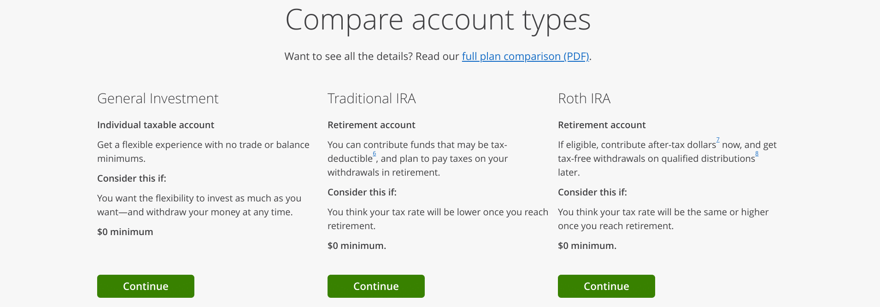
Ability To Open IRAs And Trust Accounts
The J.P Morgan Investing account can function either as a standard brokerage account or you can open up a Roth IRA or Traditional IRA. However, you won't find any self-employed retirement plan options like a Solo 401k, SEP IRA, or SIMPLE IRA.
You can also open Trust Accounts, but opening a trust account cannot be done online. You have to call a phone number to open the account.
Other Account Types
Self Directed Investing now offers UTMA accounts so you can open an investment accounts for your children as well.
Technically, J.P. Morgan does offer 529 college savings plans. But they're only sold through financial professionals which means they're not accessible to the firm's Self-Directed Investing clients.
Few Advanced Trading Options
You can trade stocks, ETFs, mutual funds, bonds (as in directly purchasing bonds), and other fixed income assets (think CDs) with J.P Morgan. And the platform tries to differentiate itself from other investing apps by helping investors keep an eye on their total portfolio while giving them the flexibility to choose from a variety of investments.
But it should be noted that while J.P. Morgan Self-Directed Investing is marketed as a “trading” platform, it doesn't support foreign currencies, cryptocurrencies, or futures. It recently launched a cryptocurrency ETF, but no direct holding of crypto.
Are There Any Fees?
Stocks, ETFs, options, and mutual funds trade commission-free with J.P Morgan Self-Directed Investing. The options contract fee is $0.65. If you want to buy bonds, you’ll pay $1 per bond (with a $10 minimum and a $270 max). Fixed income also costs $1 per trade. Transaction fees you may face include:
Transaction | Fee |
|---|---|
Returned check | $12 |
Stop payments | $30 |
Third-party wire transfer | $25 |
ACAT (outgoing) | $75 |
Broker-assisted trade | $25-$30 |
Free trades don’t run out after an introductory period, making this the perfect app for people who want to buy and hold individual stocks along with ETFs or other assets.
How Does J.P. Morgan Self-Directed Investing Compare?
The J.P. Morgan Self-Directed Investing app isn't sexy. It’s functional and low-cost. Investors who want gamification, ticker charts, and constant sensory experiences won’t like what J.P. Morgan has to offer. But that doesn’t make J.P. Morgan a bad app. Quite the opposite.
I found J.P. Morgan to be very easy to use. It had more than adequate investment selection, and I loved the Portfolio Builder tool. Investors who want a primarily “plain vanilla” portfolio with a few individual stocks or options will love the low fees and the easy-to-use app.
That said even “plain vanilla” investors may have better options outside of J.P. Morgan’s Self-Directed app. Charles Schwab offers a greater variety of account types, and it also offers free trades. And Robinhood supports cryptocurrency in addition to stocks and ETFs.
Perhaps the biggest draw to J.P. Morgan rather than its competitors is the integration with Chase. People who have a Chase credit card, will find that opening a J.P. Morgan investment account becomes an easy next step. By contrast, other companies make opening an account more difficult.
Header | |  |  |
|---|---|---|---|
Rating | |||
Commissions | $0 | $0 | $0 |
Per Contract Fee On Options | $0.65 | $0.65 | $0 |
Fractional Shares | |||
Futures | |||
Crypto | |||
Forex | |||
Margin Trading | |||
Cell |
How Do I Open An Account?
People who already have a Chase product can simply open an account through the Chase Mobile App. This involves answering a few questions and funding the account.
Those who aren’t current account holders must either download Chase Mobile or visit the Chase.com website. Once users provide personal and employment information, they can choose the type of account to open. From there, it's up to the investor to fund the account and start investing.
Bonus Offers
Right now, you can get the following bonus offer:
Up To $1,000 With J.P. Morgan Self-Directed Investing
Cash promotion is limited to one per customer and can only be applied to one new J.P. Morgan Self-Directed Investing account (General Investment, Traditional IRA, or Roth IRA). To enroll in the up to $1,000 offer, you must open an account through this page. This offer does not apply to J.P. Morgan Automated Investing or any account opened with a J.P. Morgan Advisor.
Right now, get up to $1,000 when you open and fund a J.P. Morgan Self-Directed Investing account with qualifying new money by January 27, 2026.
Here are the bonus tiers:
Deposit Amount | Bonus Amount |
|---|---|
$5,000 to $24,999 | $50 |
$25,000 to $99,999 | $150 |
$100,000 to $249,999 | $325 |
$250,000 or more | $1,000 |
Is It Safe And Secure?
J.P. Morgan Securities is a member of FINRA and the SIPC. It’s a well-known company, for a large bank, is remarkably free from scams and shady business. Investors should not expect some sort of bait and switch. I don’t expect J.P. Morgan to raise rates on any of its investment products soon.
The accounts are also protected through multi-factor authentication. Users are prompted for multiple factors even when logged in from known IP addresses. To me, this is an excellent example of consistent security.
Investors' accounts are also somewhat protected from theft as long as the fault is J.P. Morgan’s and not yours. That said, the investments in the account are not perfectly safe. Investments in any brokerage account can lose value and even go down to zero. Stock market investors need to be ready to risk money if they're going to invest.
How Do I Contact J.P. Morgan Chase?
If you need assistance with your Self-Directed Investing account, you can call 1-800-392-5749 from 8 AM to 9 PM (ET). J.P. Morgan is different than many other top brokers in that you can also receive in-person support at any of Chase's 4,700+ local branches. Investors can schedule meetings in a local branch here.
But access doesn't always mean quality. Like most national full-service banks, customers often complain about Chase's customer service (or lack thereof). Chase.com currently has 1.3/5 star rating on Truspilot and J.P. Morgan Chase is only slightly less dismal at 1.6/5. The company does have an A- rating with the Better Business Bureau, however.
Why Should You Trust Us?
I have been writing about and reviewing investment firms and brokerages since 2009, and have reviewed almost every US-based investment firm open to individual investors. I have seen this space evolve from high cost to low cost options, and have seen the amount of investment tools grow for individuals.
Furthermore, we have been polling our audience for years to find out which investment firms they trust and use, and that's how we put together our annual rankings of the best investment companies.
Finally, we have our compliance team that regularly checks and updates the facts on our reviews.
Who Is This For And Is It Worth It?
J.P. Morgan is neither the first company to offer no-fee trades nor is it the most innovative company in the bunch. However, it offers a few unique selling points. The Portfolio Builder tool is an excellent option for people who want to own funds along with individual stock positions. The easy buy and sell buttons make the “nuts and bolts” of investing easy to manage.
The only real drawback to the platform is that it only supports after-tax brokerages and traditional and Roth IRAs. Business owners or side hustlers will need to host their self-employed retirement plans elsewhere.
Overall, I don’t think I would move my money from another no-fee brokerage to J.P. Morgan Self-Directed Investing. However, it will make top apps for free trades for the foreseeable future. New investors are likely to find that it’s easy to use, even if it's a little bit boring. I like that it encourages responsible investing in line with risk tolerances and time horizons.
INVESTMENT AND INSURANCE PRODUCTS ARE: NOT A DEPOSIT • NOT FDIC INSURED • NO BANK GUARANTEE • MAY LOSE VALUE
J.P. Morgan Self-Directed Investing FAQs
Let's answer a few of the most common questions that are asked about J.P. Morgan Self-Directed Investing:
How much money do you need to invest with J.P. Morgan?
While its Automated Investing accounts have $500 minimums, there are no minimum investment requirements to open a J.P. Morgan Self-Directed Investing taxable account or IRA.
Does J.P. Morgan have a separate app for advanced traders?
No, unlike many of its competitors, J.P. Morgan does not offer a dedicated platform for active traders. All clients, regardless of experience or trading volume, use the Chase Mobile app to send trades and manage their accounts.
Can you trade after-hours with J.P Morgan Self-Directed Investing?
No, any trades placed before 9 AM (ET) or after 4:30 PM (ET) will be queued until the start of the next trading day.
Does J.P. Morgan have any welcome bonuses or offers?
Right now, you can get up to a $1,000 cash bonus.
J.P. Morgan Self-Directed Investing Features
Account Types |
|
Tradable Assets |
|
Account Minimum | $0 |
Stock Commissions | $0 |
ETF Commissions | $0 |
Mutual Fund Transaction Fee | $0 |
Options Costs |
|
Basic Account Fee | $0 |
Margin Trading | No |
Fractional Shares | Yes |
Banking Services | Yes |
Customer Service Number | 1-800-392-5749 |
Customer Service Hours | 8 AM – 9 PM and Saturday 9 AM – 5 PM ET |
Web/Desktop Account Access | Yes |
Mobile App Availability | iOS and Android |
Promotions | Up to $1,000 |
J.P. Morgan Self-Directed Investing Review
-
Commission and Fees
-
Ease Of Use
-
Customer Service
-
Tools and Resources
-
Investment Options
-
Specialty Services
Overall
Summary
J.P. Morgan Self-Directed Investing is a commission-free trading platform. It compares well with other apps on cost. But some of its top competitors offer more account types and tradable assets.
Pros
- Commission-free trading
- Easy-to-use app and web interface
- Keeps investors focused on overall portfolio allocation and long-term growth
- Supports fractional shares
Cons
- Doesn’t support forex, futures, or crypto trading
- Can’t trade on margin
- No self-employed retirement accounts
Editor: Clint Proctor Reviewed by: Ashley Barnett

Get the latest financial news and actionable insights.
How it works:
- 1Enter your email and subscribe.
- 2Get the latest personal finance and education news delivered every week.
- 3Take control of your finances with real insights.
- 4We won't spam you, ever!

Robert Farrington is the founder of The College Investor and is widely recognized as one of the nation’s leading voices on student loan debt and saving for college. He holds an MBA from UC San Diego Rady School of Management and has spent over 15 years researching, writing, and advising on student loans, 529 plans, financial aid programs, and saving and investing for young professionals.
Robert has been featured in the The New York Times, The Wall Street Journal, The Washington Post, NBC News, and Forbes, where he has been a regular personal finance contributor for over a decade. His work combines both professional expertise and personal experience – he successfully navigated his own student loan repayment journey and has helped thousands of readers do the same.
He is committed to making the intersection of personal finance and education transparent and accessible. You can learn more about Robert on the About Page or on his personal site RobertFarrington.com.