How To Answer Student Income Tax Information Questions For FAFSA®
Here's how to correctly enter the student's tax questions and how to provide consent for transfer of information from the IRS.

Provide Consent To Transfer Data From The IRS Using The IRS Data Retrieval Tool
To be eligible for financial aid, you have to allow the FAFSA to automatically import your tax return information from the Internal Revenue Service (IRS) using the IRS Data Retrieval Tool.
Providing consent also means you don't have to answer any of the remaining questions relating to your tax return - it's all imported automatically.

When doing the online application, simply check "Approve" to consent to the transfer.
If doing the paper application, make sure you check the box on Question 24.
We will break down all the paper questions below so you understand what information the FAFSA is using and why.
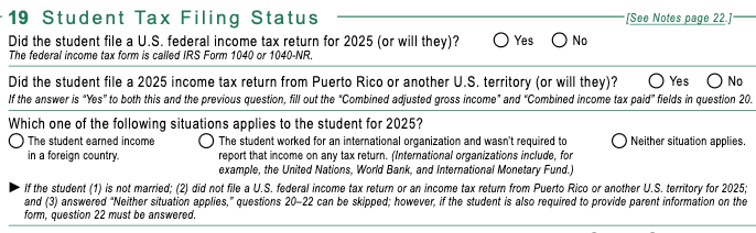
19. Student Tax Filing Status
Your FAFSA uses your tax filing status to determine what information is required to complete the FAFSA. For example, if you're married, you'll need to provide your spouse's information.
How To Answer These Questions
- Select "Yes" if you filed a 2025 IRS Form 1040 or 1040-NR.
- Select "Yes" if you earned income from a foreign country. Not sure, check if you filed Form 1116.
- Select "No" if none of these apply.
Can I Skip These Questions?
Yes, as long as you provided consent for the IRS Data Retrieval Tool to import your data.
20. Student's Tax Return Information
This is the key information that the FAFSA uses to calculate your Student Aid Index (SAI) which can qualify you for financial aid.
Again, if you use the IRS Data Retrieval Tool, you DON'T have to enter this data manually! It will be automatically submitted. But, you should know what they are looking at!
How To Answer These Questions
- Tax Filing Status: Enter the tax filing status from your tax return (Single is most common for dependent students)
- Income Earned From Work: How much you earned from work (W-2 or 1099 income)
- Tax Exempt Interest Income: Comes from bonds usually
- Untaxed Portions of IRA Distributions: Did you withdraw from an IRA (this could be a Roth IRA used to pay for college)
- IRA Rollover: If you rolled over the IRA, you can enter that amount here.
- Untaxed Portions of Pensions: If you withdrew from a pension plan.
- Pension Rollover into an IRA or Other Qualified Plan: If you rolled a pension plan over into another qualified retirement account (like a 401k or IRA).
- Adjusted Gross Income: This is your adjusted gross income from your tax return.
- Income Tax Paid: This is how much income tax you paid.
- Did the student receive the Earned Income Tax Credit: Only if you received this for yourself.
- IRA Deductions and Self-Employed Retirement Plan Contributions: Enter how much you contributed to an IRA or other plan.
- Education Credits: Enter the value of any education tax credits you received.
- Did the student file Schedule A, B, D, E, F, or H? Check your tax return, did you file any of these forms?
- Net Profit or Loss From Schedule C: This is business and side hustle income.
- Amount of Taxable Scholarships and Grants Reported: This is for taxable scholarships, usually for room and board.
- Foreign Earned Income Exclusion: If you had foreign income, it now counts on the FAFSA.
Can I Skip These Questions?
Yes, as long as you provided consent for the IRS Data Retrieval Tool to import your data.

21. Annual Child Support Received
Child support does count as an asset for FAFSA purposes.
How To Answer These Questions
Report the child support you received in the last calendar year. Remember, this is the student section, not the parent's section. This only applies if the student had a child and is receiving child support for the child(ren).
Can I Skip These Questions?
No, they are required. If you received none, enter 0.

2027-28 FAFSA Questions Step-By-Step
Find answers to the other FAFSA questions here:
Student Spouse Information
Parent Information
Parent Financial Information
Parent Spouse Information
FAFSA® is a registered service mark of U.S. Department of Education, Federal Student Aid.