How To Answer Student Asset Questions For FAFSA®
Here's how to correctly enter the student's asset information for the FAFSA.

22. Student Assets
Your FAFSA uses your assets to determine your Student Aid Index (SAI), which is a critical component of how much financial aid you'll receive.
Student assets are extremely weighted, and it's essential that you calculate the net worth of your assets and answer these questions correctly.
How To Answer These Questions
First, net worth means the current value as of the date you file the FAFSA. If a value is negative (like a business), use $0.
You'll notice that they don't ask about debt. Consumer debts, like mortgage, car loan, student loans, are NOT factored into the FAFSA. There are little things you can do to lower your assets for FAFSA, such as making a mortgage payment before reporting the value of your checking account.
Value of Cash, Savings, and Checking Accounts
This is pretty self-explanatory. As the student, you input the value of your cash, checking, and savings account.
Many students have joint or custodial teen bank accounts (since they couldn't open their own as a minor). These are still reported as the student's asset if they are for the student.
Current Net Worth Of Investments, Including Real Estate
The current net worth of investments means the value the day you file the FAFSA. For rental real estate, it's the fair market value minus any debt on the property.
Investments include:
- Stocks
- Bonds
- Mutual Funds
- Money Market Funds
- Certificates of Deposit (CDs)
- Stock Options (ESOP)
- Commodities
- Cryptocurrency
- Rental real estate
- Second homes or vacation homes
- Land sale contracts
UGMA/UTMA accounts, where the student is the owner/beneficiary, are included in this as a student asset.
529 plans are the asset of the owner. The student is typically the beneficiary. For example, if the parent is the owner, and the child is the beneficiary, it's reported as a parent asset, not a student asset. In cases where the student is an independent student, its a student asset.
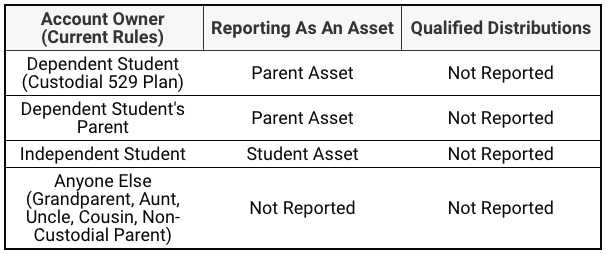
🚨 DO NOT INCLUDE THE FOLLOWING 🚨
You do NOT include the following assets (and these can be BIG mistakes):
- Your primary residence.
- Retirement accounts like 401(k)s, IRAs, annuities, and pensions.
- Life insurance policies.
- UGMA/UTMA accounts if the student is not the owner.
- 529 plans for other children not applying for aid.
- Value of small business, family farm, or family fishing operations.
Current Net Worth of Businesses and Farms
You only have to report the value of a business or farm ownership if it doesn't meet the following criteria:
Small Business: You don't have to report a small business with less than 100 full-time or full-time equivalent employees that is owned and controlled by the family.
Family Farm: You don't report a family farm on which the family resides.
Commercial Fishing Business: You don't report a commercial fishing business and re-lated expenses, including fishing vessels and permits owned and controlled by the family.
The result is that you don't have to report any side hustle or small family businesses as assets. However, you still report the income from these activities in the income section.
Can I Skip These Questions?
No, they are required.

2027-28 FAFSA Questions Step-By-Step
Find answers to the other FAFSA questions here:
Student Spouse Information
Parent Information
Parent Financial Information
Parent Spouse Information
FAFSA® is a registered service mark of U.S. Department of Education, Federal Student Aid.

Get the latest financial news and actionable insights.
How it works:
- 1Enter your email and subscribe.
- 2Get the latest personal finance and education news delivered every week.
- 3Take control of your finances with real insights.
- 4We won't spam you, ever!