How To Answer Student Personal Circumstances Questions For FAFSA®
Here's how to correctly enter the student personal circumstances section of the FAFSA®, including what certain circumstances mean, unusual circumstances, family size, and more.

4. Student College Or Career School Plans
This question is designed to be used that schools know what grade level you're applying for. Some types of aid, like federal student loan limits, are based on the year of college you're enrolled in.
How To Answer These Questions
- Select the year of college you're applying for the 2027-28 academic year (not this year). For example, if you're a high school senior, you typically select "First-year undergraduate (Freshman)". This is true even if you did dual enrollment or have other earned college credit during high school. There are exceptions.
- If you're pursing a masters or doctorate, select the appropriate box.
- If you already have a bachelors degree, select the appropriate box.
- If you're planning to be a teacher and going for your credential, select this box as yes. You may be eligible for aid like a TEACH grant.
Exceptions: If you have over 30 credit hours of dual enrollment on a community college transcript, you can select second-year. If you have over 60 hours of credit hours on a community college transcript, you can select other undergraduate. AP/IB don't translate directly for this so they don't count. Only credit-hours already taken and on a college transcript count.
Can I Skip These Questions?
No, they are required.

5. Student Personal Circumstances
These questions are designed to determine if you're a dependent or independent student for the FAFSA. Your dependency status determines your financial aid.
How To Answer These Questions
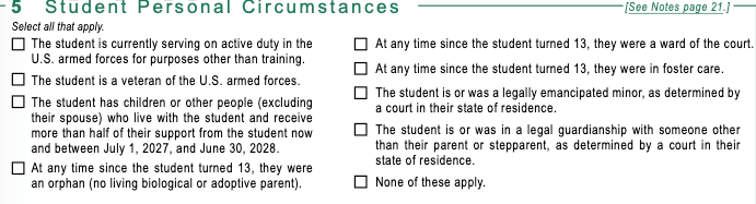
Check this box if you're currently servicing in the U.S. armed forces, National Guard, or Reserves for more than just training purposes.
You cannot check this box if you're a cadet of midshipman at a service academy.
Checking this box should also send your information to your college's VA or military liaison office, where they will help you qualify for certain types of military or VA education benefits.
Check this box if you've engaged in active duty in the U.S. armed forces, National Guard, or Reserves for more than training purposes.
You can also check this box if you were a cadet or midshipman and were released (other than for dishonorable discharge).
You can check this box if you're currently active duty, but will be a veteran by June 30, 2027.
Checking this box should also send your information to your college's VA or military liaison office, where they will help you qualify for certain types of military or VA education benefits.
Check this box if you have children, or will have children after July 1, 2027.
You can also check this box if you provide more than 50% support to a dependent who isn't a child, such as a parent or sibling.
Check this box if you had no living or adoptive parents after turning 13.
If you're living with another relative or guardian, they do not report their income and assets for FAFSA. Only biological or adoptive parents do.
Check this box if you were a ward of the court any time after you turned 13, even if you're no longer a ward of the court today.
If you're living with another relative or guardian, they do not report their income and assets for FAFSA. Only biological or adoptive parents do.
Check this box if you were in foster care any time after you turned 13, even if you're no longer in foster care today.
If you're living with another relative or guardian, they do not report their income and assets for FAFSA. Only biological or adoptive parents do.
Check this box if you're an emancipated minor through a court order, marriage, or military sercvice.
Check this box if your legal guardian is someone other than your parent or stepparent, as determined by a court.
If you're living with another relative or guardian, they do not report their income and assets for FAFSA. Only biological or adoptive parents do.
Can I Skip These Questions?
No, they are required.
6. Student Homelessness
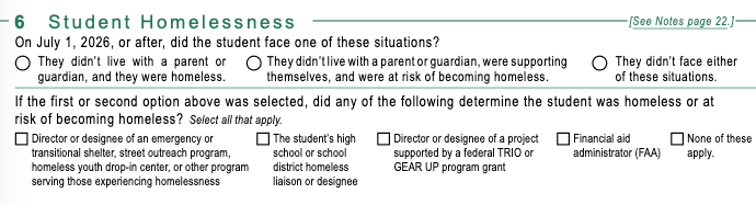
This question helps determine if you're a dependent or independent student for the FAFSA. Students who have experienced homelessness are considered independent.
How To Answer These Questions
- Answer yes if at anytime after July 1, 2026 you were unaccompanied and homeless or self-supporting and at-risk of being homeless.
Homeless is defined as not having fixed, regular, and adequate housing. You may be homeless if you’re living in shelters, parks, motels, hotels, public spaces, camping grounds, cars, abandoned buildings, or temporarily living with other people because you have nowhere else to go. Also, if you are living in any of these situations and fleeing an abusive parent, you may be considered homeless even if your parent can offer a place to live.
Unaccompanied means you are not living in the physical custody of your parent or guardian.
Can I Skip These Questions?
No, they are required.
7. Student Unusual Circumstances
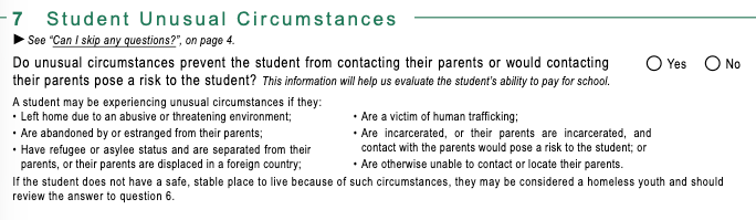
This question helps determine if you're a dependent or independent student for the FAFSA. Students who answer yes to this question may be considered independent for FAFSA purposes.
How To Answer These Questions
Answer "Yes" to this question if any of these situations apply:
- Left home due to an abusive or threatening environment.
- Are abandoned by or estranged from their parents, and have not been adopted.
- Have refugee or asylee status and are separated from their parents, or their parents are displaced in a foreign country.
- Are a victim of human trafficking.
- Are incarcerated, or their parents are incarcerated, and contact with the parents would pose a risk to the student.
- Are otherwise unable to contact or locate their parents, and have not been adopted.
Can I Skip These Questions?
Yes, you can skip this question if you were born before 2002, are married or remarried, or you selected "College Graduate, Professional, or Beyond" for the level of college you're applying for the FAFSA.
8. Direct Unsubsidized Loan Only
You can opt to only apply for a Direct Unsubsidized Loan only. This would apply if your parents refuse to fill out the FAFSA.
How To Answer These Questions
- Answer "Yes" if your parents refuse to provide their information for FAFSA
Can I Skip These Questions?
Yes, you can skip this question if you were born before 2001, are married or remarried, or you selected "College Graduate, Professional, or Beyond" for the level of college you're applying for the FAFSA.

9. Family Size
Your family size for the FAFSA is used when determining your Student Aid Index (SAI). The SAI is the number that financial aid offices use when determining financial aid and Pell Grant eligibility.
You'll skip this question as a dependent student.
How To Answer These Questions
- Enter the number of people living in your household (including yourself), who get at least 50% of their financial support from you. This is typically your spouse and children.
- Don't include your parents (they'll fill out their own FAFSA)
Can I Skip These Questions?
Yes, you can skip this question if you were born before 2001, are married or remarried, or you selected "College Graduate, Professional, or Beyond" for the level of college you're applying for the FAFSA.

2027-28 FAFSA Questions Step-By-Step
Find answers to the other FAFSA questions here:
Student Spouse Information
Parent Information
Parent Financial Information
Parent Spouse Information
FAFSA® is a registered service mark of U.S. Department of Education, Federal Student Aid.

Get the latest financial news and actionable insights.
How it works:
- 1Enter your email and subscribe.
- 2Get the latest personal finance and education news delivered every week.
- 3Take control of your finances with real insights.
- 4We won't spam you, ever!