Key Points
- Sen. Peter Welch and Rep. Joe Courtney are pushing Congress a second time this year to pass a bill setting all federal student loan interest to 0%.
- The bill would automatically zero out interest on existing Direct Loans starting July 1, 2026, funded by a new Education Affordability Trust Fund.
- The renewed push comes as an estimated 9.5 million borrowers (1 in 5) sit in default on $233.3 billion in federal student debt.
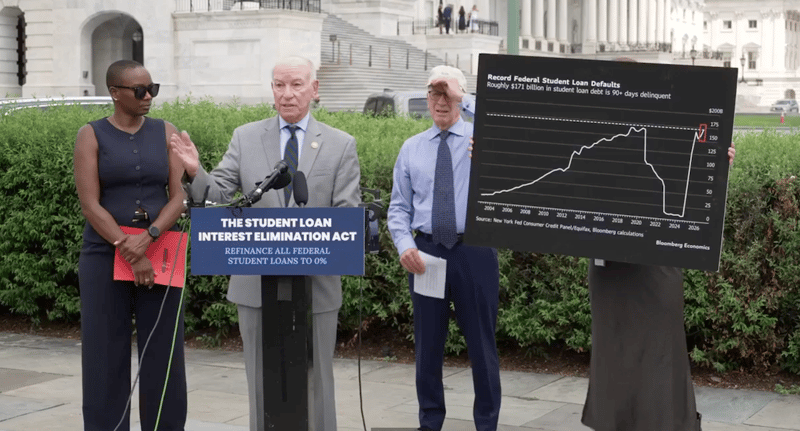
Sen. Peter Welch (D-Vt.) and Rep. Joe Courtney (D-Conn.) held a press conference on Capitol Hill last week urging Congress to take up the Student Loan Interest Elimination Act (PDF File), which would set the rate on every existing and future federal student loan to 0%.
The press conference marks the lawmakers' second attempt in 2026 to move the bill. Welch introduced S. 4169 in the Senate and Courtney introduced H.R. 8045 in the House back on March 24, 2026, and neither version has advanced out of committee in the four months since. We covered that introduction when it happened.
The renewed push arrives as federal default numbers reach levels the system has never recorded before.
Would you like to save this?
By The Numbers
- 9.5 million federal borrowers (roughly 1 in 5) are now in default, meaning more than nine months behind, up from 5.3 million in June 2025. The New York Fed had already flagged a 3.6 million jump and 91-point credit score drops among newly defaulted borrowers.
- $233.3 billion in federal student loan debt currently sits in default, up from the $179 billion handed to the Treasury Department for collection earlier in the cycle.
- Nearly 43 million Americans hold federally held student loans, with an outstanding balance approaching $2 trillion. See our full student loan debt statistics.
- About $40,000 is the average federal balance per borrower.
- 6.52% is the new undergraduate Direct Loan rate for 2026-27, with graduate unsubsidized at 8.07% and PLUS loans at 9.07%.
What The Bill Would Do
If enacted, the Education Department would automatically modify every eligible Direct Loan so that no interest accrues. Borrowers would not need to apply, and they could opt out at any time.
Borrowers holding older FFEL, Perkins, or federal health professions loans could refinance into a 0% Direct Consolidation Loan with no origination fee. Also, the bill blocks the major downsides of consolidation.
Consolidating today normally costs borrowers twice: it can stretch out the repayment term, and it resets the count of payments already made toward forgiveness. The bill blocks both. Anyone who consolidates keeps the same repayment term that was in effect on the original loan, and the Education Department would have to credit the new loan with prior qualifying payments toward Public Service Loan Forgiveness, weighting each old loan's payment count by its share of the new consolidated balance, then rounding to a whole number. That mirrors the PSLF weighted average rule already on the books.
All new federal loans disbursed on or after July 1, 2026 would carry a 0% rate. Subsidized Stafford loans would end, since the interest subsidy becomes redundant at zero, and annual and aggregate borrowing limits would rise and be indexed to inflation starting July 1, 2027.
How It Would Be Funded
The bill's distinguishing feature is its funding mechanism. The Education Department would create an Education Affordability Trust Fund holding borrower principal payments. A board of trustees would invest those dollars in Treasury and municipal bonds, and the returns would cover the administrative cost of running the loan program.
Any surplus would fund supplemental Pell Grants and competitive grants for college completion and retention programs. Welch's office compares the structure to the Railroad Retirement Board.
How This Connects
We covered the March introduction alongside Rep. Mike Thompson's Lowering Student Loans Act (H.R. 7810), which would set a flat 2% rate instead of zero.
Both proposals face the same practical issue: roughly 60% of borrowers repay under income-driven plans like the Repayment Assistance Plan or IBR, where the monthly bill is set by income, not by the interest rate. Eliminating interest would stop balances from growing and cut lifetime repayment cost substantially, but it would not lower the monthly payment for most borrowers already enrolled in an income-driven plan. And RAP effectively doesn't this via the interest subsidy already.
For the 9.5 million borrowers already in default, a 0% rate would do nothing about collections that are restarting soon. Those borrowers still need rehabilitation or another path out of default to stop wage garnishment and tax refund offsets.
The bill is endorsed by the American Association of Colleges and Universities, EdTrust, and the Hildreth Institute. With Republicans controlling both chambers, no committee action has been scheduled in either the House or the Senate.
Don't Miss These Other Stories:
Editor: Colin Graves

Get the latest financial news and actionable insights.
How it works:
- 1Enter your email and subscribe.
- 2Get the latest personal finance and education news delivered every week.
- 3Take control of your finances with real insights.
- 4We won't spam you, ever!

Robert Farrington is the founder of The College Investor and is widely recognized as one of the nation’s leading voices on student loan debt and saving for college. He holds an MBA from UC San Diego Rady School of Management and has spent over 15 years researching, writing, and advising on student loans, 529 plans, financial aid programs, and saving and investing for young professionals.
Robert has been featured in the The New York Times, The Wall Street Journal, The Washington Post, NBC News, and Forbes, where he has been a regular personal finance contributor for over a decade. His work combines both professional expertise and personal experience – he successfully navigated his own student loan repayment journey and has helped thousands of readers do the same.
He is committed to making the intersection of personal finance and education transparent and accessible. You can learn more about Robert on the About Page or on his personal site RobertFarrington.com.