Key Points
- President Donald Trump announced a proposal to create a new retirement savings plan modeled on the federal government’s Thrift Savings Plan, offering up to a $1,000 annual government match.
- Roughly 40 million to 56 million private-sector workers lack access to an employer-sponsored retirement plan, according to estimates from the Economic Innovation Group and AARP.
- The proposal appears to build on the “Savers Match” created under the 2022 Secure 2.0 law, though the White House has not yet released a formal plan.
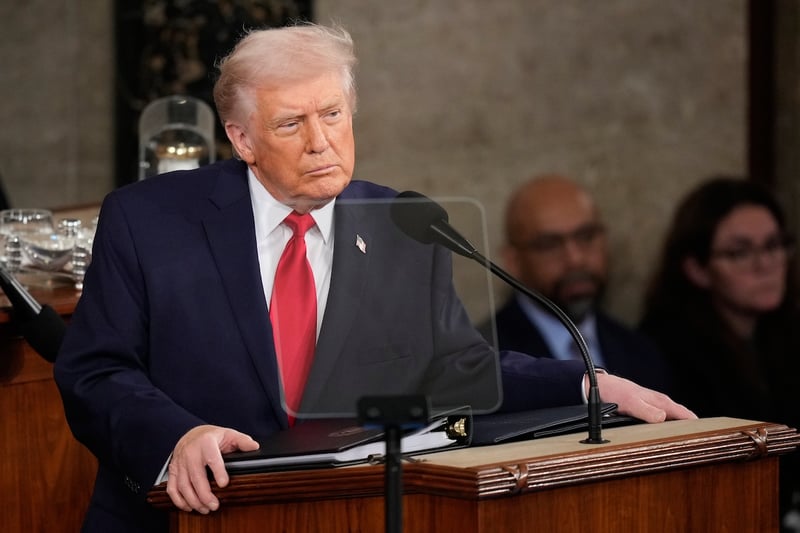
During his State of the Union address Tuesday night, President Trump previewed what could become one of the most consequential retirement policy changes in years: a new, federally backed retirement account for workers who do not have access to a 401(k).
“We will match your contribution with up to $1,000 each year,” Trump said, describing the effort as a way to give “forgotten American workers” access to the same type of retirement plan available to federal employees.
Details were sparse. No legislative language has been released, and administration officials say more specifics will come in the “coming weeks and months.” Still, early statements suggest the proposal would mirror the structure and investment options of the federal government’s Thrift Savings Plan, often referred to as the TSP.
Would you like to save this?
What Is The Thrift Savings Plan?
The Thrift Savings Plan is a defined contribution retirement plan available to federal workers and members of the military.
The TSP offers:
- A menu of low cost index funds.
- Lifecycle, or target-date, funds that automatically adjust risk over time.
- Automatic payroll deductions.
- Government matching contributions for many participants.
Trump’s proposal appears to extend a similar framework to private-sector workers whose employers do not offer retirement benefits.
Who Doesn't Have A Retirement Plan?
Access to workplace retirement plans remains uneven.
According to AARP, about 56 million private-sector employees work for companies that do not offer an employer-sponsored retirement plan.
Lower-income workers, part-time employees, and workers at small businesses are significantly less likely to have access to a 401(k) or similar plan. Workers without access are far less likely to save on their own through an individual retirement account.
This access problem has long concerned policymakers in both parties. Research consistently shows that automatic payroll deductions dramatically increase participation and savings rates compared with voluntary, self-initiated investing.
Trump characterized the situation as a “gross disparity” between workers who can invest tax-advantaged dollars at work and those who cannot.
What Is The Saver's Match In SECURE 2.0?
The proposal may also build on a policy already set to take effect under the SECURE 2.0 Act.
SECURE 2.0 created a “Savers Match,” replacing the previous Saver’s Credit. Beginning in 2027, eligible low- and moderate-income workers who contribute to a retirement account can receive a federal matching contribution of up to $1,000, deposited directly into their retirement account rather than provided as a tax credit.
Whether the proposal represents an expansion, rebranding, or restructuring of SECURE 2.0’s Savers Match will depend on legislative details that have not yet been released.
Could This Plan Actually Make It Into Law?
Treasury Secretary Scott Bessent suggested in an interview that the administration could pursue the plan through budget reconciliation, the same process used to pass the One Big Beautiful Bill Act (OBBBA) last year.
Using reconciliation could allow the proposal to advance without bipartisan support, provided it meets budgetary requirements. Retirement policy has historically drawn bipartisan interest, however, and similar concepts have been floated by lawmakers from both parties.
The Retirement Savings for Americans Act, reintroduced in 2025 by Senators John Hickenlooper and Thom Tillis along with Representatives Lloyd Smucker and Terri Sewell, would also create portable, federally matched retirement accounts for eligible workers.
What This Could Mean For Families
For households without workplace retirement plans, the impact could be significant - depending on the final structure.
A $1,000 annual government match is substantial for low- and middle-income workers. For example:
- A worker contributing $1,000 per year and receiving a full $1,000 match would effectively double their savings.
- Over 20 years, assuming a 6% annual return, $2,000 per year in contributions could grow to roughly $73,000.
- Without the match, $1,000 per year at the same return would grow to about $36,500.
The difference (nearly $37,000) illustrates how matching contributions can materially change a family's finances.
However, policy design matters. Without clear guardrails, the benefits could skew toward workers who already have the financial flexibility to contribute.
Don't Miss These Other Stories:
Editor: Colin Graves

Robert Farrington is the founder of The College Investor and is widely recognized as one of the nation’s leading voices on student loan debt and saving for college. He holds an MBA from UC San Diego Rady School of Management and has spent over 15 years researching, writing, and advising on student loans, 529 plans, financial aid programs, and saving and investing for young professionals.
Robert has been featured in the The New York Times, The Wall Street Journal, The Washington Post, NBC News, and Forbes, where he has been a regular personal finance contributor for over a decade. His work combines both professional expertise and personal experience – he successfully navigated his own student loan repayment journey and has helped thousands of readers do the same.
He is committed to making the intersection of personal finance and education transparent and accessible. You can learn more about Robert on the About Page or on his personal site RobertFarrington.com.