
Many Americans will be seeing a much smaller tax refund this year. This comes after years of record-breaking tax refunds.
The average tax return last year was $3,004 according to the IRS. That was up 0.9% from the prior year - highlighting the impact of the Covid-era stimulus programs that were coming to an end.
But sadly, due to many of the new and expanded programs ending, tax refunds will be smaller for many (and could be delayed too - check out our Tax Refund Calendar). Even worse, many could find themselves owing taxes when they’ve never had to owe before. Here’s why there's a good chance your tax refund is going to be smaller this year.
Promo Offer: If you're looking to get your tax return faster, check out CashApp, which has free tax filing, and if you opt to get your refund deposited into your CashApp account, you can get it up to 6 days early. Open a CashApp account here >>
Child And Dependent Care Tax Credit
Tax Refund Reduction: $5,000 to $10,000
One of the biggest expansions in tax credits came through the Child and Dependent Care Tax Credit. There was a huge increase in the amount of the tax credit, the income levels were higher, and the tax credit was fully refundable (meaning you could get more refunded to you than you even made).
For 2024, this credit is back to the original rules - meaning millions of families nationwide will see much smaller tax refunds.
The following rules apply for 2024 (which will reflect on your 2025 tax return):
- You can receive $3,000 for one qualifying person, and $6,000 for two or more qualifying individuals
- The percentage of qualifying expenses is 20% to 35%
- There is no longer an upper limit for income to claim the credit
Child Tax Credit
Tax Refund Reduction: $1,000 to $1,600
The Child Tax Credit was another huge expansion to tax credits that are back to their pre-Covid levels.
For 2024 (the tax return you file in 2023), the Child Tax Credit reverts back to the original rules:
- $2,000 for all children under 17
- Only $1,700 of the tax credit may be refundable
- You must have an AGI of $200,000 or less for single, or $400,000 or less for joint returns or the credit phases out in $50 increments
The result of this change is that 17 year olds are left out of the credit again.
Related: What To Do If My Parents Claimed Me On Their Taxes?
Earned Income Tax Credit (EITC) Changes
Tax Refund Reduction: Up To $7,430
There are also changes to the Earned Income Tax Credit (EITC) in 2024 that could reduce the tax refund for young adults and other low income individuals. The fact is that the limits on this tax credit didn't rise very much, but some people are going to see their salaries increase a lot.
To qualify with 0 children, you would have to earn less than $18,591 as a single filer, or $25,511 as married. That's pretty low given how much inflation has impacted things.
This year, the credit amounts vary:
- No Children: $632
- 1 Child: $4,213
- 2 Children: $6,960
- 3 or More Children: $7,830
No Student Loan Interest
Tax Refund Reduction: $250 to $550
A popular tax deduction for the 43 million Americans with student loan debt is the student loan interest deduction. To claim this deduction, you must pay student loan interest during the tax year. You can only deduct up to a maximum of $2,500 in interest paid.
Note: You'll only receive a 1098-E if you paid $600 or more in student loan interest. But you can still claim the deduction for any interest you paid on a qualifying education loan.
The student loan interest deduction is an adjustment of your gross income. So if you earned $60,000 and paid $2,500 in student loan interest, you’ll only pay taxes on $57,500.
Even though student loan repayment restarted, many borrowers have been stuck in limbo and still haven't been required to make student loan payments. Up to 30% of borrowers may be in forbearance still due to the ongoing SAVE plan litigation, according to our student loan statistics.
Furthemore, even those that did have interest start accruing, many will not exceed the $600 level required.
The result? You might not qualify to deduct any interest on your taxes - thus increasing your tax bill.
A Rise In Side Hustles
With rising inflation and concerns about the economy, our latest survey revealed that 55% of Americans currently have a side hustle, and another 16% are actively looking for one.
Unlike working a job and getting a paycheck, income earned from gig economy work or through self-employment isn’t subject to any tax withholding. Instead, you report your income and expenses at tax time and pay the IRS any tax due.
Sadly, with most people working these gigs because they urgently needed the money, many may not have set any aside for taxes. If you didn’t earn a lot of money (or none at all), you won’t owe much if anything. But if you were making good money on the side, you could have a substantial tax bill.
Plus, starting next year, the IRS is requiring payment processors like Venmo and PayPal to send 1099-K forms to everyone who received over $20,000 in income. This will force side hustlers to report more income than they may have previously.
How To Reduce Your Side Hustle Tax Liability
Before you freak out, make sure that you are properly accounting for both your income and your expenses. As a freelancer or self-employed person, you do have to claim your income, but you also get to deduct any expenses related to that work.
So, if you made $5,000 driving food delivery, that would be your income. But let’s say you drove 5,000 miles on your vehicle to make that money. You would deduct your mileage expense ($0.625 x 5,000) of $3,125, 50% of your cell phone bill which is $300, and $50 in supplies.
After your mileage deduction, you would actually only owe taxes on $1,525 in income. You can then look at your tax bracket and see how much you would owe. If you find yourself owing taxes and can’t pay, the worst thing you can do is avoid it. Check out this guide on what to do if you owe the IRS money.
Investment Gains
It's important to remember that if you sold stocks, crypto, or NFTs last year, you're going to owe taxes on your gains. And if you went all in on meme stocks and knocked it out of the park, those gains can be very large.
When you have investment gains, you pay capital gains taxes. Here are the capital gains tax rates. If your gains were from investments held less than a year, you pay the short term rate. If you held it longer than a year, the long term rate.
The stock market was up over 27% in 2024 - meaning you might have some amazing investment gains.
Note: Remember, you only pay taxes when you sell. If you haven't sold, you don't pay taxes. You can also do what's called "Tax Loss Harvesting", which is where you sell losses to offset capital gains.
Tax Bracket Changes
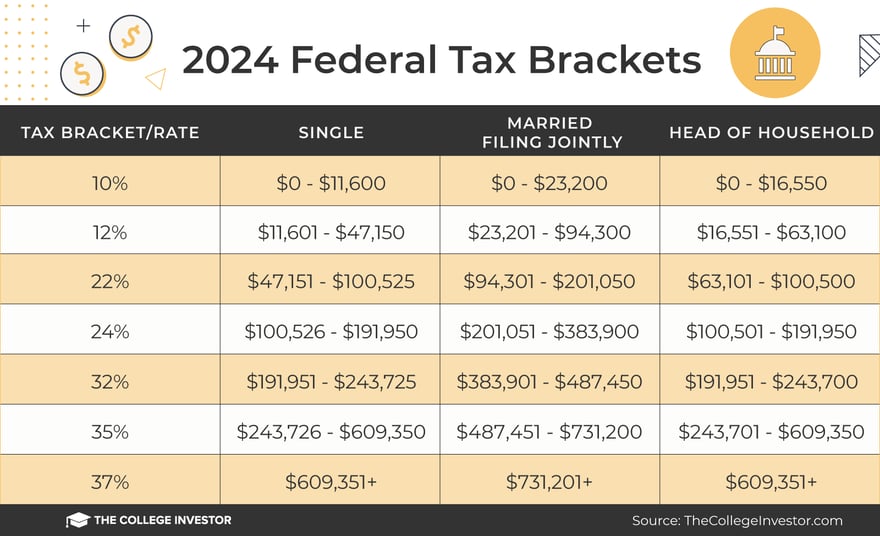
Rising inflation over the last few years has shifted the tax brackets upward, which is nice for people who haven't seen their income rise.
However, the brackets have not kept up with inflation fully, meaning that could face a higher tax burden for all the reasons we listed above.
Here's what the brackets look like for 2024, which you'll file in 2025:
Important Reminders
Some states may have offered additional stimulus checks or even gas tax or inflation refunds. These new stimulus programs may or may not be taxable. On the state level, these payments should not be taxable, but federally, they may be.
Second, more Americans have been getting unemployment benefits this year. If you're getting the full amount, contact your state’s Unemployment Benefit office to have them start withholding taxes. Otherwise, you may find yourself in a similar situation again next year.
Finally, many student loan borrowers have been getting loan forgiveness this year. While the blanket student loan forgiveness program is on hold due to lawsuits, there are still other initiatives like PSLF. These programs are tax-free federally, but may have state tax issues. Learn more about student loan forgiveness and taxes here.
Final Thoughts
Depending on your tax situation, it's possible that you could be losing upwards of $18,500 in tax credits. While some of these are not going to impact all tax filers, many low and middle-income families will see a sizable reduction in their tax refund compared to last year.
It will be even worse for families that swing from a tax refund to potentially owing on your taxes.
If you find yourself owing money to the IRS that you can’t afford, speak to a tax professional. Beyond addressing your current situation, you'll want to resolve the underlying issues to avoid future unpleasant tax surprises.
Editor: Colin Graves Reviewed by: Chris Muller

Robert Farrington is the founder of The College Investor and is widely recognized as one of the nation’s leading voices on student loan debt and saving for college. He holds an MBA from UC San Diego Rady School of Management and has spent over 15 years researching, writing, and advising on student loans, 529 plans, financial aid programs, and saving and investing for young professionals.
Robert has been featured in the The New York Times, The Wall Street Journal, The Washington Post, NBC News, and Forbes, where he has been a regular personal finance contributor for over a decade. His work combines both professional expertise and personal experience – he successfully navigated his own student loan repayment journey and has helped thousands of readers do the same.
He is committed to making the intersection of personal finance and education transparent and accessible. You can learn more about Robert on the About Page or on his personal site RobertFarrington.com.