
Key Points
- You can deduct up to $2,500 of student loan interest per year without itemizing. Most borrowers save $300 to $550 in federal tax.
- For 2026, the deduction phases out between $85,000 and $100,000 of MAGI for single filers and $175,000 to $205,000 for joint filers. Married filing separately gets nothing.
- Interest you actually paid on federal or private loans counts. Interest the government waived under RAP, or your employer paid tax-free, doesn't.
Yes, you can deduct student loan interest. If you paid interest on a qualified student loan during the year, you're legally obligated on the loan, nobody claims you as a dependent, and your income is under the limit, you can subtract up to $2,500 of that interest from your taxable income.
It's an "above-the-line" adjustment, which means you take it on top of the standard deduction. You don't have to itemize your tax return to claim it!
The deduction matters more in 2026 than it has in years. This is the first full year of interest for the roughly 7 million borrowers who sat in the SAVE forbearance at 0% until interest resumed, so a lot of people who had nothing to deduct during the pause will have a real number on their 2026 return.
Here's who qualifies, what the 2026 limits are, and where it goes on your return.
Would you like to save this?
Who Can Claim The Student Loan Interest Deduction
Not everyone with student debt qualifies. You must meet these requirements, according to IRS Publication 970:
- You paid interest on a qualified student loan during the tax year.
- You're legally obligated to pay that interest (co-signers qualify).
- Your MAGI is below the phaseout thresholds.
- You're not claimed as a dependent on someone else's return.
A qualified student loan is one you took out solely to pay qualified education expenses (tuition, fees, room and board, books, supplies, and transportation) for yourself, your spouse, or a dependent, while the student was enrolled at least half-time in a degree or credential program. Federal and private loans both qualify. A loan from a relative or from a qualified employer plan does not.
The married-filing-separately rule catches IDR borrowers who file separately to shrink a RAP or IBR payment. Filing separately kills this deduction along with several credits, so run both filing scenarios before you choose.
Student Loan Interest Deduction Income Limits For 2026
The deduction shrinks once your MAGI crosses the phaseout floor and disappears at the ceiling. The IRS set the 2026 figures in Rev. Proc. 2025-32.
Student Loan Interest Deduction Income Limits 2026 | |||
|---|---|---|---|
Tax Filing Status | Full Deduction | Phase Out | No Deduction |
Single | $85,000 | $85,000 to $100,000 | Over $100,000 |
Married, Filing Joint | $175,000 | $175,000 to $200,000 | Over $200,000 |
Married, Filing Separate | No Deduction | No Deduction | No Deduction |
Head of Household | $85,000 | $85,000 to $100,000 | Over $100,000 |
For this deduction, MAGI is your AGI figured before the student loan interest deduction itself, with a few exclusions (like the foreign earned income exclusion) added back. For most borrowers, MAGI and AGI are the same number.
Inside the phaseout band, the deduction drops proportionally. A single filer with $92,500 of MAGI in 2026 is halfway through the $85,000–$100,000 band, so the maximum deduction is cut in half to $1,250. The 1098-E article walks through the worksheet.
What Counts As Student Loan Interest
The IRS counts more than the interest line on your statement. Under Publication 970, deductible student loan interest includes:
- Regular interest you paid during the year, required or voluntary.
- Loan origination fees (unless they paid for services), spread over the life of the loan.
- Capitalized interest — unpaid interest that was added to your principal. You deduct it as you pay it down.
- Interest on refinanced or consolidated loans, as long as the new loan only refinanced qualified student loans. Refinance a student loan together with a car loan and none of it qualifies.
- Interest on a private student loan or a revolving line of credit used solely for qualified expenses.
What doesn't count: interest the Department of Education waived under RAP, interest paid with tax-free money from an employer repayment program, and any part of a loan that covered expenses already paid by a tax-free scholarship or a 529 distribution. The tax-deductible interest glossary page has the short version.
Can Parents Deduct Student Loan Interest?
It depends on whose name is on the loan.
Parent PLUS loans. The parent is the borrower, so the parent deducts the interest, subject to the parent's own MAGI limit. The student can't deduct interest on a Parent PLUS loan, even if the student is the one sending the payments.
A parent paying the student's loan. If the loan is in the student's name and the student isn't claimed as a dependent, Publication 970 treats a payment made on the student's behalf as a gift to the student, who is then treated as having paid the interest. The student deducts it and the parent doesn't. If the student is still a dependent, nobody gets the deduction that year.
Co-signers. A co-signer is legally obligated, so a co-signed parent who makes the payments can deduct them, again within their own income limit. Only one person can deduct any given dollar of interest. Qualified education loan status follows the loan, not the payer.
RAP, SAVE, And The Interest You Actually Paid
The deduction is for interest you paid, which is a different number from the interest you were charged. Three 2026 situations trip people up.
Former SAVE borrowers. Interest was 0% during the SAVE forbearance until August 2025. 2026 is the first full calendar year it has accrued at your normal rate, so the interest line on your 2026 return will be larger than anything you've seen since 2023. If you're still in a forbearance and paying nothing, you have nothing to deduct until you're back in repayment. Here's where the SAVE exit stands.
RAP borrowers. Under the Repayment Assistance Plan, any interest your full, on-time payment doesn't cover is waived. Waived interest was never paid, so it isn't deductible. Only the portion of your payment that actually went to interest is. The $50 principal match is principal, not interest. Run your payment through the RAP calculator to see how much of it is interest at all.
Employer help. Employers can pay up to $5,250 a year toward your student loans tax-free, and OBBBA made that permanent. You can't also deduct interest that was paid with those tax-free dollars. Your own payments on top of the employer's still count.
How To Claim The Deduction And How Much It Can Save You In Taxes
If you paid $600 or more in interest to one servicer during the year, that servicer sends you Form 1098-E by January 31, by mail or in your online account. If you have loans with more than one servicer, each one that received $600 or more sends its own form.
Under $600, you don't get a form, but you can still deduct what you paid. Federal Student Aid's guidance to servicers says borrowers can pull the exact interest figure from the servicer's website or request a statement. Save the statement as your documentation. If your loans were transferred during the year, check both the old and new servicer, since each reports only what it collected.
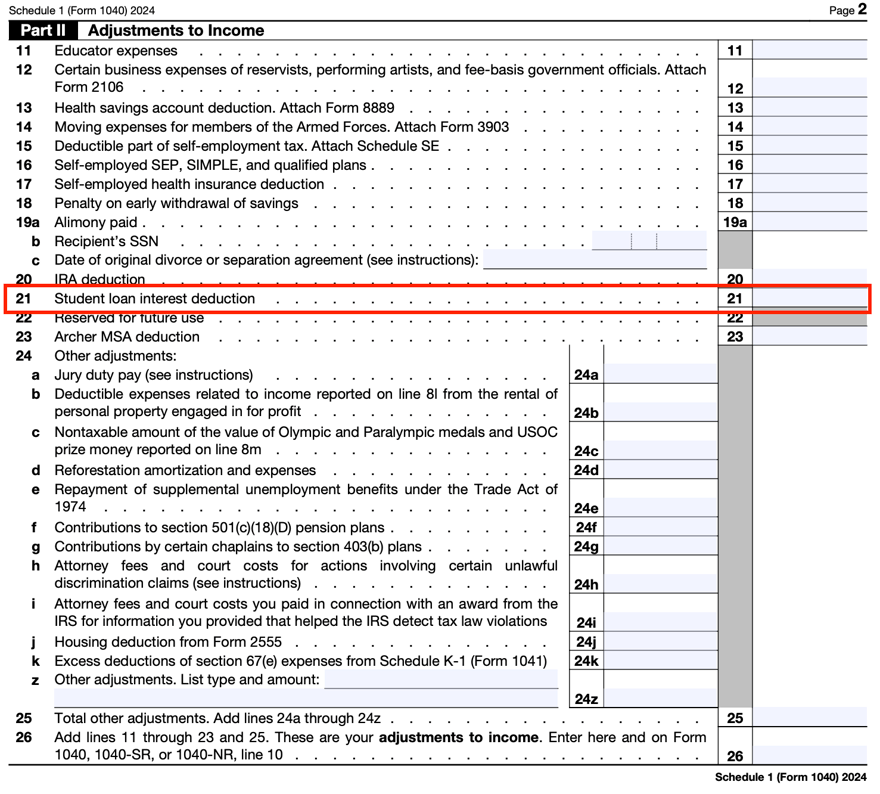
Enter the total on Schedule 1 of Form 1040, in the "Adjustments to Income" section, then carry Schedule 1 to your 1040. You don't attach the 1098-E. Every major tax software package asks for it in the education section and does the phaseout math for you.
How Much The Deduction Actually Saves You
A deduction lowers the income you're taxed on, not your tax bill directly. The savings equal the deduction times your marginal tax bracket.
Take a single borrower earning $50,000 in 2026 who paid $2,500 in interest. After the $16,100 standard deduction, taxable income is $33,900, which sits in the 12% bracket. The $2,500 deduction saves $300. A borrower in the 22% bracket (taxable income over $50,400 single, or $100,800 joint, in 2026) saves $550. Those brackets come from the IRS's 2026 inflation adjustments.
Paid less than $2,500? You deduct what you paid. $1,200 of interest in the 12% bracket is worth $144.
Some taxpayers confuse the deduction with a credit. A credit cuts your bill dollar for dollar. The student loan interest deduction is worth less than the education tax credits available while you're still in school, and it's one of the few tax breaks that helps you after you graduate.
State Taxes
In states that start their return from your federal AGI, the deduction flows through automatically. California conforms to the federal rules, with one exception for military spouses in community-property states, per the Franchise Tax Board's Schedule CA instructions. Check your own state's adjustments schedule; the state income tax overview lists which states have no income tax at all.
Missed It? You Can Amend
If you paid interest in a prior year and didn't claim it, file Form 1040-X. The IRS gives you three years from the date you filed the original return (or two years from when you paid the tax, whichever is later), and 1040-X can be filed electronically. Pull the prior-year 1098-E or a servicer statement before you file it.
Is The Deduction Worth Anything?
$300 to $550 a year is real money, and you should claim every dollar of it. It's also not a reason to borrow. Anyone weighing how to pay for college still comes out ahead with scholarships, grants, and work over debt with a small tax break attached.
The deduction also disappears exactly when interest hurts most. A borrower earning over $100,000 with private loans gets no deduction and has no federal protections to lose. For that borrower, a lower rate is the only lever left.
Frequently Asked Questions
Can I deduct student loan interest if I take the standard deduction?
Yes. It's an adjustment to income on Schedule 1, so it stacks on top of the standard deduction.
Do private student loans qualify?
Yes, if the loan was used solely for qualified education expenses at an eligible school. Interest on a refinanced private loan counts too, as long as the refinance covered only student loans.
I paid less than $600. Can I still deduct it?
Yes. You won't get a 1098-E, but your servicer's site shows the interest paid, and you can request a statement.
Does interest waived under RAP count?
No. Only interest you paid is deductible. The RAP interest subsidy cancels interest before you pay it.
Can I claim it if I'm married filing separately?
No. That's one of the tax costs of filing separately to lower an income-driven payment.
Did the One Big Beautiful Bill change the student loan interest deduction?
No. OBBBA left the $2,500 cap and the phaseout structure alone. It did make the $5,250 employer repayment exclusion permanent, and interest paid with that money can't be deducted twice.
Don't Miss These Other Stories:
Editor: Clint Proctor

Robert Farrington is the founder of The College Investor and is widely recognized as one of the nation’s leading voices on student loan debt and saving for college. He holds an MBA from UC San Diego Rady School of Management and has spent over 15 years researching, writing, and advising on student loans, 529 plans, financial aid programs, and saving and investing for young professionals.
Robert has been featured in the The New York Times, The Wall Street Journal, The Washington Post, NBC News, and Forbes, where he has been a regular personal finance contributor for over a decade. His work combines both professional expertise and personal experience – he successfully navigated his own student loan repayment journey and has helped thousands of readers do the same.
He is committed to making the intersection of personal finance and education transparent and accessible. You can learn more about Robert on the About Page or on his personal site RobertFarrington.com.