Key Points
- Every federal student loan program, including RAP enrollment, IBR, PSLF, and consolidation, is free on StudentAid.gov or through your servicer. Nobody needs to charge you to apply.
- Upfront fees for debt relief sold over the phone are illegal under the FTC's Telemarketing Sales Rule, and posing as the Department of Education violates the FTC's Impersonation Rule.
- If you already paid, change your FSA ID password, revoke any power of attorney, call your servicer, and dispute the charge with your bank or card issuer.
One of the most common questions readers send me is whether a company offering to help with their student loans is legit. If you're asking, something about the pitch probably didn't sit right, and that instinct is usually correct.
Student loan relief companies range from outright fraud to firms charging hundreds of dollars for paperwork you can file yourself in minutes, and the April 2026 FTC action against an alleged student loan debt relief scheme shows the problem is still active. Our running list of top student loan scams tracks the newest ones.
Here's how to judge any company in front of you, what scammers are selling right now, and what to do if you already paid.
Would you like to save this?
How Can You Tell If A Student Loan Company Is A Scam?
A student loan company is almost certainly a scam if it charges before doing any work, asks for your FSA ID login, or tells you to stop paying your servicer. Any one of these is enough to walk away, whether the pitch is about forgiveness or a lower payment. Federal help is free, a point the Federal Student Aid scam warnings make directly.
Watch for these seven warning signs:
- Upfront or monthly fees before results. Charging advance fees for debt relief sold over the phone violates the FTC's Telemarketing Sales Rule.
- Requests for your FSA ID username and password. With your login, a company can change your contact information, your plan, and your servicer communications without you knowing.
- "Stop paying your servicer" or "pay us instead." Missed payments lead to delinquency and default. A legit helper will never route your loan payments through itself.
- Claims of a Department of Education partnership. Private companies don't work for ED. Official-looking seals, "federal" names, and ".gov"-style branding are a classic tell.
- Pressure and deadlines. "Program closing Friday" or "you've been pre-approved for forgiveness" are sales tactics. Real deadlines are posted on StudentAid.gov.
- Unsolicited robocalls, texts, or mailers. Especially ones that already list your balance.
- A power of attorney form. It gives the company legal authority over your federal loan account.
| Signal | Scam | Unnecessary Paid Service | Legitimate Help |
|---|---|---|---|
| Fees | Upfront or monthly fees before any work | Fee for paperwork you can file free | Flat, disclosed fee or free |
| Your FSA ID | Asks for your login | Sometimes asks | Never asks |
| Payments | Tells you to stop paying your servicer | May route payments through them | Tells you to keep paying |
| Government Ties | Claims to work with the Department of Education | Uses official-looking names | States it is independent |
| What You Get | Nothing, or a forbearance | A form you could file yourself | A plan you understand |
What's The Difference Between A Scam And An Unnecessary Paid Service?
A scam takes your money and does nothing, or does something harmful, like parking your loans in forbearance for months while fees pile up. An unnecessary service actually files your paperwork but charges for something that's free, often without checking whether it's the right move for you. Both are bad deals, and the second can still cost you if they file the wrong thing, such as a consolidation that ends your IBR access.
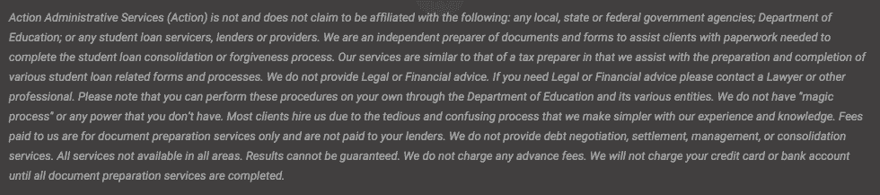
Look for a "document preparation" disclaimer on the company's website. These firms state that they don't give financial advice and only process forms. That's a legal hedge, and it tells you they won't be accountable for whether the forms were right for you. Our post on why you shouldn't pay for student loan consolidation covers these firms in more detail.
What Are Student Loan Scammers Selling In 2026?
Scammers follow the news, and the 2026 rule changes gave them new scripts. Every one of these is free through StudentAid.gov or your servicer, as our rundown of what's changing for student loans in 2026 shows:
- "RAP enrollment" or "new government repayment plan" help. The online RAP application takes about 10 minutes on StudentAid.gov, according to the Department of Education. Our RAP explainer walks through it.
- "SAVE transition" services. Borrowers leaving SAVE choose a new plan themselves. There's no fee and no special program.
- "Parent PLUS deadline" consolidation. The June 30, 2026 window has closed. A new Parent PLUS consolidation now only qualifies for the Tiered Standard Plan, so anyone selling it as a path to income-driven repayment is wrong or lying.
- "Forgiveness" or "loan cancellation" enrollment. There's no broad cancellation program. PSLF and IDR forgiveness require qualifying payments over years.
The FTC case from April 2026 followed this pattern. The operators allegedly posed as the Department of Education or borrowers' servicers, charged up to $1,400 a month in advance fees, collected at least $8.8 million, and told borrowers to stop paying their loans, which pushes people toward default, according to Orrick's summary of the court filing.
How Do You Research A Student Loan Company?
Spend 15 minutes checking a company before you share any information or money. Start by confirming your real servicer, which you can see by logging into StudentAid.gov. Our list of federal student loan servicers shows who's legitimate.
Then check the company itself:
- Search the name plus "complaints" and "FTC." Enforcement actions show up quickly.
- Check the CFPB complaint database for the company name.
- Check your state attorney general and financial regulator. Many states require debt relief companies to be licensed.
- Read the fine print for a document-preparation disclaimer or power of attorney requirement.
- Ask what the fee covers, in writing, and whether it's refundable if nothing changes.
If a company passes all of that, ask yourself whether you need it at all. If what they're offering is a plan enrollment or an application, you can do it yourself for free, starting with our RAP vs. IBR comparison.
Does The Department Of Education Ever Contact You?
Yes. Your servicer contacts you about payments, plan changes, and recertification by mail, email, phone, and text, and the Department of Education sends official notices too. The safe move isn't ignoring every message. It's verifying before you act. The FTC's student loan scam alert puts it simply: the only place to manage federal loans is StudentAid.gov.
Don't click links or call numbers from an unexpected message. Log into StudentAid.gov or your servicer's site directly. If the request is real, you'll see it there. If you suspect someone took out loans in your name, follow our steps for student loan identity theft.
What Should You Do If You Already Paid A Student Loan Company?
Act quickly to lock down your account and try to get your money back.
- Change your FSA ID password on StudentAid.gov and check that your email, phone, and address are yours.
- Call your servicer. Confirm your repayment plan, ask whether anyone changed it or requested forbearance, and remove any third-party authorization.
- Revoke any power of attorney in writing, to both the company and your servicer.
- Stop future payments to the company by contacting your bank or card issuer, and dispute the charges you've already paid.
- Report it to the FTC at ReportFraud.ftc.gov, to Federal Student Aid, and to your state attorney general. File a CFPB complaint too. Our post on filing a complaint against a financial company shows how.
- Get back on a real plan. If your loans were left in forbearance or went delinquent, pick a plan now using our repayment plan comparison.
If the company holds a large amount of your money or damaged your credit, a consumer or student loan lawyer can tell you whether you have a claim.
Where Can You Get Real Help With Student Loans?
Free help comes first. StudentAid.gov handles plan applications, PSLF certification, and consolidation. Your servicer can answer account questions. If you're stuck, the Federal Student Aid Ombudsman Group handles disputes with servicers. Our PSLF eligibility walkthrough and RAP calculator cover the two questions readers ask most.
If you'd rather pay for advice, pay for advice, not paperwork. Student Loan Planner charges a flat consulting fee, builds a plan around your loans, and doesn't take over your account. For private loans, refinancing can lower your rate, and you can compare offers through Credible without a hard credit check.
Bottom Line
Every federal student loan program is free. A company that charges before it does anything, wants your FSA ID, or tells you to stop paying your servicer is a scam, and a company that charges to file a free form is a waste of money at best. Check your real servicer on StudentAid.gov, run any company through the checklist above, and if you've already paid, lock down your account and dispute the charges today. Keep our top student loan scams list bookmarked for new pitches.
Frequently Asked Questions
Is It Illegal For Student Loan Companies To Charge Upfront Fees?
For debt relief services sold over the phone, yes. The FTC's Telemarketing Sales Rule bars companies from collecting fees before they've delivered results. Many state laws add more restrictions.
Can A Company Get My Student Loans Forgiven Faster?
No. Forgiveness depends on federal program rules, such as 120 qualifying payments for PSLF. No private company can speed that up or get you into a program you don't qualify for.
Should I Give A Company My FSA ID?
Never. Your FSA ID is your legal signature for federal student aid. Sharing it lets someone change your plan, contact details, and servicer settings without your knowledge.
How Do I Know Who My Real Student Loan Servicer Is?
Log into StudentAid.gov and look at your loan details. It lists each loan's current servicer and contact information. Only use the contact details shown there.
Can I Get My Money Back From A Student Loan Scam?
Sometimes. Dispute the charges with your bank or card issuer right away, report the company to the FTC and your state attorney general, and keep every receipt and message. FTC settlements sometimes return money to victims, though not always quickly.
Editor: Clint Proctor Reviewed by: Chris Muller

Robert Farrington is the founder of The College Investor and is widely recognized as one of the nation’s leading voices on student loan debt and saving for college. He holds an MBA from UC San Diego Rady School of Management and has spent over 15 years researching, writing, and advising on student loans, 529 plans, financial aid programs, and saving and investing for young professionals.
Robert has been featured in the The New York Times, The Wall Street Journal, The Washington Post, NBC News, and Forbes, where he has been a regular personal finance contributor for over a decade. His work combines both professional expertise and personal experience – he successfully navigated his own student loan repayment journey and has helped thousands of readers do the same.
He is committed to making the intersection of personal finance and education transparent and accessible. You can learn more about Robert on the About Page or on his personal site RobertFarrington.com.