
Key Points
- Both fall 2026 sections of UC San Diego’s MATH 2 (a course covering middle school and early high school material) are full, with 175 students waitlisted.
- Between 61% and 68% of MATH 2 enrollment comes from California’s highest-need high schools, and the campus found that few, if any, students who place into MATH 2 have finished an engineering degree.
- The class carries no degree credit, costing roughly $1,762 in tuition and fees at in-state rates, and every extra quarter of catch-up adds about $6,608 more to the total cost.
Both fall quarter sections of MATH 2 at UC San Diego are full, and 175 students are sitting on waitlists. A screenshot of the campus booking system posted this week to the r/UCSD subreddit shows one 180-seat section at zero availability with 99 waitlisted, and a second 10-seat section with 76 more waiting. That puts roughly 365 incoming students in or chasing a class that awards no degree credit. This aligns with what the college reported last year about collapsing freshman math skills.
MATH 2 sits below precalculus. The UC San Diego course catalog describes it as “Introduction to College Mathematics,” a four-unit class covering linear relationships, exponents and polynomials, rational expressions, and basic geometry and trigonometry. However, most people understand it’s a catch-up class designed to cover math topics generally addressed in Grades 6-12.
Students land there by scoring low on the school’s Math Placement Exam. Since UCSD and other UC schools don’t use standardized tests for admissions, students are required to take a math placement exam before enrollment to truly understand what grade level of math they should be going into. The grade inflation that pushed high school GPAs upward has simply magnified the results of this exam.

Would you like to save this?
Why It Matters
The catalog labels MATH 2 “workload credit only—not for baccalaureate credit,” and is graded pass/no pass. A student takes a full quarter’s course slot, pays the same flat tuition every other freshman pays, and finishes with zero of the 180 units UC San Diego requires to graduate.
This is an extremely expensive way to catch up on basic math skills that should have been addressed well before college enrollment. The more frustrating fact is that many of these students thought they were doing well because of great inflation and expectation set in high school.
This process has become almost predatory because these same students are the ones that direct admission policies and test-optional policies are supposed to “help.” Instead they’re being saddled with thousands of dollars in extra costs.
The Numbers
The campus Academic Senate’s special academic workgroup report put figures behind what UC math faculty have been arguing since last fall:
- MATH 2 launched in 2016 serving under 100 students a year, about 1% of the incoming class.
- Fall 2024 combined MATH 2 and MATH 3B enrollment topped 900 students, 12.5% of the incoming freshman class.
- Fall 2025 held at 921 students, 11.8% of the class, after enrollment management adjustments.
- Freshmen failing to meet high school math standards rose nearly 30x between 2020 and 2025.
- More than 25% of students placed into MATH 2 carried a 4.0 high school math GPA, and the correlation between high school math grades and placement results measured about 0.25.
Roughly one in eight entering students now tests below a high school standard, and more than 70% of that group falls below a middle school standard, per the Inside Higher Ed summary of the report.
On the other side of the equation, UC San Diego received 141,767 first-year applications for fall 2026. It’s statistically impossible that UC San Diego couldn’t find an additional 900 students that were proficient in math. Their admission criteria simply doesn’t sort for it.
Who Ends Up In MATH 2
The workgroup traced placement back to specific feeder schools. In 2021-22, 56% of MATH 2 and MATH 3B enrollment came from LCFF+ high schools (campuses with high concentrations of low-income students, English learners, and foster youth) and that share climbed to between 61% and 68% in the years after.
Those schools, the report notes, “struggle with both availability of higher-level math courses and qualified instructors,” which means a student can take every math class their school offers, earn an A in all of them, and still place years behind (the same college readiness gap districts are now confronting in their own grading policies).
Voice of San Diego created this chart of San Diego High schools that shows the percentage of students passing the class, versus the percentage of students meeting state standards. That gap is the whole issue here:
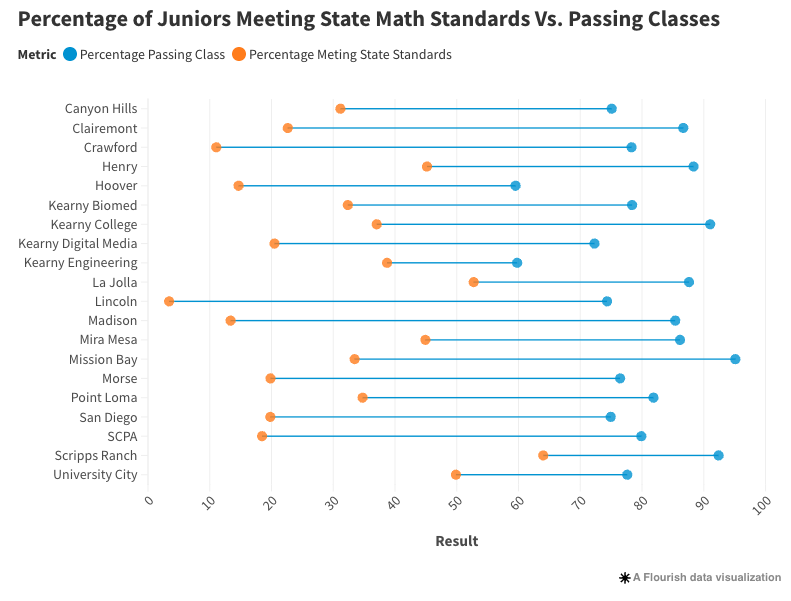
About 36% of UC San Diego’s incoming freshmen are first-generation college students, according to the campus’s Triton Firsts program, and a first-gen student with a 4.0 in math and an acceptance letter from a top public university has no reason to suspect a problem.
But without an SAT or ACT score, nothing in the admissions file flags it. The first signal arrives with the placement exam result, after the deposit is paid and the housing contract is signed.
What It Costs
UC San Diego’s published cost of attendance for California residents for 2026-27 runs $21,519 in tuition and fees and $47,289 all-in for students living in the dorms on campus. Spread across three quarters and the 15 units a term needed to reach 180, that works out to roughly $440 per unit. MATH 2 costs about $1,762 for coursework that moves a student no closer to a degree, not counting any books or supplies needed.
The total costs don’t stop there. Students who start with MATH 2 post D, F, or withdrawal rates of 24.1% in MATH 10A, 30.3% in 10B, and 40.7% in 10C, and 51.8% in MATH 20C for the engineering-track sequence. Meaning they still have a way above-average failure rate in the normal math sequences even after the catch-up course.
Each failed and repeated class costs another term of tuition, and each delayed quarter adds roughly $6,608 in tuition and fees or $14,743 counting housing, food, and living costs. An extra year at the on-campus rate runs $47,289, which is more than the median federal student loan balance most borrowers carry at graduation.
Worse than the delay is the dropout rate. The UCSD workgroup found “few, if any students who place into Math 2 have successfully completed an engineering degree,” and flagged longer times to degree across the group.
Students who leave with student loan debt and no credential are the worst outcome group of borrowers. They have the financial consequences of the debt, but they don’t get the financial benefits of the degree.
How This Connects
UC went test-optional in 2020, but over the last two years, there’s been a massive debate on whether standardized testing should be re-instated for admissions. EdSource reported that 1,427 faculty (including seven of UC’s nine math department chairs) signed a letter asking the system to require the SAT or ACT for STEM applicants, a push humanities faculty later joined.
Meanwhile, nationwide most applicants are submitting scores again even where nobody asks, and the list of colleges reinstating requirements keeps growing.
What’s Next
UC’s Board of Admissions convened a work group in June 2026 to study a return to testing, with an Academic Senate recommendation due by June 2027 and a Board of Regents vote after that.
If testing returns, the earliest affected cycle would be fall 2028, meaning current high school sophomores. Families weighing whether to sit for the SAT should watch that timeline rather than today’s test-optional policies. Any student headed to college should fully understand their own academic ability to gauge their potential success against the financial cost of dropping out.
Editor: Colin Graves

Robert Farrington is the founder of The College Investor and is widely recognized as one of the nation’s leading voices on student loan debt and saving for college. He holds an MBA from UC San Diego Rady School of Management and has spent over 15 years researching, writing, and advising on student loans, 529 plans, financial aid programs, and saving and investing for young professionals.
Robert has been featured in the The New York Times, The Wall Street Journal, The Washington Post, NBC News, and Forbes, where he has been a regular personal finance contributor for over a decade. His work combines both professional expertise and personal experience – he successfully navigated his own student loan repayment journey and has helped thousands of readers do the same.
He is committed to making the intersection of personal finance and education transparent and accessible. You can learn more about Robert on the About Page or on his personal site RobertFarrington.com.