
Key Points
- Average GPAs are rising, but test scores are not, signaling widespread grade inflation.
- Parents and colleges are increasingly misled by inflated grades, undermining accountability and preparedness.
- Standardized testing is making a return as grades lose value, and policymakers are being urged to restore grading rigor.
Grade inflation has been quietly reshaping American education. The idea of grade inflation is that teachers are giving students higher grades for same (or lower) quality of work than prior years. There are many causes, from school and state policies to parental pressure, but the end result is clear: An "A" today is not the same as an "A" was 10 to 20 years ago.
Since the Covid-19 pandemic, schools have reported sharp increases in average grades even as test scores drop. In 2021, ACT test-takers posted the lowest scores in over a decade while recording the highest GPAs ever. Even students in the 25th percentile of ACT performance logged GPAs over 3.0.
In high school math, the average adjusted GPA climbed from 3.02 in 2010 to 3.32 in 2022, according to ACT. These numbers suggest a B+ average even as national readiness in math continues to decline. English, science, and social studies have seen similar patterns, though math has the steepest inflation.
What was once an occasional concern among educators has grown into a systemic issue. A Fordham Institute study using North Carolina data revealed that students with B grades in Algebra I often failed the related end-of-course exams. In the years since, the trend has only accelerated.
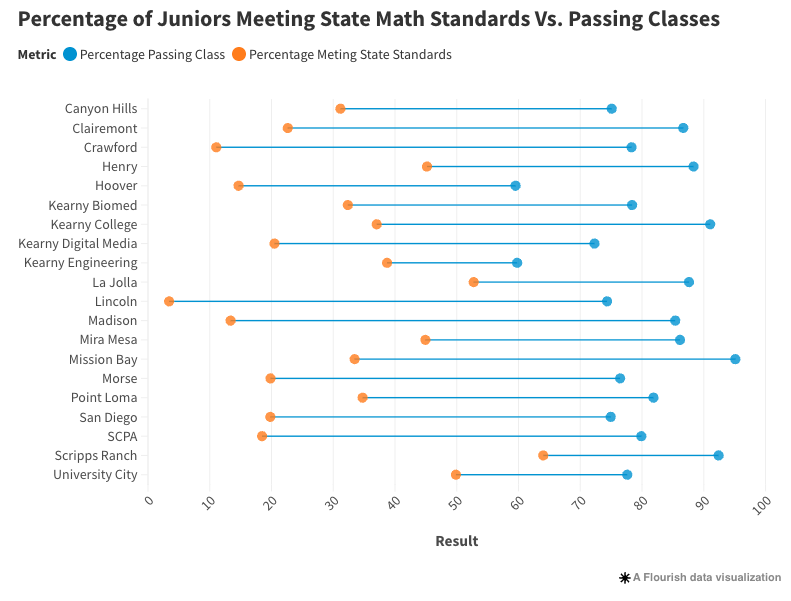
Another study by Voice of San Diego looked at San Diego area high school grades, and compared them to how many student's passed the state proficiency exam. The gap is troubling:
Would you like to save this?
Why Grades Don't Tell The Full Story
Grades have long been a touchstone for parents trying to assess their children’s academic progress. But as GPAs climb and learning outcomes stagnate, the disconnect grows. A joint report by TNTP and Learning Heroes found that around 80% of parents say their kids bring home mostly A's and B's, despite widespread pandemic-era learning loss.
The misleading comfort of inflated grades may limit access to support. If students in under-resourced schools are getting good grades that don’t match actual performance, they may not receive the tutoring or help they need. A 2023 study in North Carolina found that after more lenient grading was introduced, lower-performing students were more likely to miss school, a signal that engagement may drop when standards are loosened.
The bottom line is that if everyone get's an A, what's does an A really mean? And does your child actually know the material? And will this prepare them to be successful in the future?
What Happens When No One Fails
Since the early 2000s, the policy push toward "no child left behind" has encouraged schools to prioritize grade advancement over content mastery. Combined with more recent pressures to soften grading policies, such as allowing late work without penalty or assigning minimum grades of 50% for missed assignments, the result is that failure has become rare.
Yet removing the threat of failure can also remove the motivation to improve. Economists David Figlio and Maurice Lucas found that students assigned to lenient elementary school teachers learned less and did worse later on. In high school, students taught by easy graders in Algebra I performed worse in later math classes.
Inflated grades also contribute to broader economic concerns. Employers relying on GPAs may overestimate the skills of recent graduates, leading to frustration, retraining costs, and mismatches in hiring. If students graduate underprepared, the workforce suffers.
Standardized Tests Regain Traction
As grade inflation erodes the usefulness of GPA, some colleges are turning back to standardized tests. A 2024 study of elite colleges found that SAT and ACT scores are now stronger predictors of academic success than GPA. This reversal comes after many schools moved to test-optional admissions during the pandemic.
The resurgence of testing is driven by concerns that grade compression, when most students receive similar high grades, makes it harder to distinguish applicants. With few students getting C's or lower, an A tells less than it used to. While some education experts have defended grade inflation as a way to build student confidence, others worry it rewards underperformance and diminishes incentives.
Policymakers are being called upon to set boundaries. ACT CEO Janet Godwin said in 2023 that grade inflation is "systemic" and must be addressed beyond the classroom. Dr. Edgar Sanchez, the author of the ACT study, warned that GPAs are becoming a less reliable measure of readiness for college or the workforce.
What Families Need To Know
Families sending their children to college should understand that not all A's reflect the same level of learning. Grades alone may no longer offer a clear picture of readiness for college-level work. When comparing schools or preparing college applications, families should consider how GPA compares with standardized test scores and whether their student has been challenged in rigorous courses.
Schools can help by using external benchmarks, such as end-of-course exams or state and national assessments, to provide a more complete view of achievement. Parents should ask whether schools offer this kind of data and request it alongside grades.
Policy changes matter too. Some grading reforms, like removing extra credit or enforcing deadlines, can support higher expectations when used consistently. Others, such as inflating minimum grades or removing accountability, may do more harm than good.
Grade inflation affects more than college admissions. It shapes how students study, how parents support their learning, and how well they’re prepared for life beyond school. For families, staying informed and asking questions about how grades are assigned is one way to make sure that letter grades still reflect something real.
Don't Miss These Other Stories:
Editor: Colin Graves

Robert Farrington is the founder of The College Investor and is widely recognized as one of the nation’s leading voices on student loan debt and saving for college. He holds an MBA from UC San Diego Rady School of Management and has spent over 15 years researching, writing, and advising on student loans, 529 plans, financial aid programs, and saving and investing for young professionals.
Robert has been featured in the The New York Times, The Wall Street Journal, The Washington Post, NBC News, and Forbes, where he has been a regular personal finance contributor for over a decade. His work combines both professional expertise and personal experience – he successfully navigated his own student loan repayment journey and has helped thousands of readers do the same.
He is committed to making the intersection of personal finance and education transparent and accessible. You can learn more about Robert on the About Page or on his personal site RobertFarrington.com.