
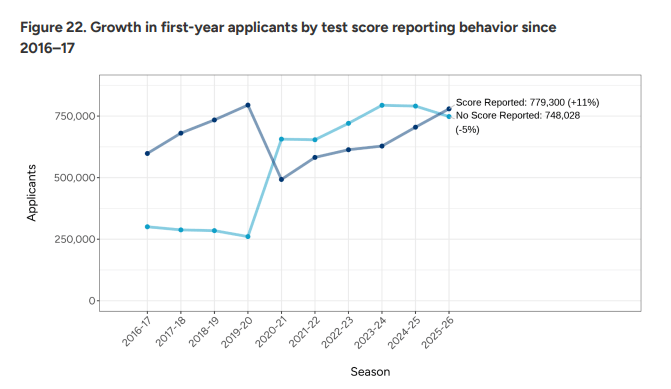
For the first time since the 2019-20 admissions cycle, more Common App applicants submitted a standardized test score than didn’t.
Common App’s End-of-Season Report for 2025-26 shows 779,300 first-year applicants reported an SAT or ACT score (up 11% from last season) while 748,028 applied without one (down 5%). That’s a reversal of the pattern that has held since Covid upended college entrance exams six years ago.
The reversal happened without colleges forcing it. Only 5% of Common App’s 1,146 member institutions actually required a test score to submit an application in 2025-26. That figure was 4% in 2023-24, an all-time low, and roughly 55% back in 2019-20 before COVID-19 disruptions pushed all but 11% of members to drop their testing requirements. Ninety-five percent of member colleges still don’t ask for a score. Students are sending them anyway.
Would you like to save this?
Why It Matters
Test-optional was never test-blind, and savvy college applicants appear to have figured out the difference.
At a school that accepts but doesn’t require scores, a strong test score is a free data point that can separate an application from thousands of similar ones and what colleges actually weigh in admissions. This has accelerated in an era of grade inflation.
When roughly half your competition submits a test score, you start to fall behind if you don’t.
What The Data Actually Shows
A few details worth noting from the headline:
- Test reporters grew, non-reporters shrank. The 11% jump in score reporters came alongside a 5% decline in non-reporters, meaning this wasn’t just growth in the applicant pool. Total applicants rose only 2%, to 1,527,328. Students actually moved from one column to the other.
- The movement is small. 779,300 versus 748,028 is a margin of about 31,000 out of 1.5 million applicants, or roughly 2 percentage points. This is a crossover, but it will be interesting to see if this trend continues this year.
- Every subgroup moved the same direction. Common App notes that across first-generation status, underrepresented minority status, fee waiver eligibility, and ZIP-code income, score reporting grew faster than non-reporting, even in the groups that still report test scores at lower rates overall.
- Test requirements are coming back. The share of colleges requiring a test increased from 4% to 5%. Small in absolute terms, but it’s the first move upward in this metric since the pandemic.
How This Connects
Over the last several years, we’ve seen a wave of highly selective schools start bringing back testing requirements for admissions.
All eight Ivy League institutions, plus Stanford and Caltech and a growing list of large publics, now require or strongly recommend test scores for fall 2027 admission — including the entire Florida and Georgia public university systems, the University of Tennessee system, UT Austin, and more.
Dartmouth moved first in early 2024, Princeton followed in October 2025, and Columbia reverted last. The visibility of those names appears to have done more to reset student behavior than any formal policy change across the other 95% of the platform, since the reasoning colleges gave for ending test-optional travels far beyond the campuses that actually changed their rules.
There’s a second force at work: application volume. Common App applicants now submit an average of 7.06 applications each, up from 4.73 a decade ago. Rising application counts are a major reason acceptance rates keep falling at selective schools without those schools becoming meaningfully harder to get into.
In a large pool of applicants, a test score is one of the few remaining signals that’s standardized across every high school in the country. Colleges are simultaneously stripping out other differentiators; Georgia Tech, UNC, Tulane and Miami all cut supplemental essays for the 2026-27 cycle, leaving fewer places for a student to make a case.
What This Means For Families
The practical read for a high school senior is to take the tests. Sit for the SAT or ACT at least once, then compare the result against each target school’s published middle-50% range before deciding where to send it. A score above a school’s median helps, while a score below it is better left unsent at a school that doesn’t require one.
Understanding what counts as a good SAT score is school-specific, not absolute, and the same number can be an asset at one campus and a liability at the next.
Families should also budget for the test itself, and for prep. Both the College Board and ACT offer fee waivers to income-qualified students, and free and low-cost prep options exist alongside the expensive ones.
What’s Next
Watch the 5% figure of colleges requiring test scores. If the share of Common App colleges requiring scores climbs again for 2026-27, the current student-led shift becomes a formal reversal.
Common App’s Deadline Update series returns in mid-November with month-by-month data for the new season, which will show whether the score-reporting crossover holds or was a one-year blip.
Editor: Colin Graves

Robert Farrington is the founder of The College Investor and is widely recognized as one of the nation’s leading voices on student loan debt and saving for college. He holds an MBA from UC San Diego Rady School of Management and has spent over 15 years researching, writing, and advising on student loans, 529 plans, financial aid programs, and saving and investing for young professionals.
Robert has been featured in the The New York Times, The Wall Street Journal, The Washington Post, NBC News, and Forbes, where he has been a regular personal finance contributor for over a decade. His work combines both professional expertise and personal experience – he successfully navigated his own student loan repayment journey and has helped thousands of readers do the same.
He is committed to making the intersection of personal finance and education transparent and accessible. You can learn more about Robert on the About Page or on his personal site RobertFarrington.com.