Key Points
- More than a dozen cities, unions, and nonprofits have sued the Department of Education over a rule that could let the Secretary disqualify certain public employers from the Public Service Loan Forgiveness program.
- The plaintiffs argue the rule is unlawful and politically motivated, accusing the Trump Administration of targeting employers whose missions it opposes.
- The lawsuit, filed in Massachusetts federal court, seeks to preserve the bipartisan promise of PSLF for workers at all government and 501(c)(3) nonprofit employers.
A coalition of major U.S. cities, labor unions, and nonprofit organizations filed a lawsuit (PDF File) Monday against Education Secretary Linda McMahon and the Department of Education, accusing the Trump Administration of turning a student loan forgiveness program into a political weapon.
The complaint, filed in the U.S. District Court for the District of Massachusetts, seeks to strike down a new rule redefining what counts as a “qualified employer” under the Public Service Loan Forgiveness (PSLF) program. The plaintiffs say the change violates federal law and the First Amendment by allowing the Education Department to cut off debt relief to workers at public or nonprofit institutions that the administration disfavors.
The plaintiffs include the cities of Boston, Chicago, Albuquerque, San Francisco, and the County of Santa Clara, along with leading labor unions such as the American Federation of Teachers, AFSCME, and the National Education Association. National advocacy groups (the National Council of Nonprofits, the National Association of Social Workers, and several legal aid and immigrant rights organizations) joined the case, represented by Protect Borrowers and Democracy Forward.
Their key issue is simple: the new rule, they argue, gives the federal government unchecked authority to punish employers based on political ideology.
"ED’s PSLF rule is an illegal attempt to weaponize the federal government against its own people” - Persis Yu, Managing Counsel at Protect Borrowers
Would you like to save this?
What The New PSLF Rule Would Do
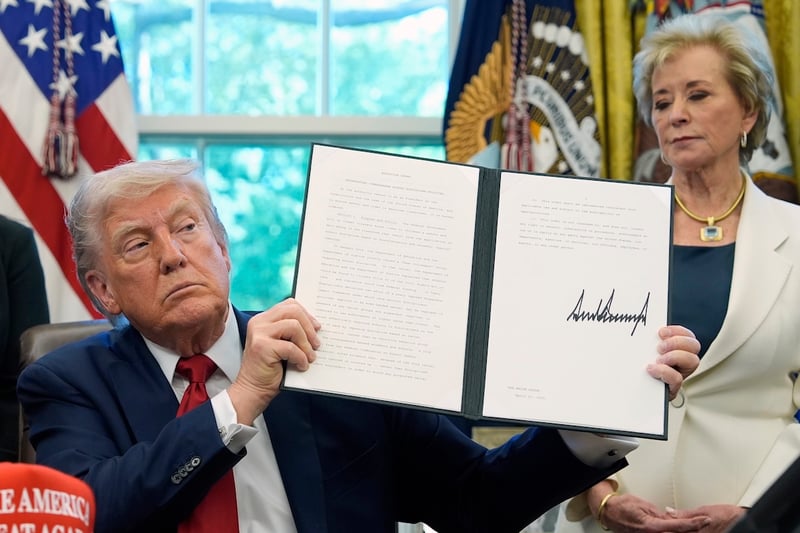
The rule at the center of the dispute stems from a March 2025 executive order titled “Restoring Public Service Loan Forgiveness.” It authorizes the Education Department to exclude any government or nonprofit employer that “engages in activities with a substantial illegal purpose.”
The regulation lists several examples of such activity:
- Aiding violations of federal immigration law
- Supporting terrorism
- Engaging in child abuse or illegal discrimination
- Violating state laws against public disorder
The administration framed the change as a way to prevent taxpayer funds from subsidizing what it called “anti-American activists.” But critics say the language is so vague that it could be used to target sanctuary cities, immigrant-rights nonprofits, or health providers offering gender-affirming care - all entities already singled out by the administration.
Under the final rule, published October 31, 2025, an employer could lose PSLF eligibility if it fails to certify that it does not engage in such activities, or if the Secretary independently determines that it does. Disqualification would last for ten years.
The Department claims the regulation improves “program integrity,” but plaintiffs say it directly contradicts the Higher Education Act, which explicitly defines all government and 501(c)(3) nonprofit employers as qualifying employers, without exception.
History of Public Service Loan Forgiveness
Congress created PSLF in 2007 with support from both parties to help borrowers burdened by student debt pursue careers in teaching, health care, social work, and public safety - jobs that often pay less than private-sector work. Borrowers who make 120 qualifying payments while working full-time for a government or nonprofit employer can have the remainder of their federal loans forgiven.
According to Education Department data, more than one million borrowers have already received over $70 billion in loan forgiveness since the program began, including hundreds of thousands of teachers, nurses, firefighters, and city workers.
Plaintiffs argue the new rule upends that structure by injecting politics into what had been a neutral, categorical standard. The law, they note, was written to encourage service “at any government or 501(c)(3) employer”—not at those deemed acceptable by whoever occupies the White House.
The complaint asserts that the Department “has no authority to investigate or strip an employer’s eligibility” and that the rule is “arbitrary, capricious, and contrary to law.”
The Legal Case Challenging The PSLF Rule
The 78-page complaint lays out several claims under the Administrative Procedure Act and the U.S. Constitution. It argues that the Department’s rule exceeds its statutory authority under the Higher Education Act, violates free-speech protections by targeting disfavored viewpoints, and denies due process by introducing vague and subjective standards.
The plaintiffs also point to procedural flaws in how the Department conducted rulemaking - compressing public negotiations into three days before the July 4 holiday, merging stakeholder groups, and dismissing nearly 14,000 public comments opposing the proposal.
According to the filing, the Department offered no evidence of PSLF-eligible employers engaged in “illegal activity” and ignored congressional letters warning that it lacked authority to rewrite the program’s eligibility criteria.
The suit also alleges a broader pattern of political retaliation by the administration against nonprofit and local government entities that oppose its policies on immigration, civil rights, and public protest.
In comments filed during the rulemaking process, the City of Albuquerque cautioned that losing PSLF eligibility “would likely create an untenable staffing crisis,” as employees might leave for eligible employers rather than risk their debt-forgiveness prospects. Nonprofits echoed those fears, saying the uncertainty alone could make recruitment harder in sectors like education, health care, and social services.
The National Association of Community Health Centers wrote that PSLF “is vital to the physicians and staff who provide care to nearly 34 million Americans” and that removing eligibility could push workers out of primary care roles, worsening shortages.
For nonprofits operating on tight budgets, PSLF has long been a critical benefit used to attract and retain staff. Without it, the lawsuit argues, many organizations could lose experienced employees or be forced to offer higher pay they cannot afford.
What Happens Next?
The lawsuit asks the court to vacate the rule and restore the prior PSLF definition, which has remained largely unchanged since 2008. Because the rule was finalized on October 31, it is set to take effect on July 1, 2026 unless the court issues a preliminary injunction. It's important to realize that the rule would only impact borrowers moving forward - it does not retroactively revoke any eligible qualifying payments.
If the lawsuit is successful, the case could reaffirm the original, categorical approach to PSLF eligibility and determine whether future administrations can alter that promise through executive rulemaking.
The case, National Council of Nonprofits et al. v. McMahon, underscores how deeply student loan policy has become entangled with national politics. For millions of borrowers in public service, the outcome could decide whether their debt relief depends on the work they do - or the administration in power.
Don't Miss These Other Stories:
Editor: Colin Graves

Robert Farrington is the founder of The College Investor and is widely recognized as one of the nation’s leading voices on student loan debt and saving for college. He holds an MBA from UC San Diego Rady School of Management and has spent over 15 years researching, writing, and advising on student loans, 529 plans, financial aid programs, and saving and investing for young professionals.
Robert has been featured in the The New York Times, The Wall Street Journal, The Washington Post, NBC News, and Forbes, where he has been a regular personal finance contributor for over a decade. His work combines both professional expertise and personal experience – he successfully navigated his own student loan repayment journey and has helped thousands of readers do the same.
He is committed to making the intersection of personal finance and education transparent and accessible. You can learn more about Robert on the About Page or on his personal site RobertFarrington.com.