
Key Points
- Sticker prices rarely include visas, health coverage abroad, currency swings, program surcharges, and weekend travel that can add thousands to a semester.
- Direct enrollment can lower tuition, while third-party providers often bundle housing and support at a higher total cost. Financial aid rules vary by program type.
- Careful pretrip budgeting for fees, flights, local transport, and foreign card charges helps families avoid last-minute borrowing.
A semester abroad can look affordable on a brochure. Then the extras show up. Program fees often cover tuition and sometimes housing, yet families quickly face spending that is not obvious at sign-up: passport and visa applications, required health insurance, residence permits, course materials, local transit, foreign transaction fees, and the cost of a last-minute flight home if plans change.
Typical budgets vary widely by destination and program model. Third-party providers that arrange housing and logistics often quote total semester prices between about $15,000 and $22,000, depending on location.
Direct enrollment at a foreign university can be much cheaper on the tuition line, ranging from a few hundred dollars per semester in parts of Europe to well over $10,000 in places like Australia and New Zealand. The tradeoff is support. Families taking the direct route typically have to handle their own tasks such as housing, course registration, and visas.
Financial aid can lower costs, but not in every scenario. Financial aid is more likely to flow to exchange or direct-enroll programs tied to your home university’s academic year. Aid is often limited for short winter or summer sessions. And it's important to note that study abroad may not always be a qualifying 529 plan expense.
Many third-party programs charge higher fees and may not accept federal aid in the same way your campus exchange does, so the net price depends on the structure your student chooses.
Would you like to save this?
Average Study Abroad Costs
Across popular destinations, budgets vary based on program type and local prices. Africa and Ocean have some of the highest prices, while Western Europe and South America has some of the lowest prices.
Region | Tuition Cost (Per Semester) | Living Costs Per Month |
|---|---|---|
Western Europe | $1,500 - $7,000 | $1,200 - $2,000 |
Asia | $2,000 - $7,000 | $1,300 - $2,200 |
Africa | $2,000 - $4,000 | $800 - $1,100 |
Central America | $1,500 - $3,000 | $800 - $1,400 |
South America | $200 - $3,000 | $500 - $950 |
Oceania | $10,000 - $13,000 | $500 - $2,900 |
Western Europe
In Western Europe, direct-enroll tuition often ranges from about $1,500 - $7,000 per semester (Italy, Spain, France), while third-party providers commonly list $11,000 - $21,300 with housing.
Asia
Asia can be cheaper on tuition: China direct enrollment runs roughly $2,000 - $7,000 each semester, while Japan lists $1,500 - $5,000 and provider programs span $7,500 - $26,000.
Africa
In Africa, South Africa direct tuition is about $2,000 - $4,000 with provider options at $15,000 - $19,500. Ghana direct ranges $2,500 - $3,500 and providers $18,500 - $19,850.
Central America
Central America is mixed: Costa Rica direct sits near $1,500 - $3,000 (providers $8,500 - $11,500) while Belize direct is $1,000 - $3,000 (providers $18,000 - $23,000).
South America
South America shows wide spreads: Argentina direct tuition can be as low as $200 - $3,000, with providers $14,000 - $17,500 while Brazil direct is $1,000 - $5,000 (providers $7,000 - $19,500).
Oceania
Oceania stands at the high end: Australia direct tuition is typically $10,000 - $13,000 per semester and $17,000 - $23,500 with providers. New Zealand direct tuition is $8,000 - $12,500, providers $15,500 - $21,000. Round-trip flights add hundreds to thousands based on distance, and monthly living costs can range from about $500 - $2,900 depending on city and country.
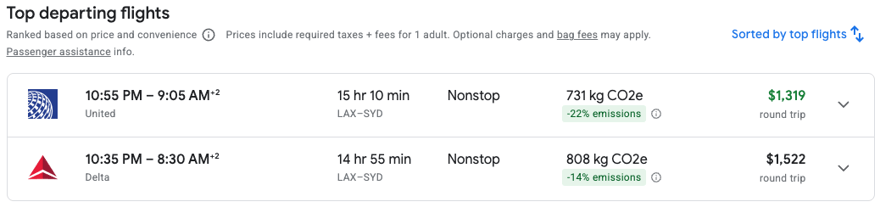
Just look at the cost of some of these flights from Los Angeles to Sydney:
Budget Busters Families Overlook
Beyond the tuition and fees, here are some other "hidden" costs families need to take into consideration.
Travel documents and permits. A new U.S. passport costs money and time. Many countries require student visas or residence permits with separate fees and in-person appointments. Some visa systems are low cost, while others can be several hundred dollars. Add transportation to a consulate if one is not nearby.
Insurance requirements. Programs and universities abroad frequently require emergency health coverage, and some countries charge national health surcharges for visiting students. Travel insurance is optional, yet many families purchase it for trip delays or cancellations.
Flights and weekend trips. One round-trip flight is only the start. Students often plan side trips to neighboring cities or countries. Extra airfare, trains, lodging, and food can double travel spending. Build an emergency fund in case a return home is needed on short notice.
Local living costs. Even when tuition is low, a city’s rent, groceries, and transit can be high. Some third-party programs include housing, while direct enrollment usually does not. Textbooks, studio or lab fees, and course supplies add to the total.
Banking and currency. Cards with foreign transaction fees typically add around 2-3% to every purchase. Exchange rate moves can push food and transit costs up or down week to week. A plan that looks affordable today can strain a budget if the dollar weakens.
University and program add-ons. Schools may charge administrative fees for study abroad. Programs can offer optional excursions, cooking classes, or cultural activities at extra cost. These are easy to accept one by one and hard to decline once abroad.
Program Structure Matters
Families face two main program paths.
Third-party provider. These programs tend to include housing and offer step-by-step support for visas, class registration, and arrival. That convenience shows up in the total price. A typical semester with a major provider often sits near the upper end of the range. Financial aid may not transfer in full, so confirm with your campus office.
Direct enrollment or exchange. Tuition can be much lower, and aid from your home university may remain in place during the academic year. The student, however, manages logistics. Savings on tuition can be offset by a high local cost of living. In a few countries, public university tuition is very low for international students, but fees still apply and big-city rents can be steep.
Short-term programs during breaks can look cheaper because they are brief. However, financial aid is often limited for these short programs, so the out-of-pocket share can be higher.
How To Avoid Overpaying
Now that you know the costs and the potential hidden fees, here's some tips to avoid overpaying on your semester abroad.
Price the whole semester, not just tuition. Build a line-by-line budget: program fee, housing if not included, round-trip airfare, passport and visa costs, required health insurance, local transport pass, books and supplies, phone plan, groceries, and an emergency flight home. Add a buffer for exchange rate moves.
Match aid to the program. Confirm with your financial aid office whether federal and institutional aid will apply to a given program, and in what amount. Aid often follows you to exchange or direct-enroll options during the standard academic year. Scholarships for study abroad exist, but each has specific eligibility rules and deadlines.
Pick the right card and bank setup. Consider a debit or credit card with no foreign transaction fees and an ATM strategy that avoids repeated small withdrawals. Notify banks about travel dates to reduce fraud flags.
Set limits on optional travel. Agree in advance on a monthly cap for weekend trips and dining out. Budget one or two larger excursions rather than many smaller ones that add up.
Plan for paperwork. Start passports and visas early to avoid expedited processing costs and extra trips to consulates. Keep digital copies of documents in a secure folder.
Compare models with total cost in mind. Third-party providers offer convenience that can be worth paying for in higher-cost or complex destinations. Direct enrollment can be a bargain where tuition is low, provided you are ready to handle logistics. But if you've never travelled abroad before, it might be nice to have a company handle the details.
Studying abroad can still fit a family budget with thoughtful planning. The decision is not only about the headline fee. It is about all the smaller bills that arrive between the welcome email and the flight home.
Final Thoughts
Families can keep study abroad affordable by pricing the entire semester before committing. Tally tuition by program type, add housing if not included, and build real figures for visas, insurance, local transit, books, a basic phone plan, and at least one emergency flight home.
Confirm how financial aid applies to each option, pick a no-foreign-fee card, and set simple caps on weekend trips. With a full budget and clear rules of the road, a semester abroad can be both memorable and manageable.
Don't Miss These Other Stories:
Editor: Colin Graves

Robert Farrington is the founder of The College Investor and is widely recognized as one of the nation’s leading voices on student loan debt and saving for college. He holds an MBA from UC San Diego Rady School of Management and has spent over 15 years researching, writing, and advising on student loans, 529 plans, financial aid programs, and saving and investing for young professionals.
Robert has been featured in the The New York Times, The Wall Street Journal, The Washington Post, NBC News, and Forbes, where he has been a regular personal finance contributor for over a decade. His work combines both professional expertise and personal experience – he successfully navigated his own student loan repayment journey and has helped thousands of readers do the same.
He is committed to making the intersection of personal finance and education transparent and accessible. You can learn more about Robert on the About Page or on his personal site RobertFarrington.com.