
Key Points
- We tested ChatGPT, Grok, Perplexity, Copilot, and Google Gemini to see how well they answered “What’s the best student loan?” and found the results varied in clarity and completeness.
- All models emphasized federal loans first but often left out important context, such as borrowing limits or the financial need requirement for Direct Subsidized Loans.
- While Google Gemini provided the clearest explanation, no AI model delivered a fully accurate and thorough answer for a family making real borrowing decisions.
When families weigh their options for paying for college, the question “What’s the best student loan?” seems straightforward. But as we learned after asking five leading AI models (ChatGPT, Grok, Perplexity, Copilot, and Google Gemini) the answers can be incomplete, sometimes unclear, and occasionally misleading.
Each tool offered a broad framework: start with federal loans, then consider private loans if needed. Yet critical details were often missing.
In some cases, explanations failed to note that Direct Subsidized Loans require demonstrated financial need. None clearly spelled out federal borrowing limits, an omission that could leave families unprepared if federal aid runs short. Or even specific scenarios or borrowing order (such as borrow the student's Direct Loan first, then supplement with Private or Parent PLUS Loans).
Last year, we discovered that Google's AI was getting financial answers incorrect 43% of the time.
When it comes to student loan recommendations, the results were better, but there were still key misses in an areas where policy change, interest rates vary, and borrower protections shift frequently.
Would you like to save this?
What We Asked And How The Models Responded
The question we posed to each model was simple: “What is the best student loan?” We wanted to see whether the tools could guide a prospective borrower toward the most cost-effective and smartest choice while covering the full range of relevant considerations.
The results were mixed. We gave each answer a rating (Good, Average, Poor) based on what it got right, what it got wrong or missed, and if the answer had any factual errors.
ChatGPT
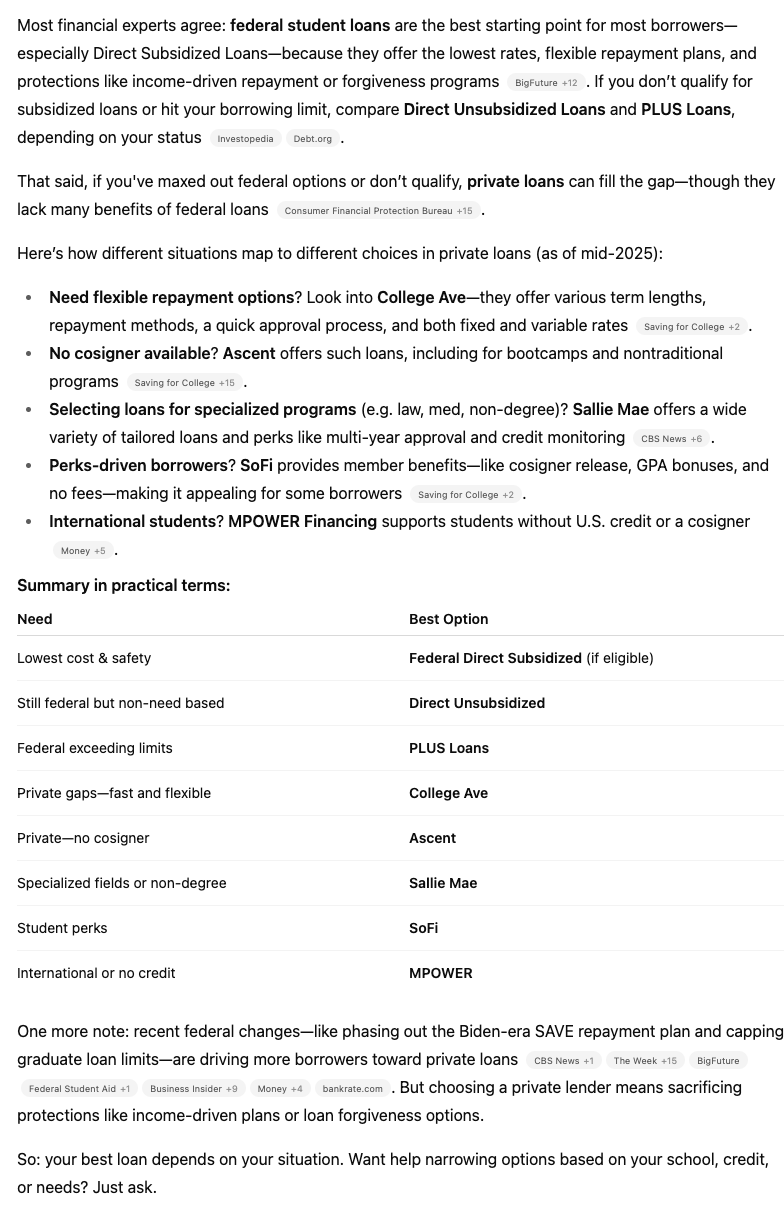
ChatGPT gave a broad overview, identifying federal Direct Subsidized Loans as the starting point and mentioning options like Direct Unsubsidized, PLUS, and private loans from lenders such as College Ave, Ascent, Sallie Mae, SoFi, and MPOWER. It offered lender recommendations by borrower type but didn’t explain the need requirement for subsidized loans or outline borrowing limits. And the "different situations" piece all map to private lenders...
Rating: Average
What It Got Right: Federal student loans are the best starting point.
What It Missed: It doesn't share that Direct Subsidized Loans require a financial need. It also doesn't share that Unsubsidized loans have a low cap. It doesn't mention the changes to PLUS Loans at all - and doesn't reference Parent PLUS or Grad PLUS (it doesn't distinguish between undergraduate and graduate school).
Factual Errors: No real errors, but it ends with "Just Ask" - who are you supposed to ask?
Perplexity
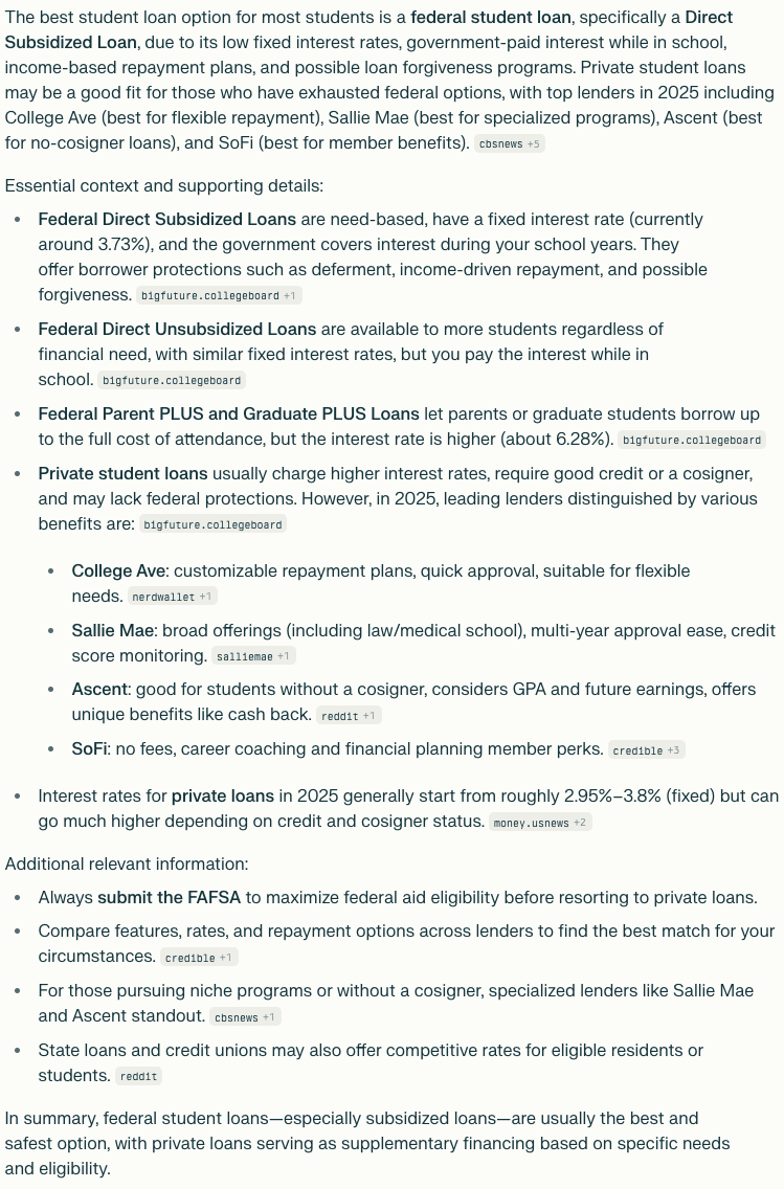
Perplexity provided a more detailed explanation of federal loan types and interest rates, along with a breakdown of private lender strengths. It noted that federal loans generally have lower rates and more protections but still missed a direct acknowledgment of the need requirement for subsidized loans.
Rating: Poor
What It Got Right: Federal student loans are the best option for most students.
What It Missed: It doesn't share that subsidized loans require a financial need. It also doesn't provide any real "order of operations" or guide for families. Just jumps from Direct Subsidized Loan to private loans.
Factual Errors: The federal Direct Subsidized Loan interest rate is 6.39% (not 3.73% as it mentions). Parent PLUS and Grad PLUS loans are 8.94% (not 6.28%).
Grok
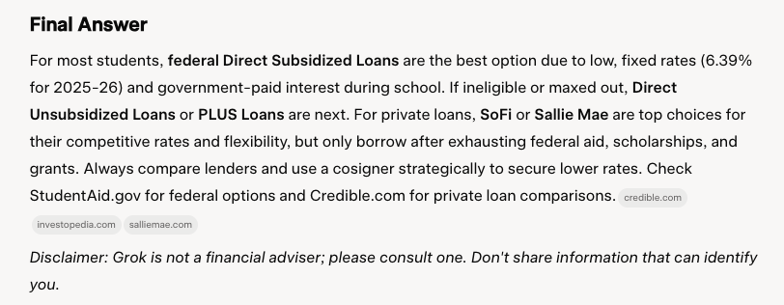
Grok did a lot of reasoning and had a huge output, but we liked that it gave a "final answer". And that answer was generally correct - even giving an order of operations for families to consider.
It touched on strategy, such as using a cosigner for better rates, but left out any discussion of loan caps or when the order of operations would come into play.
Rating: Good
What It Got Right: Federal student loans are the best option and it got a decent order of operations.
What It Missed: It only recommends two private lenders (SoFi and Sallie Mae) and doesn't really elaborate why.
Factual Errors: None
Copilot
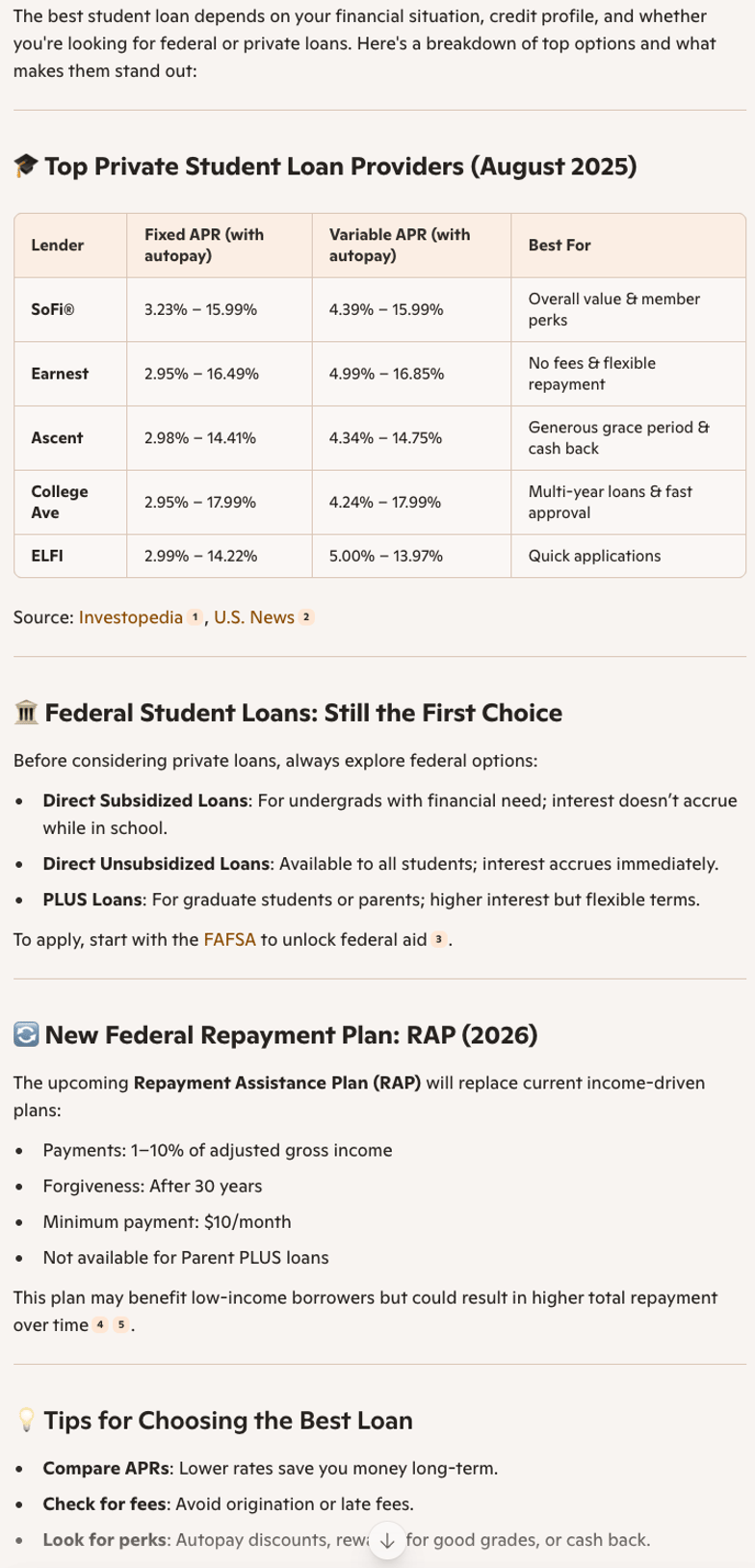
Copilot started their output with "top options" that was basically a private student loan lender table. Only then does it go back to "explore federal options". It followed it up by an unrelated section about the new Repayment Assistance Plan (RAP) launching in 2026 - but that's not a relevant answer to the question.
Rating: Poor
What It Got Right: It got the details about the federal loan programs correct.
What It Missed: It led with private student loans, it didn't mention when you should consider which type of loan, and it provided a section about a student loan repayment plan that doesn't go into effect yet.
Factual Errors: No factual errors, but a poor output.
Gemini
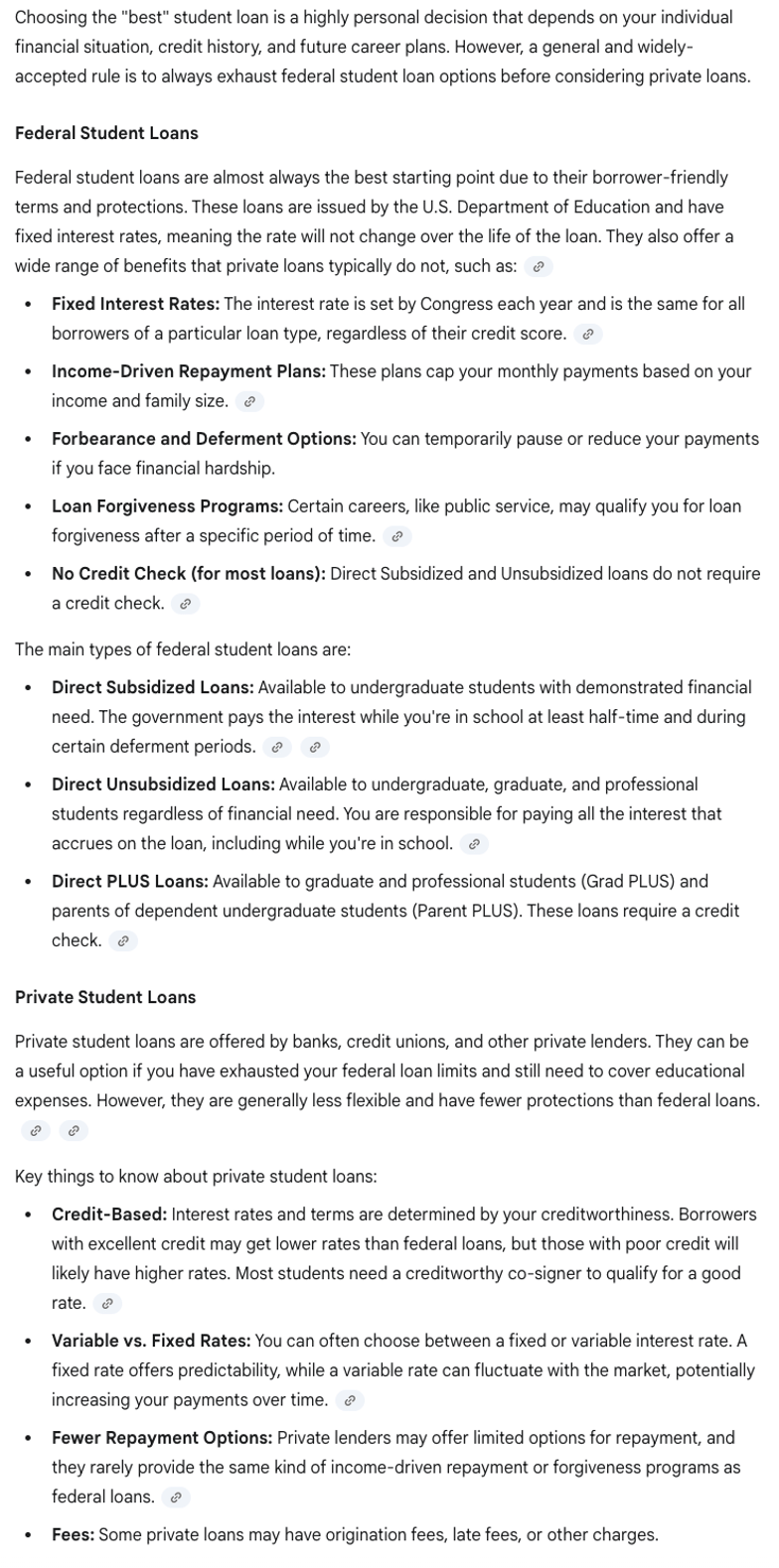
Google Gemini delivered the most organized answer - and even though it hedged itself on loan choices being personal, it still highlighted that federal student loans should be considered first. It correctly defined Direct Subsidized Loans as need-based and highlighted key benefits like fixed rates, income-driven repayment, and student loan forgiveness programs.
Still, it didn’t mention federal borrowing caps, which can be a deciding factor in whether private loans are necessary.
Rating: Good
What It Got Right: It provided a good rule about using federal student loans first before private loans.
What It Missed: It didn't highlight the loan caps on Federal loans, or the potential upcoming changes to federal student loan options that may make private loans more attractive.
Factual Errors: None
What Is The Correct Answer?
All five models agreed that federal loans should be the first stop for most students, and for good reason: they offer fixed interest rates, income-driven repayment plans, deferment and forbearance options, and potential forgiveness programs.
Within that category, Direct Subsidized Loans are generally the most borrower-friendly because the government pays the interest while the student is in school at least half-time and during certain deferment periods. But they are only available to undergraduates with demonstrated financial need.
That distinction matters. A student who assumes they’ll qualify for a subsidized loan without applying for federal aid could be caught off guard when the offer doesn’t arrive. Likewise, the absence of any mention of annual and aggregate loan limits leaves families unaware that even if they qualify for federal loans, they may still face a gap in their financing plan.
Anyway, for undergraduates, the correct answer every time is:
- Borrow the Direct student loan first (whether subsidized or unsubsidized) up to the loan limit
- Then look at either Parent PLUS or Private student loans
The Parent PLUS vs. Private student loan debate is very nuanced - and the battle is shifting more towards private student loans after the One Big Beautiful Bill Act was signed.
Where Do Private Student Loans Fit In?
Once federal options are exhausted, private loans may be necessary to close the gap between aid and the total cost of attendance. This is where the AI models diverged most in their recommendations.
Some focused on specific lenders (pulling generic quotes from their marketing):
- College Ave for fast approval and flexible terms
- Ascent for students without a cosigner
- Sallie Mae for specialized programs like law or medical school
- SoFi for borrower perks such as career coaching
- MPOWER Financing for international students without U.S. credit history
Others gave general tips, such as comparing APRs, checking for fees, or choosing between fixed and variable interest rates. But none mentioned that interest rates for private loans can vary widely (from under 3 percent for well-qualified borrowers to double-digit rates for those with weaker credit) or that repayment options are typically less flexible than federal programs.
Some mentioned lack of forgiveness programs - but all the AI options were basically scraping "best private student loan" lists.
What About Upcoming Policy Changes?
Several models briefly referenced upcoming federal loan changes, such as the phase-out of the SAVE repayment plan and new RAP Plan. One briefly mentioned how these changes could push more borrowers toward private loans, but couldn't tell you why.
It was also obvious that the models couldn't distinguish between Parent PLUS Loans (which continue forward with new caps) and Grad PLUS Loans (which are being eliminated).
Finally, while most highlighted deferment and forbearance as options, none discussed the big changes coming with deferment and forbearance programs.
Bottom Line On AI Student Loan Recommendations
While AI models can deliver a quick overview, they are not a substitute for a complete student loan strategy. All five tools correctly identified federal loans as the safest starting point. But key omissions (from borrowing limits to eligibility requirements) could lead a family to overestimate how much federal financial aid will cover, or misunderstand when private loans become necessary.
A borrower who used AI advice as their sole resource might end up with an incomplete plan, particularly if they didn’t cross-check the details with the Federal Student Aid website or a financial aid officer.
As with most AI-generated content, the information is only as good as the prompt, the model’s training (what websites they stole their content from and when it was last checked), and the user’s ability to fact-check. But that last part is hard: if a user doesn't have knowledge of a subject, it becomes increasingly difficult to fact-check.
At the end of the day, borrowers looking for student loans should focus on tools and experts and brands that have deep knowledge in the space, and are known experts. Not AI tools.
Editor: Colin Graves

Robert Farrington is the founder of The College Investor and is widely recognized as one of the nation’s leading voices on student loan debt and saving for college. He holds an MBA from UC San Diego Rady School of Management and has spent over 15 years researching, writing, and advising on student loans, 529 plans, financial aid programs, and saving and investing for young professionals.
Robert has been featured in the The New York Times, The Wall Street Journal, The Washington Post, NBC News, and Forbes, where he has been a regular personal finance contributor for over a decade. His work combines both professional expertise and personal experience – he successfully navigated his own student loan repayment journey and has helped thousands of readers do the same.
He is committed to making the intersection of personal finance and education transparent and accessible. You can learn more about Robert on the About Page or on his personal site RobertFarrington.com.