Key Points
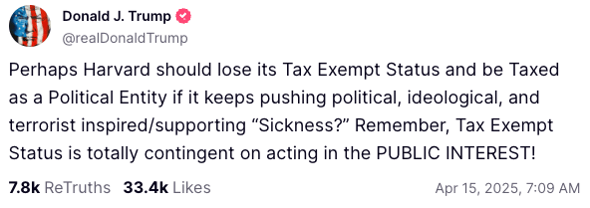
- President Trump has publicly called for Harvard’s nonprofit status to be revoked, accusing the university of ideological bias and refusing federal demands.
- Federal law prohibits the president or executive branch from directing the IRS to audit or investigate a specific taxpayer, including a university.
- The IRS can revoke tax-exempt status, but it must follow an extensive legal process involving audits, documentation, and opportunities for appeal.
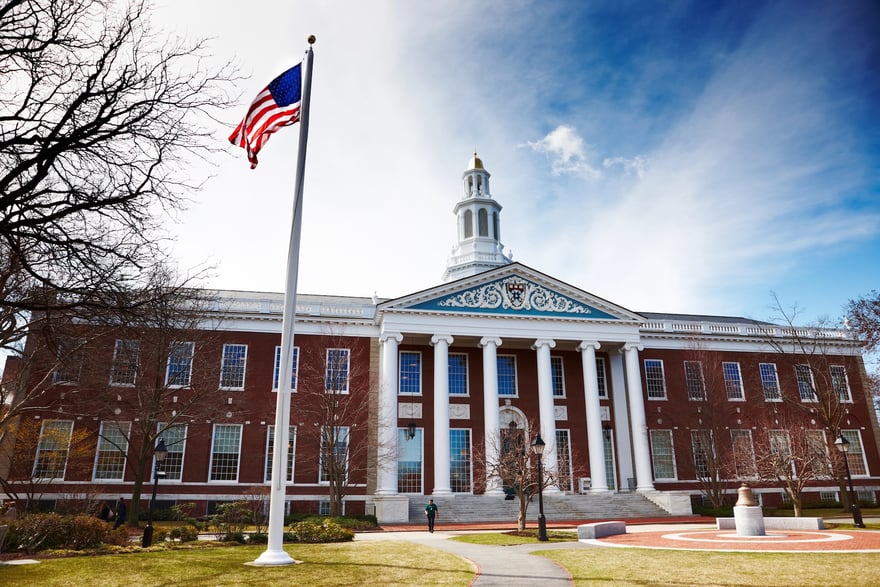
The battle between Harvard University and the Trump Administration escalated again this week, after the university refused to comply with the administration's demands last week.
After Harvard declined to comply with demands from the Trump administration to release hiring and admissions data and cancel its diversity programs, the president suggested publicly that the university’s nonprofit status should be rescinded. Now, reports indicate the Internal Revenue Service is reviewing the matter.
Whether the president can actually make that happen is another story.
What The Law Says About Presidential Influence Over The IRS
Under U.S. law, the IRS is supposed to operate independently from political pressure. A specific statute (26 U.S. Code § 7217) explicitly bans members of the executive branch, including the president, from directing or influencing taxpayer audits or investigations. Any such request must be reported to the Treasury Inspector General.
26 U.S. Code § 7217 - Prohibition on executive branch influence over taxpayer audits and other investigations
(a)ProhibitionIt shall be unlawful for any applicable person to request, directly or indirectly, any officer or employee of the Internal Revenue Service to conduct or terminate an audit or other investigation of any particular taxpayer with respect to the tax liability of such taxpayer.
The law exists to keep public trust in the fairness of the tax system. If taxpayers believe audits can be ordered for political reasons, that trust could erode. During the Obama administration, the IRS was sharply criticized for delaying tax-exempt status for conservative groups. Those events sparked congressional hearings and long-term damage to the agency’s reputation.
In this case, while Trump has publicly called for action against Harvard, whether there’s been an official internal directive remains unknown. Even if the IRS initiates an investigation, it must follow due process.
How The IRS Can Revoke Tax Exempt Status (And Why It's Rare)
Harvard is a 501(c)(3) nonprofit, like most U.S. colleges and universities. That status gives it broad exemptions from federal income tax and makes it eligible to receive tax-deductible donations. In exchange, it must not endorse political candidates, engage in substantial lobbying, and must show that it serves the public interest.
The IRS can revoke tax-exempt status, but it rarely happens. And when it does occur, that only happensafter a thorough investigation.
Past cases have taken years and often start with an audit or public records review. A famous example is Bob Jones University, whose tax-exempt status was revoked in the 1980s because of racially discriminatory admissions policies. That case reached the U.S. Supreme Court, where it eventually lost it's non-profit status.
In order to even revoke a tax exempt status, the IRS would have to audit Harvard and find that its actions violate the rules governing 501(c)(3) organizations.
Even then, if it loses its audit it would be entitled to a legal challenge, including a possible hearing before the U.S. Tax Court and appeals through the federal court system. This entire process would take months, if not years, before it could be resolved. In the example of Bob Jones University, the IRS started the process in 1970 with an official notice to the university, and it was finally resolved by the Supreme Court in 1983 - an almost 13 year process.
There is no known precedent of the IRS revoking a university’s tax exemption (or any other organization's) in direct response to public statements by a president.
It Would Be Hard To Prove Harvard Doesn't Qualify
The administration’s claim rests on the argument that Harvard is no longer acting in the public interest and is instead advancing a political or ideological agenda. But courts have generally held that academic freedom allows universities to determine their curricula and faculty without government interference.
Higher education institutions must report their finances and activities to the IRS annually through a tax return just like every other entity. Unless the school is actively violating the rules (such as endorsing candidates or engaging in illegal conduct) a revocation would be difficult to justify.
While the president and his allies have expressed outrage over specific hires and diversity programming, such practices do not automatically violate IRS rules. Most nonprofit universities operate independently and make academic decisions without federal input. Political disagreements, even heated ones, have not historically been grounds for tax status changes.
Harvard, like other large private universities, has an endowment of over $50 billion and receives some federal research funding. Losing tax-exempt status would affect not only the institution’s tax obligations, but also its eligibility for federal dollars and philanthropic support.
In Trump's first term, he signed into law a 1.4% excise tax on endowment income for wealthier institutions. Today, he's looking to increase that endowment tax to 14%.
What's Next?
This is not only a challenge to Harvard, but a warning to other colleges. There are over 60 colleges currently being targeted by the administration, including Columbia University which has already agreed to some changes.
Any effort to single out one university, particularly in response to criticism, is likely to face judicial scrutiny. The IRS, while housed within the Treasury Department, has traditionally been insulated from political interference. If that firewall is weakened, the consequences could extend beyond higher education.
Don't Miss These Other Stories:
Editor: Colin Graves

Get the latest financial news and actionable insights.
How it works:
- 1Enter your email and subscribe.
- 2Get the latest personal finance and education news delivered every week.
- 3Take control of your finances with real insights.
- 4We won't spam you, ever!

Robert Farrington is the founder of The College Investor and is widely recognized as one of the nation’s leading voices on student loan debt and saving for college. He holds an MBA from UC San Diego Rady School of Management and has spent over 15 years researching, writing, and advising on student loans, 529 plans, financial aid programs, and saving and investing for young professionals.
Robert has been featured in the The New York Times, The Wall Street Journal, The Washington Post, NBC News, and Forbes, where he has been a regular personal finance contributor for over a decade. His work combines both professional expertise and personal experience – he successfully navigated his own student loan repayment journey and has helped thousands of readers do the same.
He is committed to making the intersection of personal finance and education transparent and accessible. You can learn more about Robert on the About Page or on his personal site RobertFarrington.com.