If you're looking to fill out an IRS Form W-4 to change your withholding, we break it down below. This is the form you fill out when you're first hired at a job, or if you want to change the amount of taxes taken out of your paycheck each month.
If you're starting a job, or finding yourself getting a huge tax refund each year - you likely want to adjust your W-4 withholding amount so that you can be accurately paid.
Here’s what you need to know about the form, so you can fill it out correctly.
What Is the Form W-4?
Whenever you start a new job, you’ll be expected to fill out a Form W-4. This form tells your employer how much money to withhold from your paycheck. The withheld money is sent straight to the IRS and your state or local revenue department to pay your income taxes.
The IRS has figured out that it collects more tax revenue when it collects money throughout the year instead of relying on people to pay a huge tax bill at the end of the year.
It’s important to note that the Form W-4 only applies to people who have a standard employer. If you’re a contractor, freelancer, small business owner, etc., you’ll need to file and pay quarterly tax estimates on your own.
After you fill out the W-4, your employer withholds a set amount of taxes based on a few different variables. The variables you can’t control include the amount you earn from that employer and whether you file as single, married filing separately, or jointly. The variables you can control include the number of allowances you select (we’ll explain this later, but more allowances means fewer taxes are withheld) and whether you ask to have more taxes withheld.
How Do I Fill Out the Form W-4?
Filling out the first bit of the Form W-4 is easy. Simply enter your name, Social Security status, and your marital status.

Source: Internal Revenue Service
Unfortunately, the easy bit is up, and the complicated bit starts when you get to Step 3.
This is where you simply enter the amount of children you have, since this is one of the most common tax credits.
How Should I Fill Out Step 4?
If you have two jobs or other deductions beyond the standard deduction, you need to fill out Step 4.
You can add in your "extra income" in Line 4(a) that isn't being taxes - this could be side hustle income like driving for Lyft. You can also add in extra deductions on Line 4(b), but this isn't very common since almost 90% of taxpayers claim the standard deduction.
An easier way to "balance" out your taxes is to simply write an amount in Line 4(c) - Extra Withholding. This is any amount you want to simply pay the IRS extra each paycheck.
How this comes in handy is if you know that you owe the IRS roughly $3,000 each year when you file your taxes, you cold simply write $115 extra per pay period (assuming you're paid every two weeks). That would close the gap you owe the IRS.
Checking Your Withholding Online
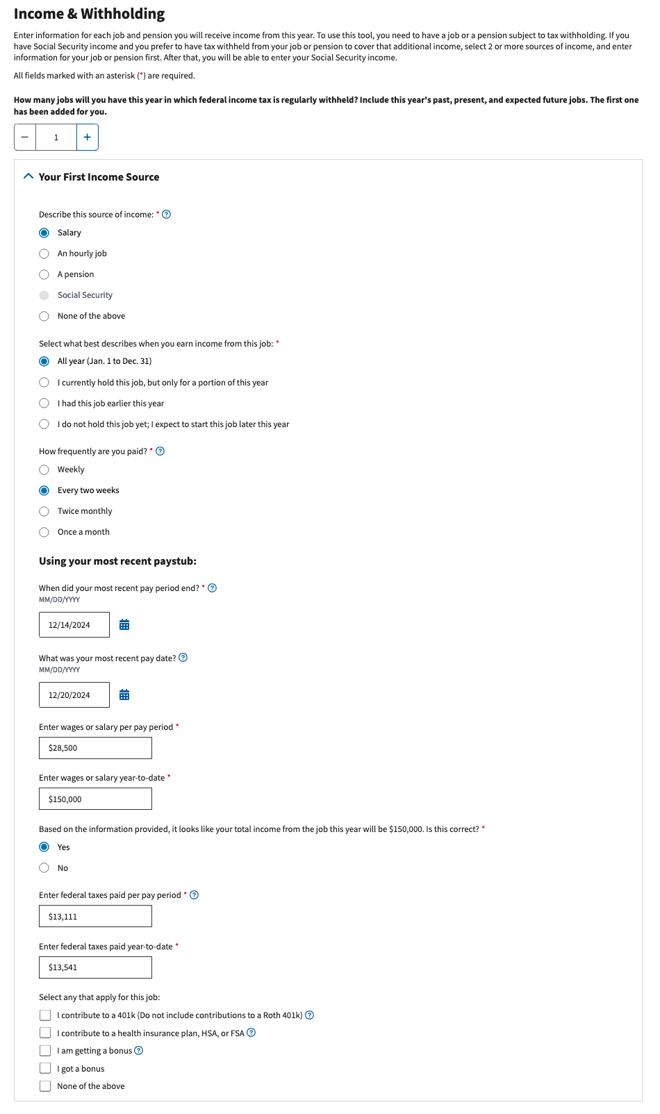
If you want to check your taxes, I recommend using the IRS Withholding Calculator to do the math for you. This can really help you understand what you're claiming and how much taxes you might owe (or get back as a refund).
It's pretty easy to do. The first step asks you about your income:
Source: Internal Revenue Service
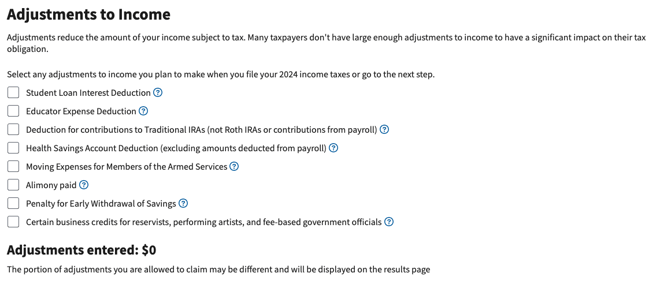
Then you enter your information about any adjustment to income. Some common ones here are student loan interest deduction and Health Savings Account deductions.
Source: Internal Revenue Service
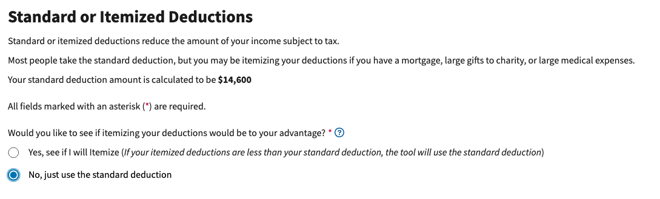
Next you select whether you're taking the Standard Deduction or itemizing your return. About 90% of people will take the Standard Deduction.
Source: Internal Revenue Service
Finally, you claim any additional tax credits you might have.
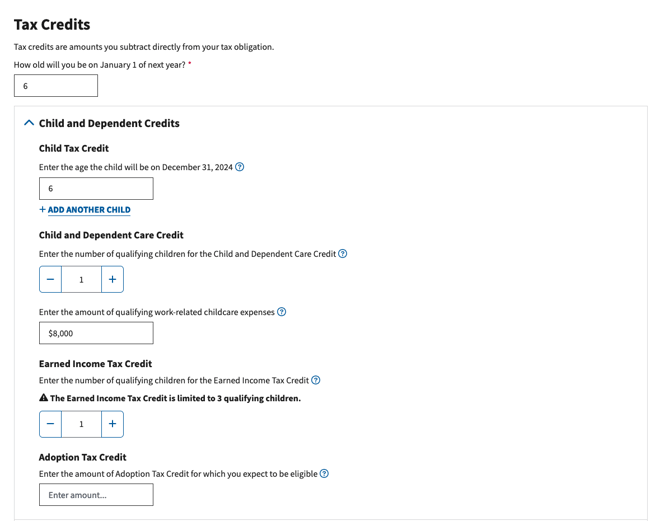
Source: Internal Revenue Service
The end result is that you can get a solid estimate of what you've paid in taxes, what you may owe in taxes, and then you can adjust your withholding appropriately.
What About State Tax Withholdings?
If you have a state income tax, and you have taxes withheld from your paycheck, you can also adjust your withholding. Each form is slightly different based on the state you're in, but the principles are the same.
Most states also allow you to add extra "flat" dollar amount withholdings if that's easier.
Bottom Line
Filling out the W-4 correctly will help you avoid over- or under-withholding. Personally, I think using the IRS calculator is the way to go. It streamlines the process. That said, filling out the W-4 by hand may give you a few good ideas on how you can reduce your tax burden, so you have more money to save and invest.
Editor: Clint Proctor Reviewed by: Chris Muller

Get the latest financial news and actionable insights.
How it works:
- 1Enter your email and subscribe.
- 2Get the latest personal finance and education news delivered every week.
- 3Take control of your finances with real insights.
- 4We won't spam you, ever!

Robert Farrington is the founder of The College Investor and is widely recognized as one of the nation’s leading voices on student loan debt and saving for college. He holds an MBA from UC San Diego Rady School of Management and has spent over 15 years researching, writing, and advising on student loans, 529 plans, financial aid programs, and saving and investing for young professionals.
Robert has been featured in the The New York Times, The Wall Street Journal, The Washington Post, NBC News, and Forbes, where he has been a regular personal finance contributor for over a decade. His work combines both professional expertise and personal experience – he successfully navigated his own student loan repayment journey and has helped thousands of readers do the same.
He is committed to making the intersection of personal finance and education transparent and accessible. You can learn more about Robert on the About Page or on his personal site RobertFarrington.com.