Key Points
- The Senate HELP Committee advanced a bill designed to block the Education Department from transferring four offices (special education, postsecondary, elementary and secondary, and Indian education) to other federal agencies.
- The bill leaves out the Office for Civil Rights and Federal Student Aid, meaning student loans and civil rights enforcement could still be moved.
- HELP Chairman Bill Cassidy opposes the bill and the House is moving 10 bills in the opposite direction, so S. 5046 faces long odds at 60 votes even with three Republican backers.
A bipartisan group of senators is moving to block at least some of the Trump administration's effort to dismantle the Department of Education.
The Senate Health, Education, Labor and Pensions Committee approved S. 5046 on Thursday by a 13-9 vote, sending it to the full Senate. The bill, introduced July 21 by Sen. Tim Kaine (D-Va.) with Sens. Susan Collins (R-Maine) and Lisa Murkowski (R-Alaska), would bar the Education Secretary from offloading four of the department's offices onto other agencies.
This comes a little more than two weeks after House Republicans sought to make the dismantling permanent with a series of 10 bills completely removing nearly all functions of the Department of Education.
Would you like to save this?
What The Bill Would Do
S. 5046 prohibits the Education Department from entering into (or carrying out) interagency agreements covering four offices:
- Office of Special Education and Rehabilitative Services (OSERS)
- Office of Postsecondary Education
- Office of Elementary and Secondary Education
- Office of Indian Education
These are the same kinds of arrangements the department used to shift special education oversight to HHS and civil rights enforcement to DOJ in June.
The prohibition reaches grant-making, technical assistance, grantee monitoring, data collection, and enforcement tied to those offices. It overrides the Economy Act, the 1932 statute the administration has leaned on to let one agency contract work out to another. It also blocks a workaround: the department can't shuffle a program to a different internal office and then hand that office's work to another agency.
Agreements in effect on Feb. 1, 2025, are grandfathered in, along with renewals carrying substantially similar terms.
Two key areas the bill doesn't touch: the Office for Civil Rights and the Office of Federal Student Aid. That means the Department of Education could still move student loans to Treasury, and Civil Rights to Justice.
By The Numbers
Since May 2025, the Education Department has signed 14 interagency agreements with six other federal agencies, moving large pieces of K-12 and higher education administration outside the building, all while the department's own inspector general found it had cut 40% of its staff.
The committee also approved an amendment from Sen. Patty Murray (D-Wash.) requiring the department to report what those agreements cost. Murray said the department has already paid more than $1 million to implement a single agreement with the Labor Department, the same agency House Republicans want running TRIO and GEAR UP.
What They're Saying
You can watch the full session here, but a quick breakdown is below:
Kaine said he wrote the bill to preserve "really core components" of the agency, adding that he left out other functions he wanted covered in order to reach bipartisan agreement quickly. It's a narrower approach than the one Senate Democrats took when they called the Treasury student loan transfer illegal last year.
Collins said the agreements the bill targets "are misaligned with their program purposes." On the HHS agreement covering special education, she said it "fundamentally misunderstands the history and intent of the special education program, which was created in 1975 to ensure that children with disabilities receive a free and appropriate public education."
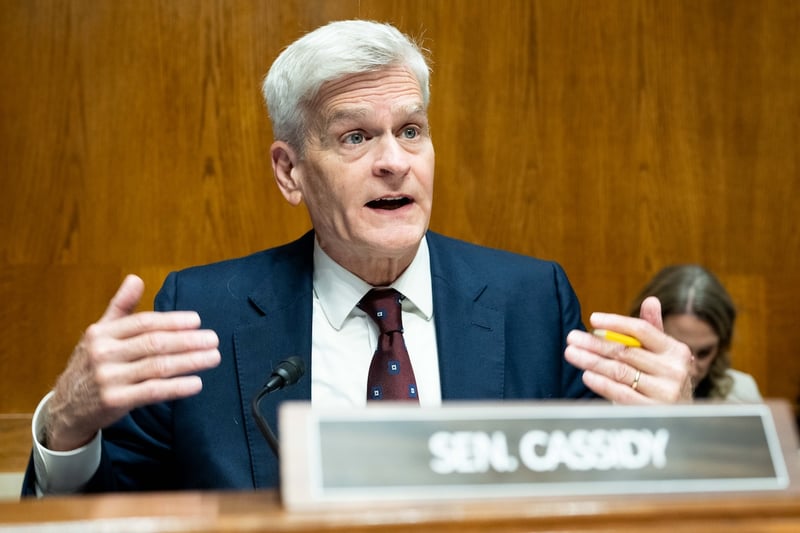
HELP Chairman Bill Cassidy (R-La.) said he won't support the bill because he doesn't object to every agreement it would unwind. "I do think the administration should be allowed to pilot how to address inefficiencies and the potential for efficiencies by operationalizing these IAAs," Cassidy said, an efficiency argument that runs into the practical costs of moving programs around Washington.
He does oppose the HHS-OSERS agreement, and had drafted a narrower bill covering only that one. He pulled it after S. 5046 covered the same ground.
McMahon defended all 14 agreements in a letter to congressional leaders Thursday, writing that "misconceptions have circulated" and that the agreements "have demonstrated measurable results by driving stronger grant competitions, streamlining government operations, and producing better outcomes for Americans." She made a similar case to House lawmakers in May.
How This Connects
The Senate bill runs counter to the House of Representatives' 10-bill package would codify most of the same transfers and go further, sending statutory responsibility for federal student loans, Pell Grants, FAFSA, and Public Service Loan Forgiveness to Treasury.
Interagency agreements can move who does the work, but they can't rewrite what Congress assigned to the Education Department, which is why 7.8 million borrowers already dealing with Treasury as their debt collector still fall under Education Department law. The House bills would change the law itself. The Senate bill seeks to block or prevent some of those changes. The disagreement make make any of it impossible to execute.
Don't Miss These Other Stories:

Robert Farrington is the founder of The College Investor and is widely recognized as one of the nation’s leading voices on student loan debt and saving for college. He holds an MBA from UC San Diego Rady School of Management and has spent over 15 years researching, writing, and advising on student loans, 529 plans, financial aid programs, and saving and investing for young professionals.
Robert has been featured in the The New York Times, The Wall Street Journal, The Washington Post, NBC News, and Forbes, where he has been a regular personal finance contributor for over a decade. His work combines both professional expertise and personal experience – he successfully navigated his own student loan repayment journey and has helped thousands of readers do the same.
He is committed to making the intersection of personal finance and education transparent and accessible. You can learn more about Robert on the About Page or on his personal site RobertFarrington.com.