
Where can you find the least expensive colleges in 2026? With college sticker prices still climbing year after year, finding cheap schools matters more than ever for students trying to graduate without crushing debt.
If you're shopping for college (or helping someone who is), the math gets ugly fast. Average published price at a four-year public school has more than doubled since the 1990s, and the all-in bill at most four-year schools now tops $25,000 once you add room and board.
The good news: there are still genuinely cheap places to earn a four-year degree. Some are tuition-free. Others charge $1,000 a year for in-state students. Below is an updated list of the 10 cheapest U.S. colleges by published in-state tuition for the 2025-26 academic year, plus what you should know before you apply.
Would you like to save this?
The Average Cost Of College
Most people assume that the cost of attending college has risen over time, but unless you look closely, you might not realize just how expensive it is today.
Here's a look at the cost of tuition and room and board for a four-year public university over the past three decades, as compiled by The College Board:
- 1992-93 Academic year — $12,190
- 2002-03 Academic year — $15,770
- 2012-13 Academic year — $22,790
- 2022-23 Academic year — $23,520
- 2023-24 Academic year — $24,030
- 2024-25 Academic year — $29,910
As you can see, the cost of tuition and room and board nearly doubled during the past 20 years. If you look at tuition and fees alone, we've seen nearly a 2.5x increase at four-year universities (from $4,870 to $11,610).
And private four-year sticker tuition averages around $43,350
Related: College Savings Statistics
What's Included In The Cost Of College?
Sticker price isn't the same as what you actually pay for college. The total cost of attendance includes tuition, mandatory fees, room and board, textbooks, transportation, and personal expenses. Schools also separate published price (the sticker) from net price (what you owe after grants and scholarships are applied).
That distinction matters. A school with a $50,000 sticker can end up cheaper than a $15,000 sticker school after financial aid. But for students who don't qualify for need-based aid, the published tuition is the number that sets the upper bound on what you'd owe.
Regardless of the costs, going to college can be worth the investment. It is true that both bachelor's degree graduates as well as those that graduate with a higher degree will earn more on average over their lifetimes than someone with just a high school diploma. Still, a lot of that depends on what field you're looking at going into and your own specific personal and financial situation.
Another consideration is that even though college graduates might make more money over their lifetimes, that comes with a cost, and money spent now is worth more than money you might make over the next 30 or 40 years. It's best to calculate your own expected ROI for college to decide if college is right for you.
How To Find The Cheapest Colleges And Universities
A few patterns hold up across the cheapest schools in the country:
- In-state public schools: are almost always the lowest-cost path. State residents at public universities pay a heavily subsidized rate funded by state taxpayers. The only thing to watch out for is the cost of room and board.
- Work colleges: such as Berea College and College of the Ozarks cover tuition entirely in exchange for student labor (typically 10-15 hours per week).
- Religiously affiliated schools: sometimes charge below-market tuition for members of the sponsoring church. The BYU schools are the prominent example, with LDS members paying roughly half what non-members pay.
- Tribal colleges: offer low published tuition, often with bigger discounts for tribally enrolled members.
- Statewide affordability programs: such as North Carolina's NC Promise cap tuition at $500 per semester at four participating public schools.
Finally, many communities colleges offer free tuition for in-state students.
Don't forget to also compare net price. The Net Price Calculator on each school's website will give you a personalized estimate based on your family's financial situation.
The 10 Least Expensive Colleges In 2026
Just like our list of the most expensive colleges, here is a list of some of the least expensive colleges in the U.S. In contrast with that list (where the "cheapest" college starts at $69,030 per year in tuition), this list starts at $6,983 for the most expensive college, and only gets cheaper!
For the vast majority of students, in-state pricing is what actually applies. We included four-year public and private nonprofit schools, and we excluded military service academies (which are free but require a service commitment) and two-year community colleges.
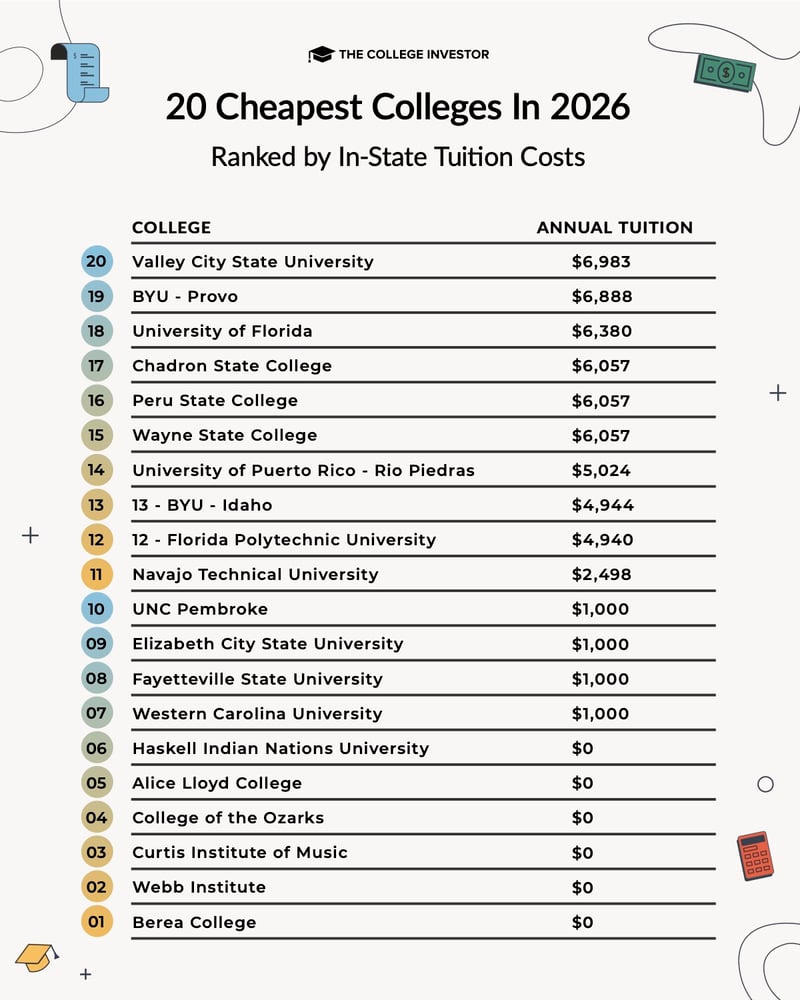
20. Valley City State University
Tuition: $6,983
Valley City State University is a small public university in southeastern North Dakota, with a focus on teacher preparation and STEM. It currently has about 1,500 students.
19. BYU - Provo
Tuition: $6,888
Brigham Young University in Provo, Utah is the flagship of the BYU system and one of the largest religiously affiliated universities in the country. The published rate applies to LDS members, while non-members pay roughly double. It currently has around 34,000 students.
18. University of Florida
Tuition: $6,381
The University of Florida in Gainesville is the state's flagship public research university and one of the top public universities in the country. Florida has held the lowest average public tuition in the nation for several years running. This school is one of the largest in the country as well, with around 60,000 students.
17. Chadron State College
Tuition: $6,057
Chadron State College is a public school in northwest Nebraska, part of the Nebraska State College System. It currently has about 2,800 students.
16. Peru State College
Tuition: $6,057
Peru State College, founded in 1867, is the oldest college in Nebraska. Like its sister schools, it charges the same tuition to residents and non-residents. It currently has about 2,500 students.
15. Wayne State College
Tuition: $6,057
Wayne State College in northeast Nebraska is the third school in the Nebraska State College System and notable for charging the same tuition rate to in-state and out-of-state students. It currently has about 4,300 students.
14. University of Puerto Rico - Rio Piedras
Tuition: $5,024
The University of Puerto Rico at Rio Piedras is the flagship campus of the UPR system and the oldest university in Puerto Rico. It currently has about 13,000 students.
13. BYU - Idaho
Tuition: $4,944
Brigham Young University-Idaho in Rexburg is privately operated by The Church of Jesus Christ of Latter-day Saints. The published rate is the LDS member rate while non-members pay close to double. This campus has around 36,000 students, including online enrollment.
12. Florida Polytechnic University
Tuition: $4,940
Florida Polytechnic University in Lakeland is the newest school in the State University System of Florida, focused exclusively on STEM disciplines like engineering, computer science, and data analytics. It currently has about 1,500 students.
11. Navajo Technical University
Tuition: $2,498
Navajo Technical University in Crownpoint, New Mexico is a federally chartered tribal university with ABET-accredited engineering programs. It's open to all students but tribally enrolled members pay a reduced amount per credit hour. It currently has about 700 students.
10. UNC Pembroke
Tuition: $1,000
The University of North Carolina at Pembroke charges $500 per semester for in-state undergraduates through the NC Promise program. It currently has around 8,000 students.
9. Elizabeth City State University
Tuition: $1,000
Elizabeth City State University is a Historically Black College (HBCU) that sits on the North Carolina coast and also participates in NC Promise. It currently has around 2,000 students.
8. Fayetteville State University
Tuition: $1,000
Fayetteville State University, a Historically Black University in North Carolina, was added to NC Promise effective 2025-26. Around 6,800 students.
7. Western Carolina University
Tuition: $1,000
Western Carolina University in Cullowhee is the largest of the four NC Promise schools, with around 11,000 students. Through NC Promise, in-state students pay $500 per semester.
6. Haskell Indian Nations University
Tuition: $0
Haskell Indian Nations University in Lawrence, Kansas is a federally operated tribal university open to enrolled members of federally recognized tribes. Published tuition is essentially $0, but there are required fees that run about $480 a year. It currently has about 750 students.
5. Alice Lloyd College
Tuition: $0
Alice Lloyd College in Pippa Passes, Kentucky offers free tuition through the Appalachian Leaders College Scholarship - but only to students from a 108-county service area across Kentucky, Ohio, Tennessee, Virginia, and West Virginia. Students work at least 10 hours per week. It currently has around 600 students.
4. College of the Ozarks
Tuition: $0
College of the Ozarks in Point Lookout, Missouri uses a 15-hour-per-week student work program to cover tuition. The Christian liberal arts school enrolls about 1,500 students.
3. Curtis Institute of Music
Tuition: $0
Curtis Institute in Philadelphia is a tuition-free music conservatory funded by its endowment. Acceptance rate hovers near 4%, making it one of the most selective schools in the country. It only has around 175 students.
2. Webb Institute
Tuition: $0
Webb Institute in Glen Cove, New York offers free tuition to all admitted U.S. citizens and permanent residents. The school grants only one degree - a dual major in naval architecture and marine engineering. It only has around 100 students.
1. Berea College
Tuition: $0
Berea College in Berea, Kentucky has charged no tuition since 1892. Every student works at least 10 hours per week as part of the no-tuition agreement. Room and board still apply but are usually covered by financial aid. This school has around 1,500 students.
Honorable Mention: University of the People
University of the People is a fully online, nonprofit, tuition-free university based in Pasadena, California. It would technically tie for first place at $0 published tuition. We left it off the main list because the comparison isn't apples-to-apples with traditional four-year campuses:
- Per-course assessment fees of $140 for undergrads add up to roughly $5,600 across a four-year bachelor's degree, plus a $60 application fee.
- It carries DEAC accreditation (national/distance), not regional accreditation. Credit transferability and employer/grad-school recognition can be more variable than at regionally accredited schools.
- It's 100% online with no residential experience and no in-state framework.
For students looking specifically at online options, University of the People is a legitimate low-cost path. Just go in with realistic expectations about transferability and recognition compared to a regionally accredited residential program.
The Bottom Line
Finding (and attending) one of these schools can help you avoid getting into significant student loan debt and achieve a higher ROI on your college investment. The total 4-year costs of these colleges is below average and can set you up for a positive lifetime of earnings.
Earning a college degree can lead to a boost in your expected lifetime earnings, but it doesn't come for free. There are a number of ways to keep your college expenses down, but one of the most important is choosing a school with a low tuition. When considering a school, look at their posted tuition rates but also reach out to the financial aid office to see what your overall college costs might be. This will help you make an informed decision.
- College Board, Trends in College Pricing and Student Aid 2025
- UNC System - NC Promise Tuition Plan
- Berea College, Webb Institute, Curtis Institute of Music, College of the Ozarks, Alice Lloyd College, and Haskell Indian Nations University official tuition pages
Editor: Colin Graves Reviewed by: Chris Muller

Robert Farrington is the founder of The College Investor and is widely recognized as one of the nation’s leading voices on student loan debt and saving for college. He holds an MBA from UC San Diego Rady School of Management and has spent over 15 years researching, writing, and advising on student loans, 529 plans, financial aid programs, and saving and investing for young professionals.
Robert has been featured in the The New York Times, The Wall Street Journal, The Washington Post, NBC News, and Forbes, where he has been a regular personal finance contributor for over a decade. His work combines both professional expertise and personal experience – he successfully navigated his own student loan repayment journey and has helped thousands of readers do the same.
He is committed to making the intersection of personal finance and education transparent and accessible. You can learn more about Robert on the About Page or on his personal site RobertFarrington.com.