
Moving into a college dorm room is often the first step to living on your own, so it makes sense that you would want to spend some money to make your new space feel like home. But dorm room move-in can be challenging.
Unfortunately, most college students have tiny budgets, so you may not have a lot of options when it comes to furnishing and decorating you dorm room or apartment.
No matter your budget, there are steps you can take to make your dorm room move-in day easier. You still have to move all your stuff, but you’ll have the things that you need to start your semester out right.
Figure Out Your Move-In Budget
When moving into your first place (even if it's a dorm room), it’s tempting to spend money to make your new room a home. But you'll have other priorities competing for your hard-earned money. And if you’re going to school in a different city than where you grew up, you may be without income until you can find a part-time job.
Before you begin buying items for your new place, create a budget. Look at your savings, and figure out how much money you can put towards making your first dorm room comfortable. If your parents are willing to help you out, ask them how much they are willing to spend on helping you get settled.
Finally, dig through your gift cards to see if you have any funds you can put toward your college costs. Once you see how much you have available, you'll have your budget amount. You may not be able to afford everything you want, but with a bit of creative thinking, you can likely get your dorm into decent shape.
Here are a few tips to help you keep your move-in costs down:
- Remember your other start-up costs. Your dorm room isn’t going to be your only “start-up” cost. You may need to buy a laptop, a bike (for transportation), and textbooks that you can’t rent. Once you add up those costs with the cost of outfitting a dorm room, you can easily blow through a summer’s worth of earnings before you’ve stepped foot into a classroom. Try to account for all your costs so you can better allocate money to your dorm room budget.
- Avoid the “haul” mentality. When you shop, it can be easy to want furniture, decor, bedding, etc. right away. Rather than buying your entire dorm in one go, think about shopping as a way to supplement items that you already have. You might have a newly-minted credit card, but you don’t want to get caught in credit card debt before you start college. Instead, try to raise your credit score by keeping your utilization low, and paying off your credit card on time and in full each month.
- Reuse items you already have. It’s common for college students to want to buy new towels, bedding, trash cans, lamps, and decor. But a hunt through your house may reveal that you’ve got plenty of high-quality items that you can bring to school.
- Think second-hand first. Furniture, mirrors, kitchen items (including microwaves and mini-fridges), and many other move-in items tend to be easy to find on Facebook Marketplace or in thrift stores. Do your best to get low-cost used items before you spend your hard-earned cash on new dorm room items.
- Shop your bedroom for decor. College is a great opportunity for a fresh start, but you probably have a few items in your bedroom that would make great decor. Bring the twinkle lights, bulletin boards, framed posters, and pictures from your bedroom to make your dorm room homey from day one.
- Reserve money for a move-in day trip. You may be tempted to spend your move-in budget on new furniture from IKEA, organization items from Target, and new wall decor. But hold back at least a few hundred dollars for an inevitable “move-in” trip to the store. You’ll inevitably forget a few items, and it’s easier to buy disposable items (paper towels, trash bags, cleaning products, laundry detergent, etc.) and a starter set of groceries after you move in.
Determine What You Need
The only thing smaller than your dorm room may be your budget. Before you start buying new stuff for your room, be sure to figure out what you actually need. That way you can budget your money and your space accordingly.
- Have a filing folder for your key documents. College is typically the first time when you’ll be living on your own. That means taking responsibility for your own documents. You'll need an accordion-style filing folder to keep key documents, such as health insurance cards, dorm-room renters insurance, your passport, a copy of your birth certificate, a copy of your Social Security Card, car-related information if you have a car on campus, any financial documents that you can’t easily get online, and financial aid information. If you’ve got medical documents that you need to keep, this filing folder is the place to put them.
- Split the packing list with your roommate. Whether your roommate is an old friend or a randomly assigned person, you’ll be sharing a living space for at least 9 months. You won’t want to double up on the items that you pack. So get in touch, and discuss move-in day details. If possible, figure out what items you each have available. One futon, one vacuum cleaner, and one microwave are enough for most dorm rooms. You may find that there are other items that you can share throughout the year. Talking through the packing list can help both of you save money.
- Avoid aspirational packing. You might decide to start practicing guitar, playing hockey, or snowboarding while in college. But in all likelihood, if you gave up a hobby in high school, you won’t have time to pick it up in college. Avoid overpacking hobby items except those that you already use regularly. If you decide to restart archery while at school, you can always figure out a way to get your bow back from home. Even if you leave things at home, you’ll be able to try out new things and save space and save money by joining clubs or teams at your school. If you’ve got great stuff left at home, consider renting it out to earn extra money. You can rent out everything from high-end purses to sports equipment, so consider whether your unused stuff could become your next side hustle.
- Be judicious about your clothing. Even if you can’t get home easily, you won’t want to bring your entire wardrobe to school. Avoid bringing clothes that don’t fit or those that you don’t prefer to wear. You may want to bring some formal attire or business attire (especially if you’re far from home), but you don’t need to bring every item you own. Most of the time, you can dress casually on campus, and you want a wardrobe to reflect that.
- Embrace a minimalist attitude. Dorm rooms are small, and you’ll share yours with a roommate. While you’ll want your room to be homey, not everything from your home will fit in your dorm room. Try to pack only the items that you really need to enjoy your college life, and leave everything else behind.
- Think about the seasons. If you live an hour or less from campus, consider leaving your cold-weather seasonal items at home. You’ll likely move in on one of the hottest days of the year, and cooler weather may be months away. If you can keep bulky sweaters, jackets, boots, and other cold-weather gear at home, you’ll save tons of space in your dorm-room closet, and move-in will go much quicker. If you live far from campus, consider using space-saving bags to reduce the size of your bulky winter gear.
Pack Like A Pro
Once you have the items you need, you’ll need to figure out how to fit everything into your car. But that’s not the biggest challenge. Once you arrive at school, you may have to carry your stuff up a few flights of stairs into your new abode. While getting settled is never easy, there are a few things you can do to ease the pain.
- Borrow a cart or a dolly. A cart or dolly makes it easy to haul bulky or heavy loads from the car to your residence hall. If your parents don’t have one, try to borrow one from friends or a sympathetic boss at your place of business.
- Make sure furniture is easy to unload. You’ll want to set up large items, like a bookshelf, a futon, a desk, or a fridge before you bring the smaller items in. If possible bring your furniture in one car and your other items separately. That way you can set up your furniture without playing stuff Tetris.
- Keep your cleaning products separate from other items. Cleaning products are the only products that I recommend buying once you arrive at school. But you may decide to eschew that advice and take the cleaning products from home. If you do, pack these separately from all your other items, and ideally carry them in a plastic tub. Chemical spills can leave huge stains, and you don’t want to be responsible for a costly carpet stain from a move-in day accident.
- Pack in clear bins and laundry baskets. If at all possible, pack your items in clear bins and laundry baskets. Clear bins are stackable, and you can easily see what you have inside of them which makes move-in easier. Plus you can use them for storage during the school year. Laundry baskets are designed to be easy to carry, and they are perfect for toting clothes, bedding, towels, pillows, and other lightweight items.
- Have a few small tools. Bring a power drill and bits, command hooks, zip ties, scissors, clear packing tape, a rubber mallet, measuring tape, and a pencil to your dorm room. You’ll definitely need some or all of these as you get your new place ready.
Related: Check out our college and dorm room packing list here >>
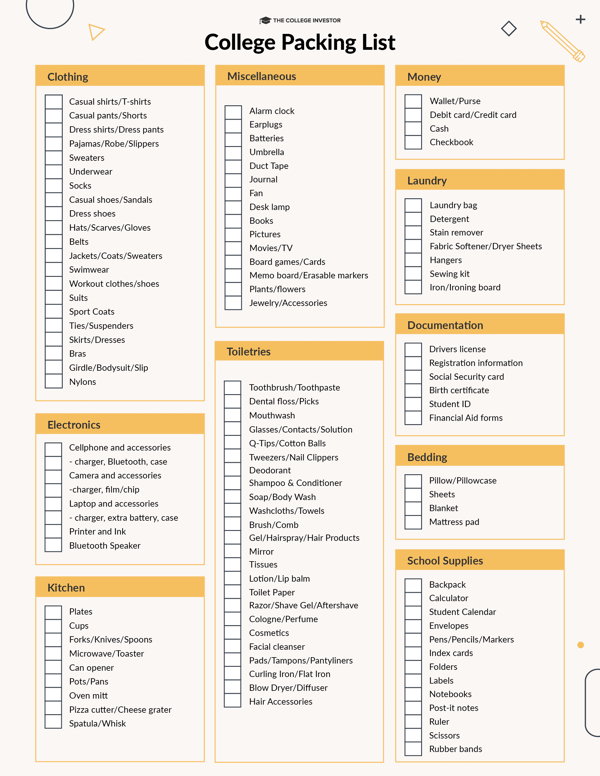
Find The Full List - Click On The Image To Get It!
Prepare Your Entourage
While preparing to move is never easy, setting expectations with your family may prove to be your biggest challenge. Move-in day is both physically and emotionally draining, but you can prepare for it with just a few tips.
- Figure out what car will get you to school. Going car-free is a great way to save money, but you’ll need some way to get all of your stuff to school. Make sure that you’ve arranged for a car and a driver to help you on move-in day.
- Recruit family members to help you move in. It’s possible to move-in by yourself. Typically the residential staff will be around to give solo students a hand with getting settled. But the more people you have to help you, the faster you can get your stuff out of the car and into your dorm. Parents, a sibling, and maybe even a friend or two can make moving in much easier. Just leave dogs and other pets behind.
- Have snacks and drinks in a cooler. Your move-in crew will work much better if they are fed and watered. Prepare a cooler full of cold drinks and snacks to feed your friends and family. If you have room, you can even keep the cooler in your dorm room, so you have a cooler when you want to go tailgating or on camping trips.
- Let your parents know when they should leave. Schools typically publish a move-in day schedule, and most include a specific event where parents are welcome. That event typically marks when your parents should say goodbye to you (at least until you come home to visit). If your parents might struggle to let go, let them know that your plan is to say goodbye after that event.
Final Thoughts
Dorm room move-in day is exciting and slightly nerve-wracking for most college students. While most look forward to a new adventure, there are a lot of unknowns. You're in a new environment, meeting new people, and sometimes you're moving away from home for the first time. Remember to follow the tips shared in this article, as it will ensure a smoother transition.
Editor: Colin Graves Reviewed by: Robert Farrington

Hannah Rounds is a data-driven personal finance writer with over a decade of experience helping readers understand how to make smarter money decisions. She specializes in breaking down complex financial topics (from student loans to investing tools) using a practical, analytical approach rooted in real-world data.
She holds a B.A. in Economics from Furman University (Summa Cum Laude), where she received the Arthur Magill Economics Award and the J. Carlyle Ellet Economics Prize. She has written extensively on taxes, investing, student loans, and financial technology, focusing on how data shapes smarter financial decisions.
When she’s not writing or analyzing spreadsheets, Hannah enjoys exploring new budgeting tools and finding fresh ways to make finance easier for families.