 Not many investors pay much attention to deflation or hyperinflation — most believe they are black swan events. Like a junk food eater who ignores diabetes because he feels okay right now, we tend to think of devastating, macro-level financial catastrophes in an abstract “out-of-sight-out-of-mind” way . . . until disaster hits our doorstep with total immediacy.
Deflation and hyperinflation are each, in their own ways, ruinous to an investor’s success. Despite short-term benefits to certain narrow segments of society (like borrowers in hyperinflation), deflation and hyperinflation ultimately hurt the entire economy by shrinking the pie for everyone. And tragically, due to our ever-increasing national debt (and the very real possibility of our government “printing money” to pay it off), investors can no longer afford to ignore these risks.
Worse yet, neither deflation — better known as “depression” — nor hyperinflation are adequately understood by the general public, including many investors and financial experts. Society has, over many years, perpetuated a number of misunderstandings about these events — what they are, who is affected, and how to avoid being harmed — that are simply misleading or untrue. I have written about some of these below.
The Risks of Deflation
Failure to Remain Liquid
The most important task during deflation, financially speaking, is to remain liquid. Because there is less money in circulation, financial obligations that were manageable before deflation can utterly wipe you out after deflation hits. A home mortgage and an auto loan, for instance, could literally deplete your life savings before you repay these debts in full. Your home can actually decrease in value until it is worth less than your remaining mortgage payments — all while your income is likely decreasing as well.
Therefore, it is not enough to merely be wealthy on paper, such as by owning real estate or stocks. You must also have enough liquid (readily accessible) wealth to sustain your financial life for however long a bout of heavy deflation lasts.
The best way to avoid being cleaned out by deflation is to be free and clear, or as close to it, before deflation hits. Fully paying off all recourse debts before deflation is the ideal scenario. If you cannot fully pay these debts off, paying them down as much as possible will help minimize deflation-related damage to your life and finances.
Editor’s Note: Do you struggle with student loan debt? Check out “8 Ways to Eliminate Your Student Loan Debt.”
Entrusting Institutions With Your Life Savings
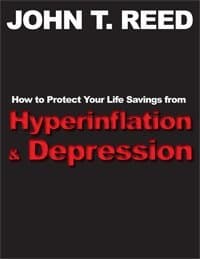 In his 2010 book How to Protect Your Life Savings from Hyperinflation & Depression, Harvard MBA John T. Reed cautions against trusting institutions with your assets. By “institutions,” Reed means everything from governments to banks to credit unions to insurance companies and investment houses.
While it may seem cynical to make the blanket claim that no institution can be trusted, one need only research the history of financial crises to understand why. During the Great Depression, large numbers of banks prevented or attempted to prevent depositors from withdrawing their money. Needless to say, cash that you cannot readily access is liquid in name only. For all practical purposes, it is illiquid and therefore useless during deflation.
Conversely, while stuffing money beneath your mattress is not usually an intelligent strategy (because it earns no interest), “cash in a mattress or safe deposit box earns a positive real return in terms of purchasing power” when heavy deflation strikes. After all, interest rates on just about anything during inflation are usually zero or close to it.
Relying on the FDIC
Some will argue that today’s consumers are safer from heavy deflation today than during the Great Depression because of federal deposit insurance. Unfortunately, while the FDIC does insure bank accounts up to $250,000, it cannot actually fulfill that promise if there is a nationwide run on banks. Federal deposit insurance was set up in 1933 as a way to protect consumers from specific, isolated bank failures — not to simultaneously pay everyone the full amount of their deposits at the same time.
Moreover, Reed writes, the FDIC has no money. It does have a $100 billion credit line with the U.S. Treasury, but the Treasury, too, is broke. Consequently, depositors should not expect much in the way of protection from the FDIC if deflation causes a nationwide bank run.
The Risks of Hyperinflation
Believing Gold is a Reliable Inflation Hedge
Gold does not have nearly the reputation of a financial crisis savior as widely assumed. For those who may refuse to even consider this possibility (i.e., gold bugs), the reasons are:
- The fact that gold does not always appreciate in value, as many claim or imply.
- The fact that gold exposes owners to 28 percent long-term capital gains taxes which, in hyperinflation, cause you to owe real taxes on hyperinflated, paper “gains.”
- The fact that governments throughout history have penalized gold ownership or resorted to financial repression, such as forcing citizens to sell their gold to the government at below-market rates.
- The fact that even such inflation “protection” as gold does provide often arrives so late that it was not at all helpful while inflation was in full swing.
Relying on Cost-of-Living Clauses or Adjustments
Others believe that they are protected from inflation-related dangers so long as they have cost-of-living adjustments in place. To an extent, they are correct. During “normal” inflation (say, 2 to 4 percent per year) cost-of-living adjustments can provide adequate protection. This goes completely out the window, however, when “normal” inflation gives way to hyperinflation. In an in-depth article on the subject, Reed offers a practical example of why cost-of-living adjustments cannot be relied upon:
Let’s say you own a $200,000 home. It does not go up in real value one penny over two years until you sell it. But because the purchasing power of the dollar dropped by 10% during that period, your sale price is $200,000 x 110% = $220,000.
How much real (adjusted for inflation) gain have you experienced? Zero. The house is now worth 10% more in dollars, but so is a gallon of milk or anything else you buy. Your house did not go up in value really, but the IRS says you owe a capital gains tax on that $20,000 “gain.
Ultimately, you are $3,000 poorer in real (inflation-adjusted) terms as a result of your “gain” — despite any cost-of-living protection you may have. The other major problem with such adjustments is that they are usually based on published changes in the CPI, which occur too slowly to account for all of the hyperinflation that happens in-between updates.
Excessive Reliance on Stocks
Stocks, too, are sometimes seen as a universal inflation beater. However, this is yet another inflation-protection belief that rests upon shaky ground.
In his book The Intelligent Investor, Benjamin Graham charts how both the CPI and stock prices changed for every five-year period from 1920-1970. When no clear pattern emerged to show that stocks consistently beat inflation, Graham begrudgingly concluded that stocks were not a guaranteed inflation hedge after all. There is also the issue that high inflation tends to cause high interest rates, which compel firms to pay out higher dividends in order to attract investors. Higher interest rates, of course, tend to drive down share prices.
Important Lessons
Some important lessons can and should be drawn from all of this. They are:
- You are generally on your own when it comes to deflation or hyperinflation. Depressing as it may be, the steps needed to shield yourself from either catastrophe are yours and yours alone to take.
- The things we expect to protect us (such as gold or cost-of-living adjustments) do not react quickly enough to help us when we need it most: in the thick of the crisis itself.
- The importance of planning. If you wait until heavy deflation or hyperinflation hits, you have generally waited too long. The correct approach is to structure your life and finances to withstand these events long before they happen, before governments and institutions make it painfully difficult to do so.
Can the Federal Reserve and U.S. government shield us from hyperinflation or deflation? Do you take steps in your portfolio to protect yourself?
Editor’s Note: Did you enjoy this article? Be sure to check out many more at TheCollegeInvestor.com and at other great investing blogs.
Editor: Clint Proctor Reviewed by: Chris Muller

Get the latest financial news and actionable insights.
How it works:
- 1Enter your email and subscribe.
- 2Get the latest personal finance and education news delivered every week.
- 3Take control of your finances with real insights.
- 4We won't spam you, ever!