
Key Points
- Trump Accounts belong to the child, so the FAFSA treats them as a student asset assessed at up to 20%, the same rate as a UGMA or UTMA custodial account.
- A parent-owned 529 plan is assessed at a maximum of 5.64%, so every $10,000 saved in a Trump Account instead of a 529 “costs” roughly $1,436 more in financial aid eligibility.
- Withdrawals after age 18 are taxable income to the student, which the FAFSA considers the student’s income.
More than 4 million children now have a Trump Account, and general contributions opened on July 4, 2026, according to IRS enrollment figures reported by The College Investor. Most of the coverage has focused on the $1,000 “baby bonus” and the $5,000 annual limit, not on what happens 17 years later, when that balance shows up on the Free Application for Federal Student Aid.
The answer is not good for families counting on need-based aid. A Trump Account is owned by the child, and the FAFSA counts what the student owns far more heavily than what the parents own. Based on the ownership rules laid out in Section 530A of the tax code, the account lands in the same FAFSA bucket as a UGMA or UTMA custodial account, meaning it’s a student’s asset.
Would you like to save this?
Trump Account Ownership And FAFSA
The FAFSA formula that produces the Student Aid Index assesses parent assets at a maximum of 5.64% and student assets at 20%. There is no asset protection allowance on the student side. Every dollar a student holds in a reportable account raises the SAI by 20 cents, which shrinks need-based grants, subsidized loans, and work-study.
The premise is simple: if the student has money, that money should be used before “free” money is given.
The statute defines a Trump Account as an account “for the exclusive benefit of an eligible individual,” and that individual is the child, according to the text of 26 U.S.C. 530A. Parents open and manage it, but they never own it, and control transfers outright at 18. That structure mirrors a custodial account, which is why the FAFSA’s student asset section requires students to report UGMA and UTMA balances as their own investments.
Financial aid expert Jack Wang put it plainly in a July interview with Yahoo Finance: “My understanding is that the Trump Account will be an asset of the student, which can reduce aid by as much as 20 cents on every dollar in the account.”
The 20% figure is the working assumption across the college planning industry, including The College Investor’s comparison of Trump Accounts and 529 plans.
The Math On A $25,000 Balance
A child born in 2026 who gets the $1,000 deposit and $2,000 a year from family, invested in a U.S. stock index fund, can realistically have $25,000 or more by senior year of high school.
On the FAFSA, that balance produces very different results depending on which account holds it, as The College Investor’s 529 and FAFSA analysis shows.
| Account | FAFSA Owner | Assessment Rate | Aid Reduction on $25,000 |
|---|---|---|---|
| Parent-owned 529 plan | Parent | Up to 5.64% | Up to $1,410 |
| UGMA/UTMA custodial account | Student | 20% | $5,000 |
| Trump Account | Student | 20% | $5,000 |
| Grandparent-owned 529 plan | Not reported | 0% | $0 |
That $3,590 difference repeats every year the student files a FAFSA, approaching $14,000 across four years for a family that never touched the money. A grandparent-owned 529 does even better under the current FAFSA, since neither the balance nor qualified distributions are reported at all.
Withdrawals Hit FAFSA A Second Time
The timing rules make it worse. The statute prohibits any distribution before January 1 of the year the child turns 18, so a 17-year-old filing the FAFSA in October of senior year has no way to spend the balance down first. Education is an allowed Trump Account expense, but for young college freshman, they can’t touch it.
The full amount sits there as a student asset, a problem the FAFSA parent asset rules never create for a 529, since parents can spend a 529 on qualified costs whenever they choose.
Once withdrawals begin, the money is taxed as ordinary income to the student. The 10% early withdrawal penalty is waived for qualified education expenses, but the income tax is not. And because the FAFSA pulls income from the tax return two years prior, that withdrawal reappears as student income, which the FAFSA assesses at up to 50% above the income protection allowance.
A 529 used for tuition generates no taxable income and no FAFSA income entry.
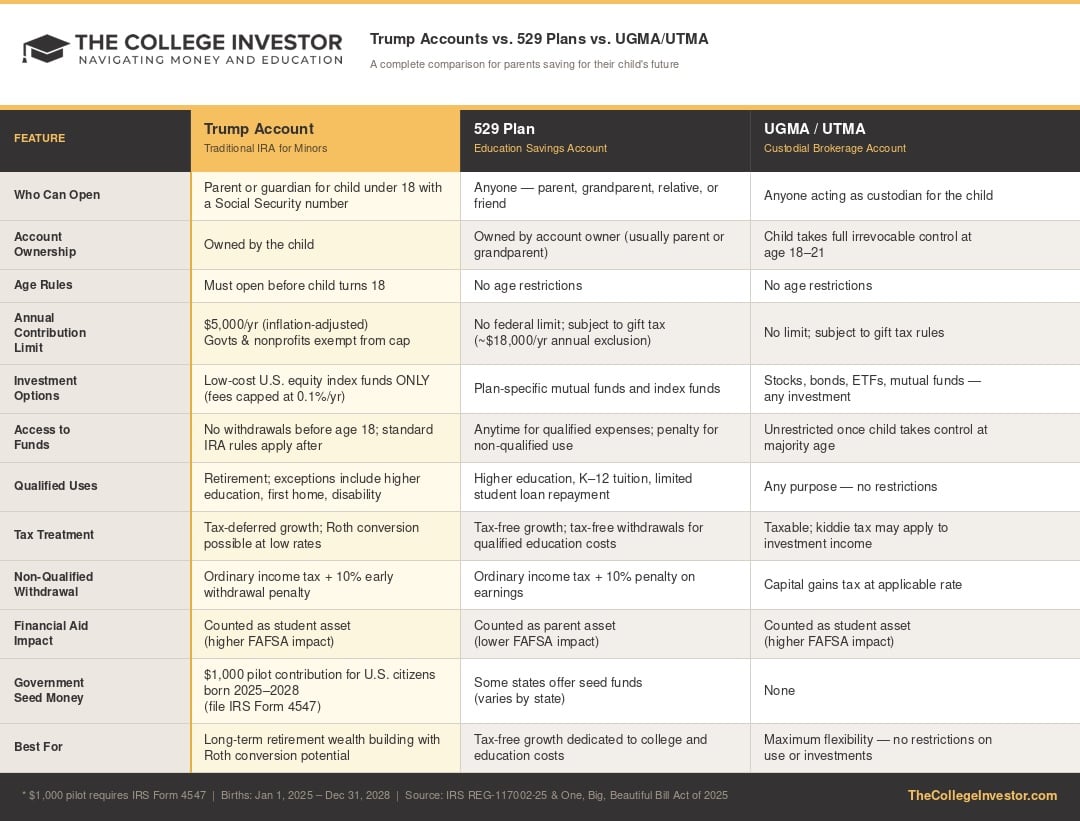
Trump Account vs. UGMA vs. 529
On financial aid alone, the Trump Account and the UGMA are twins: student assets at 20%, control transferred at 18, no way for a parent to reclaim the money. The differences show up in taxes and flexibility. A UGMA has no contribution limit beyond gift tax rules and no restriction on withdrawals, but its earnings face the kiddie tax every year, as The College Investor’s UGMA and UTMA breakdown explains. The Trump Account grows tax-deferred but is locked until 18 and limited to low-cost U.S. index funds.
The 529 wins on every count that matters for financial aid: parent ownership, the 5.64% rate, tax-free withdrawals for qualified expenses, and no income hit. The only thing a 529 cannot do is collect the $1,000 federal deposit, which is why the $1,000 baby bonus is the one Trump Account benefit worth claiming regardless of aid plans.
Wang’s advice was the same: take the seed money, then decide separately whether to keep contributing.
What Families Should Do
- Claim the $1,000 deposit for any child born 2025 through 2028, since it costs nothing and the financial aid impact of a single $1,000 seed is under $200 per year. How to claim the Trump Account baby bonus.
- Direct ongoing college savings to a 529 rather than a Trump Account if there is any chance the family will qualify for need-based aid. Trump Accounts vs. 529 plans.
- Run the numbers on both accounts before senior year using the SAI formula, because the 20% student rate compounds across four FAFSA filings. 2027-28 Student Aid Index chart.
- Treat the Trump Account as a retirement fund for the child rather than a tuition account, which is where its tax deferral and Roth conversion path pay off. Trump Account rules, limits and use cases.
Editor: Colin Graves

Robert Farrington is the founder of The College Investor and is widely recognized as one of the nation’s leading voices on student loan debt and saving for college. He holds an MBA from UC San Diego Rady School of Management and has spent over 15 years researching, writing, and advising on student loans, 529 plans, financial aid programs, and saving and investing for young professionals.
Robert has been featured in the The New York Times, The Wall Street Journal, The Washington Post, NBC News, and Forbes, where he has been a regular personal finance contributor for over a decade. His work combines both professional expertise and personal experience – he successfully navigated his own student loan repayment journey and has helped thousands of readers do the same.
He is committed to making the intersection of personal finance and education transparent and accessible. You can learn more about Robert on the About Page or on his personal site RobertFarrington.com.