
Key Points
- A vocal group of SAVE borrowers say they won't switch repayment plans until forced, hoping a pending lawsuit or another twist rewards those who stayed put.
- The one active lawsuit, Havens v. U.S. Department of Education, doesn't ask to extend SAVE or the forbearance, rather it asks the court to restore the older REPAYE plan — meaning even a borrower victory would restart payments, at amounts higher than SAVE.
- The waiting itself has a running cost: roughly $3,500 per year in interest for the typical borrower, plus months of no direct progress toward forgiveness.
Formal 90-day notices began going out to more than 7 million SAVE borrowers on July 1, arriving in waves. Borrowers who don't choose a new repayment plan by their deadline (roughly September 30 for the first group) will be placed on the Standard plan automatically.
In response, a common refrain has emerged in comment sections and forums: "I refuse to switch until I'm notified I have to. That way, if any new court action benefits SAVE borrowers, it will still apply to me because I'm technically still registered under SAVE."

This includes some organizations that are encouraging their members to not take action:
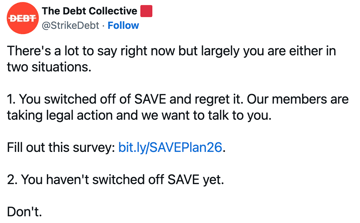
It makes it sound like waiting in the SAVE forbearance could be a smart move.
But when you walk through every scenario that could actually unfold (the pending lawsuit, a forbearance extension, and the even longer-shot wildcards) the strategy delivers almost nothing different that switching wouldn't also deliver, while the costs of waiting increase every month.
The simple truth is that waiting only preserves your no-payment forbearance. Your loan balance is growing, you're not making progress towards forgiveness, and the longer you wait, the more likely you are to have even higher payments in the future.
Here's what to know about each scenario and how it could impact you as a SAVE borrower thinking about waiting it out.
Would you like to save this?
Scenario 1: The Havens Lawsuit Wins And Ends The SAVE Forbearance Anyway
The only active legal effort standing between borrowers and the transition deadline is Havens v. U.S. Department of Education. This court case isn't new - it started back in March. But with the timelines starting to move borrowers out of SAVE, the plaintiffs have filed more motions to try and get an injunction.
Here's what most borrowers banking on this case misunderstand: the plaintiffs are not asking to "save" SAVE. Their argument is that when the courts vacated the SAVE rule in March, the prior regulation (REPAYE, the repayment plan SAVE was built on) should have been restored.
They contend the Department's refusal to administer REPAYE is a "shadow repeal" carried out without the required rulemaking, and that involuntarily transferring borrowers without the option for REPAYE exceeds the Department's statutory authority.
Follow that logic to a win, and the outcome surprises the wait-and-see crowd.
If the court orders the Department to allow REPAYE, borrowers could enroll in the plan. The REPAYE plan required payments for 20 years for undergrads and 25 years for graduate borrowers. The payment was 10% of discretionary income, using 150% of the poverty line. That's a higher payment than SAVE for nearly everyone.
The three things that could happen:
- Winning ends the SAVE forbearance. Allows REPAYE until 2028.
- Losing is the status quo, with SAVE forbearance still ending.
- Possible forbearance continuing while the court case happens, but only if the judge issues an injunction (which hasn't happened yet).
Just as important: the relief requested is a stay of the agency's actions, not just a relief for those enrolled in SAVE. That means, if this case wins, everyone has access to REPAYE until 2028. You don't have to be in the SAVE forbearance to get the benefit.
One named plaintiff isn't enrolled in anything relevant — his claim is that he can't apply to REPAYE. If REPAYE were restored as an option, a borrower who already switched to IBR or PAYE could apply right back into it until it ends in 2028.
The odds: The case has been pending since March without any injunctive relief, and the Department argues a D.C. court cannot override the Missouri court's final judgment that ended SAVE. Earlier challenges over SAVE and REPAYE went nowhere while the state-led challenges that dismantled the plan succeeded.
Here's the the pros and cons of waiting on the outcome of this lawsuit:
Pros
Cons
Scenario 2: The Forbearance Gets Extended
An extension is plausible — not because of any court, but because of logistics. Servicers are working through 7 million borrowers needing to change repayment plans, likely between now and March 2027.
But look at what an extension actually delivers: more months of forbearance during which interest accrues and nothing counts toward forgiveness.
This is the same scenario borrowers have been on since 2024, and many are worse off as a result.
Here's the the pros and cons of waiting on to see if the forbearance is extended:
Pros
Cons
Scenario 3: The Wildcards
Retroactive credit for forbearance months. If any court order or future administration ever grants forgiveness credit for time in the SAVE forbearance, eligibility would rest on having been in the forbearance (a fact permanently recorded in federal loan data) not on remaining in it. The IDR account adjustment worked exactly this way, crediting past periods based on loan history regardless of the borrower's current plan.
So, leaving now would end the SAVE forbearance, but also resuming payments gets you credits towards forgiveness. This is a super long shot, but you could argue that you've cost yourself several months of payments you wouldn't have had to make, at the risk of it continuing to grow your loan with no benefit.
A future Congress or administration revives a generous plan. Any new statute or regulation would set its own eligibility rules. The only real grandfathering in current law (access to IBR, PAYE, and ICR) is based on having loans disbursed before July 1, 2026, not on SAVE enrollment.
Access to repayment plans is based on loan origination date, not being enrolled in a specific plan.
And the earliest we could see massive change again is 2030. This assumes that in 2029 and Presidency changes as well as both the House and Senate - and that they work over the summer to pass massive reform that could take effect in 2030.
Here's the the pros and cons of waiting on either of these wildcard outcomes:
Pros
Cons
Waiting Has A Cost
Interest on SAVE loans resumed August 1, 2025. Eleven months later, the typical affected borrower has added roughly $3,200 to $3,500 to their balance, based on Student Borrower Protection Center estimates (PDF File) of about $300 per month.
The forgiveness cost is less visible but often larger. None of the forbearance time counts toward IDR forgiveness, and it counts toward PSLF only through the buyback program — which offers no discount for these months and carries a multi-year processing queue.
A PSLF borrower who waited from August 2025 through September 2026 gave up 14 qualifying months. And if you're buying back, your payments today in 2026 are exactly the same cost as repayment would be. For someone within a few years of forgiveness, that delay can actually increase costs in the future.
For those going for time-based loan forgiveness, future payments are likely to be more expensive. That means that either you're going to pay more lifetime, and/or reduce future loan forgiveness.
The benefit is what most borrowers are focused on: no payments due.
Staying put does protect your short-term cash flow — real relief if you're facing hardship. But it converts today's breathing room into a larger balance, a longer clock, and a riskier deadline. As The College Investor's SAVE decision framework puts it:
- If your goal is forgiveness, you need the cheapest qualifying months that count.
- If your goal is payoff, you want to repay the smallest amount legally allowed.
The forbearance accomplishes neither - and makes both scenarios more expensive for you over time.
Common Questions
How much has staying in SAVE forbearance typically cost borrowers in added interest so far, and what is the monthly impact?
A typical borrower has racked up roughly $3,200 to $3,500 in added interest since charges resumed on August 1, 2025, which works out to about $300 per month in interest that keeps building while payments are paused.
Does time spent in SAVE forbearance count toward IDR or PSLF forgiveness, and how does the PSLF buyback program change that?
Months in SAVE forbearance earn no credit toward IDR forgiveness, and they only count toward PSLF if you use the buyback program — which charges you what you would have paid anyway and sits in a processing queue that can take years.
What are the possible outcomes of the Havens v. U.S. Department of Education lawsuit, and do any of them truly reward borrowers for staying in SAVE forbearance?
If the plaintiffs win, REPAYE returns through June 30, 2028, but the SAVE forbearance ends and billing restarts at rates higher than SAVE, and if they lose nothing changes — so neither outcome pays off for borrowers who waited instead of switching to a plan that earns forgiveness credit.
Bottom Line
If you run every scenario forward, the same answer keeps coming back: staying in SAVE forbearance isn't likely to benefit you financially long-term.
The pathways on the table (including the ones the Havens plaintiffs are actually asking for) either apply to switchers and stayers alike, or are based on your payment history that's already on record.
The one benefit waiting is that you have no payment due. But this option doesn't change the long-term math of a growing loan balance. Every month in the forbearance adds roughly $300 in interest for the typical borrower and moves no one closer to forgiveness.
Borrowers pursuing PSLF or IDR forgiveness should switch now and restart the clock, using The College Investor's Student Loan Calculator to compare payments. For most borrowers pursuing PSLF, the goal is the lowest monthly payment between IBR, PAYE, and RAP.
And for households that truly can't afford a payment, the forbearance remains a legitimate hardship tool — just treat it as that, not as a long term strategy, and calendar the deadline so you don't end up in Standard plan unexpectedly.
Don't Miss These Other Stories:
Editor: Colin Graves

Robert Farrington is the founder of The College Investor and is widely recognized as one of the nation’s leading voices on student loan debt and saving for college. He holds an MBA from UC San Diego Rady School of Management and has spent over 15 years researching, writing, and advising on student loans, 529 plans, financial aid programs, and saving and investing for young professionals.
Robert has been featured in the The New York Times, The Wall Street Journal, The Washington Post, NBC News, and Forbes, where he has been a regular personal finance contributor for over a decade. His work combines both professional expertise and personal experience – he successfully navigated his own student loan repayment journey and has helped thousands of readers do the same.
He is committed to making the intersection of personal finance and education transparent and accessible. You can learn more about Robert on the About Page or on his personal site RobertFarrington.com.