
Key Points
- High school juniors and seniors should plan to visit and tour college campuses they are interested in attending.
- Explore beyond the official tour by checking dorms, dining halls, and student hangouts to get a real sense of campus life.
- Take notes, ask candid questions, and reflect afterward to determine whether the school feels like the right fit.
For all the data students and parents can find online (from college rankings to TikTok dorm room tours) nothing replaces the experience of walking across a campus in person. A school that looks perfect on paper can feel overwhelming or impersonal once you arrive, while another that was barely on the radar might suddenly feel like home.
Campus tours have become an essential step in the college search. According to surveys by the American Council on Education (PDF File), most students say that visiting schools was the biggest factor in choosing where to apply. It’s also one of the first chances for families to see how a student might fit into the daily rhythm of academic and social life.
But tours are no longer casual drop-ins. They’re structured, often competitive to book, and, in many cases, tracked by admissions offices as a sign of “demonstrated interest.” Knowing how to approach them can make the difference between a helpful trip and a wasted afternoon.
Would you like to save this?
Step 1. Plan Ahead And Register Early
Once upon a time, families could stroll into an admissions office and join the next available tour. Today, tours at popular colleges often fill weeks in advance - especially during spring break or long weekends when juniors and seniors are most likely to visit.
To secure a spot:
- Register online through the admissions website at least a month ahead of your intended date.
- Check policies carefully. Some schools still limit group sizes, a practice left over from pandemic protocols.
- Look into alternatives. If tours are booked, many schools offer self-guided materials or mobile apps. Virtual tours (ranging from polished presentations to student-made videos) can also help narrow choices before you travel.
Planning ahead also signals interest to admissions officers. At schools that track demonstrated interest, showing up on the official tour list may give a small boost when application time comes.
⚠ Pro Tip:
Make sure that you register for the campus tour using the same email address you plan to use for your college application. That way any "demonstrated interest" can be correlated to your admissions application.
Step 2. What To Do On The Actual Campus Tour
The official walking route will typically cover highlights: the library, dining hall, a classroom, and the student center. While helpful, these are curated to impress. To get a fuller picture, families should go beyond the brochure version of campus life.
Read the student newspaper. Tour guides (often paid student ambassadors) are unlikely to mention controversies or challenges. The campus paper can reveal what students are really talking about, from housing shortages to labor disputes.
Check the commons. Watch how students actually use cafeterias, study lounges, and green spaces. Are they full of energy? Are their clubs or booths or activities setup? Do students seem connected or isolated? These observations can be just as telling as admissions statistics.
Explore on your own. If time allows, walk through dorm areas, attend a class, or grab lunch in the dining hall. Not every tour includes these opportunities, so families may need to schedule them separately through admissions.
⚠ Pro Tip:
Depending on the location of the school, climate and weather matter. If you're not from a certain climate, you may consider doing your campus tour during the opposite season you're use to. For example, if you're from Southern California and want to attend college in the Northeast, consider visiting during the winter or early Spring to see if you enjoy (or are open to) the different climate.
Step 3. Ask Questions That Matter
What questions to ask is one of the most common questions we get in our Parent Facebook groups.
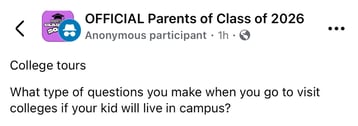
The most useful questions are specific, candid, and focused on daily life. Students and parents may want to split up so each can ask without embarrassment. A few examples:
- How easy is it to register for required classes?
- What’s your favorite study or hangout spot on campus?
- How often are professors, not teaching assistants, leading classes?
- What kind of academic or mental health support is available?
Parents can also discreetly ask about career services, alumni networks, and how the school prepares students for internships or jobs - areas that may not be top of mind for a high school junior.
⚠ Pro Tip:
Join a group tour so that you can listen to the questions other families ask. You simply don't know what you don't know, and hearing other questions or concerns can spark conversation.
Step 4. After The Visit Reflections And Comparisons
By the third or fourth campus visit, schools can start to blur together. That’s why it’s important to capture impressions in real time.
- Take notes immediately after each tour. Write down both facts and feelings, such as whether the campus felt welcoming, overwhelming, or just right.
- Snap photos of spaces that stood out. These visual reminders will help when comparing schools later.
- Discuss impressions with family or friends. Sometimes others will notice things you missed. Even better if you know an alumni!
- Follow up with admissions officers or student guides if you still have unanswered questions.
Organizing your reflections into a pros-and-cons list can make it easier to see which schools stand out when application season arrives.
Virtual Tour Alternatives
Not every family can afford multiple road trips. Virtual tours have surged in popularity (especially since 2020), with some platforms reporting usage increases of more than 200% in recent years. Colleges now offer interactive maps, live Q&A sessions with students, and even 360-degree residence hall videos.
While they can’t fully capture the atmosphere of a bustling quad, virtual tours are useful for narrowing a list of schools before committing time and money to travel. Families can maximize the experience by:
- Preparing questions in advance to ask during live sessions.
- Comparing notes across multiple schools to spot patterns.
- Supplementing with unofficial sources like student vlogs, social media (TikTok is very popular for college student life), and review sites.
What Families Should Keep In Mind
Campus visits can be tiring, expensive, and at times overwhelming. But they remain one of the most effective ways to gauge whether a college feels like the right fit - something no ranking or website can fully capture.
For parents, the challenge is balancing support with giving students room to form their own impressions. A quiet walk across the quad or an hour in the dining hall may say more than an hour-long presentation in an admissions office.
The ultimate goal is clarity. After several visits, patterns emerge: Do you prefer large or small schools? Bustling urban campuses or quiet rural settings? Schools where academics dominate the conversation, or those with a lively social scene? Each visit helps refine the answer.
Bottom Line
Choosing a college can be stressful, but campus tours can really give you a better sense of "fit". With that in mind, students and families should:
- Plan ahead. Tours fill quickly, and some schools track visits as part of admissions.
- Look beyond the script. Check out dorms, dining halls, and student papers to see the real student experience.
- Reflect afterward. Notes, photos, and candid conversations will help you compare schools when decisions loom.
In the end, the best campus tour is the one that helps a student see whether they can picture themselves thriving there. The brochures may promise opportunity, but only by standing on the quad can you start to imagine whether it feels like home.
Don't Miss These Other Stories:
Editor: Colin Graves

Robert Farrington is the founder of The College Investor and is widely recognized as one of the nation’s leading voices on student loan debt and saving for college. He holds an MBA from UC San Diego Rady School of Management and has spent over 15 years researching, writing, and advising on student loans, 529 plans, financial aid programs, and saving and investing for young professionals.
Robert has been featured in the The New York Times, The Wall Street Journal, The Washington Post, NBC News, and Forbes, where he has been a regular personal finance contributor for over a decade. His work combines both professional expertise and personal experience – he successfully navigated his own student loan repayment journey and has helped thousands of readers do the same.
He is committed to making the intersection of personal finance and education transparent and accessible. You can learn more about Robert on the About Page or on his personal site RobertFarrington.com.