• Skip to primary navigation
  • Skip to main content
  • Skip to primary sidebar
  • Skip to footer

Navigating Money And Education

  • About
  • Podcasts
  • Social
  • Newsletter
  • Save For College
  • Student Loans
  • Investing
  • Earn More Money
  • Banking
  • Taxes
  • Forum
  • Search
Home / News / 40 Top Colleges Beat Lawsuit Over Financial Aid “Price Fixing”

40 Top Colleges Beat Lawsuit Over Financial Aid “Price Fixing”

Updated: January 4, 2026 By Robert Farrington | < 1 Min Read 2 Comments

Many or all of the products featured here may be from our partners who compensate us. This doesn't influence our evaluations or reviews. Our opinions are our own. Investing information is for educational purposes only. Learn more here.Advertiser Disclosure

There are thousands of financial products and services out there, and we believe in helping you understand which is best for you, how it works, and will it actually help you achieve your financial goals. We're proud of our content and guidance, and the information we provide is objective, independent, and free.

But we do have to make money to pay our team and keep this website running! Our partners compensate us. TheCollegeInvestor.com has an advertising relationship with some or all of the offers included on this page, which may impact how, where, and in what order products and services may appear. The College Investor does not include all companies or offers available in the marketplace. And our partners can never pay us to guarantee favorable reviews (or even pay for a review of their product to begin with).

For more information and a complete list of our advertising partners, please check out our full Advertising Disclosure. TheCollegeInvestor.com strives to keep its information accurate and up to date. The information in our reviews could be different from what you find when visiting a financial institution, service provider or a specific product's website. All products and services are presented without warranty.

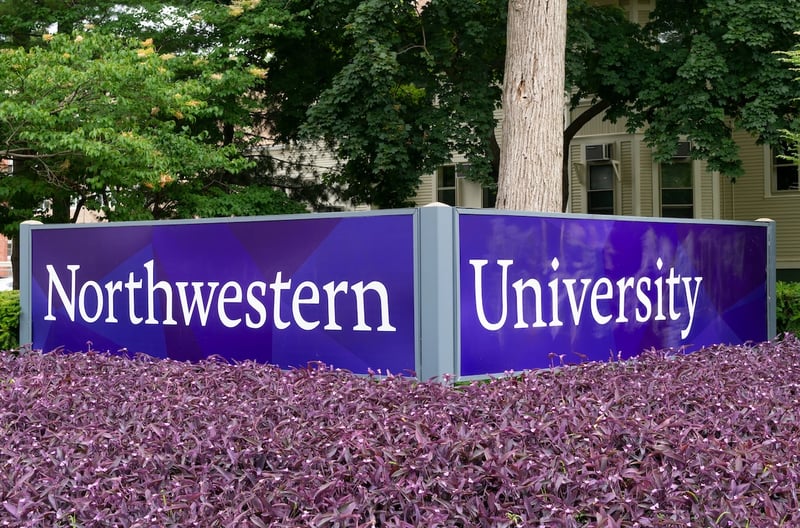
A prominent, angled purple sign for Northwestern University stands at the entrance to the campus in Evanston, IL, USA. The sign features "Northwestern" in white capital letters on the left panel and "University" on the right panel, both against a background with subtle geometric patterns. Lush, dark purple foliage, possibly ornamental sweet potato vines or similar groundcover, fills the foreground beneath the sign. In the background, beyond the sign and vibrant greenery, mature trees with full green canopies provide shade, and the corner of a building with visible windows can be seen. This image contextualizes the article's discussion of a recently dismissed lawsuit involving 40 U.S. colleges, including Northwestern, concerning allegations of financial aid collusion.

Key Points

  • A federal judge dismissed a lawsuit accusing 40 U.S. colleges of colluding to reduce financial aid awards by requiring noncustodial parent income information.
  • Filing the FAFSA and CSS Profile is tedious and confusing for families looking for financial aid.
  • The decision highlights the challenges children of divorced or estranged parents face in qualifying for financial aid.

This week, 40 prominent U.S. universities (including Harvard, Yale, MIT, Northwestern, Georgetown, and Cornell) won dismissal of a lawsuit (PDF File) that accused them of conspiring to overcharge students by limiting financial aid.

The lawsuit, filed by a Boston University student and a Cornell graduate, claimed the schools worked together through the College Board to require financial information from noncustodial parents - often those that were divorced or estranged. According to the plaintiffs, this inflated families’ expected contributions, cut down on financial aid packages, and cost students thousands more per year.

Judge Sara Ellis of the U.S. District Court in Chicago ruled that while the schools all used similar policies, the plaintiffs did not present enough evidence that the institutions had entered into an illegal agreement. The case was dismissed without prejudice, meaning the plaintiffs may try again in the future if they have stronger evidence.

Would you like to save this?

We'll email this article to you, so you can come back to it later!

Why Non-Custodial Parent Rules Matter

When applying for federal aid, families submit the FAFSA, which only looks at the parent or household who provides the most financial support. But many private colleges also require the CSS Profile, run by the College Board, which allows schools to ask for both custodial and noncustodial parent financial information.

That distinction matters most for students whose parents are divorced, separated, or estranged:

  • If the noncustodial parent refuses to contribute, colleges may still count their income, leaving the student with a gap to cover.
  • Loans and debt can increase, since the aid formula assumes resources the student cannot actually access.
  • Aid awards differ between schools, since some institutions do not require noncustodial parent information.

According to the lawsuit, students attending schools with the extra requirement paid, on average, about $6,200 more per year than students at otherwise comparable colleges that did not.

The Court's Reasoning

Judge Ellis emphasized that antitrust law requires more than showing that schools used the same policy. To prove collusion, plaintiffs must demonstrate an actual agreement through evidence like coordinated policy changes, explicit communications, or secret arrangements.

In this case, the plaintiffs pointed to the College Board’s 2006 push to encourage schools to consider noncustodial parent income, which many institutions adopted over time. But the judge noted:

  • Schools did not adopt the policy all at once; the process stretched across nearly two decades.
  • Each institution had discretion in how it used the data.
  • Many other colleges outside the lawsuit also required the same information.

Without stronger evidence of coordination, the judge found the allegations insufficient under the Sherman Antitrust Act.

What Happens Next?

The plaintiffs’ lawyers can amend the complaint and refile, possibly adding more details on timing, communications, or evidence of a shared agreement. If they succeed, the case could return to litigation.

Meanwhile, the ruling may embolden universities to keep their current financial aid policies, while critics argue those rules remain unfair to students from divided households.

This case follows a 2022 antitrust lawsuit against a different group of elite universities (PDF File) accused of colluding on aid formulas under a now-expired federal exemption. That earlier litigation led to settlements totaling $166 million, showing that courts and families are willing to challenge elite institutions on financial aid practices.

What Families Should Do When Applying For Financial Aid

For parents and students navigating college costs:

  • Check each school’s financial aid policy. Not all colleges require noncustodial parent information. Some may offer waivers for cases of estrangement or nonpayment.
  • Document family circumstances. If a noncustodial parent refuses to contribute, gather court orders, correspondence, or financial evidence that can support an appeal.
  • Compare net prices. Use each school’s net price calculator to see how aid policies affect actual costs.

Key Takeaway

The dismissal is a reminder that while colleges may share similar approaches to calculating financial aid, proving illegal collusion is legally complex. For families, the bottom line is that aid rules (especially around divorced parents) remain a significant factor in what students ultimately pay.

Don't Miss These Other Stories:

Government Shutdown and Student Loans Explained (2026 Update)

Government Shutdown and Student Loans Explained (2026 Update)

New Data: 5.4 Million Student Loan Borrowers Delinquent On Their Loans

New Data: 5.4 Million Student Loan Borrowers Delinquent On Their Loans

Unemployment Rates By Education Level

Unemployment Rates By Education Level

Editor: Colin Graves

Robert Farrington
Robert Farrington

Robert Farrington is the founder of The College Investor and is widely recognized as one of the nation’s leading voices on student loan debt and saving for college. He holds an MBA from UC San Diego Rady School of Management and has spent over 15 years researching, writing, and advising on student loans, 529 plans, financial aid programs, and saving and investing for young professionals.

Robert has been featured in the The New York Times, The Wall Street Journal, The Washington Post, NBC News, and Forbes, where he has been a regular personal finance contributor for over a decade. His work combines both professional expertise and personal experience – he successfully navigated his own student loan repayment journey and has helped thousands of readers do the same.

He is committed to making the intersection of personal finance and education transparent and accessible. You can learn more about Robert on the About Page or on his personal site RobertFarrington.com.

Please Share And Support

  • Facebook
  • X
  • LinkedIn
  • Reddit
  • Flipboard
  • Bluesky
  • Print
  • Email
Editorial Disclaimer: Opinions expressed here are author’s alone, not those of any bank, credit card issuer, airlines or hotel chain, or other advertiser and have not been reviewed, approved or otherwise endorsed by any of these entities.
Comment Policy: We invite readers to respond with questions or comments. Comments may be held for moderation and are subject to approval. Comments are solely the opinions of their authors'. The responses in the comments below are not provided or commissioned by any advertiser. Responses have not been reviewed, approved or otherwise endorsed by any company. It is not anyone's responsibility to ensure all posts and/or questions are answered.
Subscribe
Notify of
2 Comments
Oldest
Newest Most Voted

Primary Sidebar

College Admissions

Featured Resources

>  Princeton Review (recommended)
>  Kaplan (recommended)
>  Khan Academy (recommended)

College Planning

  • How To Make A College List: Finding Academic and Financial Fit
  • How Colleges Admit Students Based On Major
  • Are College Admissions Counselors Worth It?
  • How Accurate Are College Admissions Calculators?
  • The Best Extracurricular Activities For College Applications
  • Best Niche Sports For College Admissions

College Application Process

  • College Application Checklist: Timeline And Printable Calendar
  • How To Build a Stronger College Application This Summer, According To The Data
  • How Does The College Admissions Process Work?
  • Best Questions To Ask A College Admissions Officer
  • Mastering The College Admission Interview
  • Should You Ever Withdraw A College Application?
  • How Do You Defer Enrollment In College?
  • Can You Accept More Than One College Admissions Offer?

College Admissions Tests

  • College Entrance Exams 101: SAT vs. ACT. vs. CLT
  • What Is A Good PSAT Score?
  • What Is A Good SAT Score?
  • What Is A Good ACT Score?
  • How Do AP Scores Work For College Admissions?

Paying For College

  • How To Fill Out The FAFSA: 2026-27 Step-By-Step Guide
  • How To Save For College: Order Of Operations For Parents
  • How To Pay For College: The Best Order Of Operations
  • Military And VA Education Benefits (Complete Guide)
  • Best Student Loans And Rates

Heading To College

  • Ultimate College Packing List: What To Bring To College
  • 101 Essential Resources And Tips For College Freshmen
  • How To Prepare And Make Dorm Room Move-In Easy
  • Best Dorm Room Renters Insurance For Students
  • 5 Risks of College And How To Protect Against Them

Admissions Guides

  • Graduate School Admissions Tips: How To Stand Out
  • MBA Admissions Guide
  • Medical School Admissions Guide: Month-By-Month

Footer

Who We Are

The College Investor® provides the latest news and analysis for saving and paying for college, student loan debt, personal finance, banking, and college admissions.

Connect

  • Social
  • Contact
  • Newsletter
  • Advertise
  • Press & Media
  • Helpful Calculators

About

  • About
  • In The News
  • Research
  • Editorial Guidelines
  • How We Make Money
  • Archives

Social

Copyright © 2026 · The College Investor® · 2514 Jamacha Rd, Ste 502, El Cajon, CA 92019

Privacy Policy ·Terms of Service · DO NOT Sell My Personal Information

wpDiscuz