• Skip to primary navigation
  • Skip to main content
  • Skip to primary sidebar
  • Skip to footer

Navigating Money And Education

  • About
  • Podcasts
  • Social
  • Newsletter
  • Save For College
  • Student Loans
  • Investing
  • Earn More Money
  • Banking
  • Taxes
  • Forum
  • Search
Home / News / Ivy League Acceptance Rates Drop Again In 2025

Ivy League Acceptance Rates Drop Again In 2025

Updated: June 10, 2025 By Robert Farrington | < 1 Min Read Leave a Comment

Many or all of the products featured here may be from our partners who compensate us. This doesn't influence our evaluations or reviews. Our opinions are our own. Investing information is for educational purposes only. Learn more here.Advertiser Disclosure

There are thousands of financial products and services out there, and we believe in helping you understand which is best for you, how it works, and will it actually help you achieve your financial goals. We're proud of our content and guidance, and the information we provide is objective, independent, and free.

But we do have to make money to pay our team and keep this website running! Our partners compensate us. TheCollegeInvestor.com has an advertising relationship with some or all of the offers included on this page, which may impact how, where, and in what order products and services may appear. The College Investor does not include all companies or offers available in the marketplace. And our partners can never pay us to guarantee favorable reviews (or even pay for a review of their product to begin with).

For more information and a complete list of our advertising partners, please check out our full Advertising Disclosure. TheCollegeInvestor.com strives to keep its information accurate and up to date. The information in our reviews could be different from what you find when visiting a financial institution, service provider or a specific product's website. All products and services are presented without warranty.

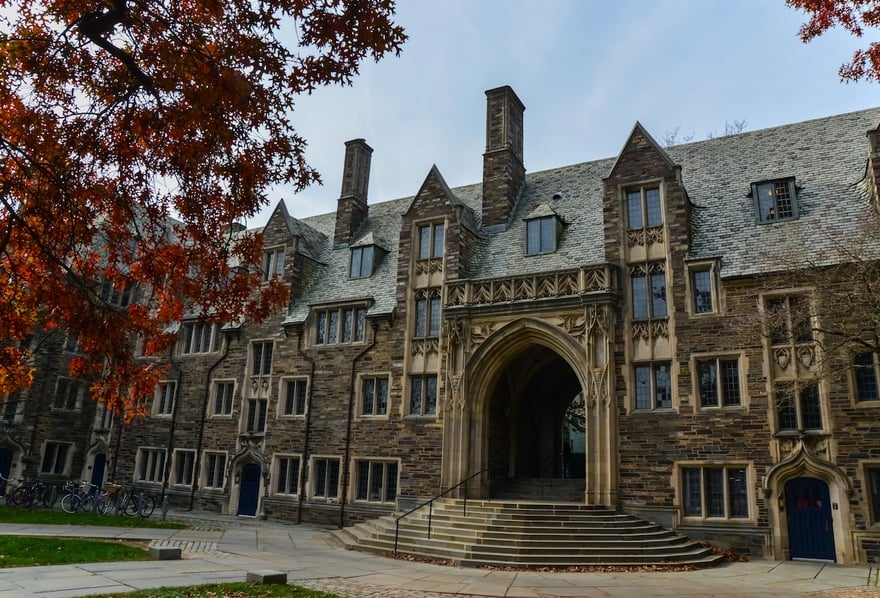
PRINCETON, NJ USA - NOVENBER 12, 2019: Ivy League College Building, Princeton University, NJ USA | Photo by hydrobiolog

Key Points

  • Ivy League and top-tier schools reported some of the lowest acceptance rates on record, many below 5%.
  • Application numbers surged again, reflecting how the Class of 2025 was one of the largest graduating high school years on record.
  • The steep competition is fueling new debates about the value of prestige and the fairness of current admissions practices.

The incoming college Class of 2029 entered one of the most competitive college admissions cycles in recent history. Acceptance rates at Ivy League and other elite universities dropped into the low single digits, continuing a trend that has intensified over the last decade. Schools like Harvard, Yale, and Columbia admitted fewer than 5% of applicants. At MIT, the acceptance rate was just 4.52%. Vanderbilt, Duke, and Rice also reported new lows.

These numbers reflect another year of record-setting applicant pools. Some schools received tens of thousands more applications than just a few years ago. As early decision programs grow in popularity and test-optional policies remain in place at many institutions, the volume of applicants continues to climb.

While Princeton and Stanford chose not to release admissions rates again this year, their silence has become part of a broader attempt to ease public pressure around rankings and selectivity.

Still, the shrinking odds have only heightened anxiety for families and applicants who feel pushed to apply to more colleges, often with little clarity on what truly improves their chances.

Would you like to save this?

We'll email this article to you, so you can come back to it later!

Testing Policies And Shifting Priorities

The Class of 2029 applied under an evolving set of institutional priorities.

While most elite schools kept test-optional policies in place, many applicants opted to submit scores. At Tufts, 65% submitted SAT or ACT scores. At Boston College, that figure was 74%. Some institutions, like MIT and Georgetown, still require scores—and they saw no drop in applicant quality.

More colleges are also focusing on first-generation students, rural applicants, and other forms of socioeconomic diversity. Amherst reported that 25% of admitted students will be the first in their family to attend college. Georgia Tech said 17% of admits are first generation students, and Brown announced that 19% of its incoming class shares this background.

The effect of the Supreme Court’s ruling against race-conscious admissions is still being assessed, but many colleges have added optional essays where students can reflect on how their identity has shaped their lives.

Early Admissions May Give A Strategic Edge

One factor helping some students gain a foothold is applying early. Early Decision and Early Action programs are not only growing in size but are also responsible for a larger share of incoming classes at top schools.

At Dartmouth, the early admit rate was 19.85%, while its overall rate landed at just over 6%. Emory’s early decision rounds accounted for more than half of its incoming class. Brown accepted 17.95% of early applicants, more than triple the rate of those admitted during the regular round.

But this strategy comes with trade-offs. Early Decision is binding, meaning students commit before seeing financial aid offers from other schools. This can disadvantage lower-income families who need to compare costs. Still, for those who can commit, applying early increasingly looks like a necessary move.

Is Prestige Still Worth It?

Behind the numbers, families are grappling with a larger question: Is the stress, cost, and uncertainty of applying to elite schools still worth it?

Many once-safety schools are now just as competitive as traditional elites. NYU received more than 120,000 applications. Notre Dame’s admit rate dropped to 9%, while Rice saw a 13% increase in applicants. At USC, the acceptance rate fell to 10.4%.

As competition rises, so does the importance of school strategy and applicant storytelling. Students are expected to show not just strong academics, but also purpose and personality. Many schools now seek applicants with distinctive interests that cross traditional boundaries, whether combining robotics and ethics, or climate science and community organizing.

Still, some families are questioning whether the college return on investment justifies the race for top-tier names. With tuition alone exceeding $70,000 per year at many elite schools, some wondering if it's worthwhile if they cannot get financial aid.

For now, the numbers suggest no slowdown. As long as elite college names carry weight in hiring and graduate school admissions, students will continue to apply in record numbers, regardless of how narrow the path becomes.

Don't Miss These Other Stories:

30 Most Expensive Colleges in 2026: Tuition Tops $72,000 at Every School on the List

30 Most Expensive Colleges in 2026: Tuition Tops $72,000 at Every School on the List

The Outsized Impact Of Ivy Plus Colleges

The Outsized Impact Of Ivy Plus Colleges

The Odds Of Winning A Scholarship Are Increasing

The Odds Of Winning A Scholarship Are Increasing

Editor: Colin Graves

Robert Farrington
Robert Farrington

Robert Farrington is the founder of The College Investor and is widely recognized as one of the nation’s leading voices on student loan debt and saving for college. He holds an MBA from UC San Diego Rady School of Management and has spent over 15 years researching, writing, and advising on student loans, 529 plans, financial aid programs, and saving and investing for young professionals.

Robert has been featured in the The New York Times, The Wall Street Journal, The Washington Post, NBC News, and Forbes, where he has been a regular personal finance contributor for over a decade. His work combines both professional expertise and personal experience – he successfully navigated his own student loan repayment journey and has helped thousands of readers do the same.

He is committed to making the intersection of personal finance and education transparent and accessible. You can learn more about Robert on the About Page or on his personal site RobertFarrington.com.

Please Share And Support

  • Facebook
  • X
  • LinkedIn
  • Reddit
  • Flipboard
  • Bluesky
  • Print
  • Email
Editorial Disclaimer: Opinions expressed here are author’s alone, not those of any bank, credit card issuer, airlines or hotel chain, or other advertiser and have not been reviewed, approved or otherwise endorsed by any of these entities.
Comment Policy: We invite readers to respond with questions or comments. Comments may be held for moderation and are subject to approval. Comments are solely the opinions of their authors'. The responses in the comments below are not provided or commissioned by any advertiser. Responses have not been reviewed, approved or otherwise endorsed by any company. It is not anyone's responsibility to ensure all posts and/or questions are answered.
Subscribe
Notify of
0 Comments
Oldest
Newest Most Voted

Primary Sidebar

College Admissions

Featured Resources

>  Princeton Review (recommended)
>  Kaplan (recommended)
>  Khan Academy (recommended)

College Planning

  • How To Make A College List: Finding Academic and Financial Fit
  • How Colleges Admit Students Based On Major
  • Are College Admissions Counselors Worth It?
  • How Accurate Are College Admissions Calculators?
  • The Best Extracurricular Activities For College Applications
  • Best Niche Sports For College Admissions

College Application Process

  • College Application Checklist: Timeline And Printable Calendar
  • How To Build a Stronger College Application This Summer, According To The Data
  • How Does The College Admissions Process Work?
  • Best Questions To Ask A College Admissions Officer
  • Mastering The College Admission Interview
  • Should You Ever Withdraw A College Application?
  • How Do You Defer Enrollment In College?
  • Can You Accept More Than One College Admissions Offer?

College Admissions Tests

  • College Entrance Exams 101: SAT vs. ACT. vs. CLT
  • What Is A Good PSAT Score?
  • What Is A Good SAT Score?
  • What Is A Good ACT Score?
  • How Do AP Scores Work For College Admissions?

Paying For College

  • How To Fill Out The FAFSA: 2026-27 Step-By-Step Guide
  • How To Save For College: Order Of Operations For Parents
  • How To Pay For College: The Best Order Of Operations
  • Military And VA Education Benefits (Complete Guide)
  • Best Student Loans And Rates

Heading To College

  • Ultimate College Packing List: What To Bring To College
  • 101 Essential Resources And Tips For College Freshmen
  • How To Prepare And Make Dorm Room Move-In Easy
  • Best Dorm Room Renters Insurance For Students
  • 5 Risks of College And How To Protect Against Them

Admissions Guides

  • Graduate School Admissions Tips: How To Stand Out
  • MBA Admissions Guide
  • Medical School Admissions Guide: Month-By-Month

Footer

Who We Are

The College Investor® provides the latest news and analysis for saving and paying for college, student loan debt, personal finance, banking, and college admissions.

Connect

  • Social
  • Contact
  • Newsletter
  • Advertise
  • Press & Media
  • Helpful Calculators

About

  • About
  • In The News
  • Research
  • Editorial Guidelines
  • How We Make Money
  • Archives

Social

Copyright © 2026 · The College Investor® · 2514 Jamacha Rd, Ste 502, El Cajon, CA 92019

Privacy Policy ·Terms of Service · DO NOT Sell My Personal Information

wpDiscuz