
Key Points
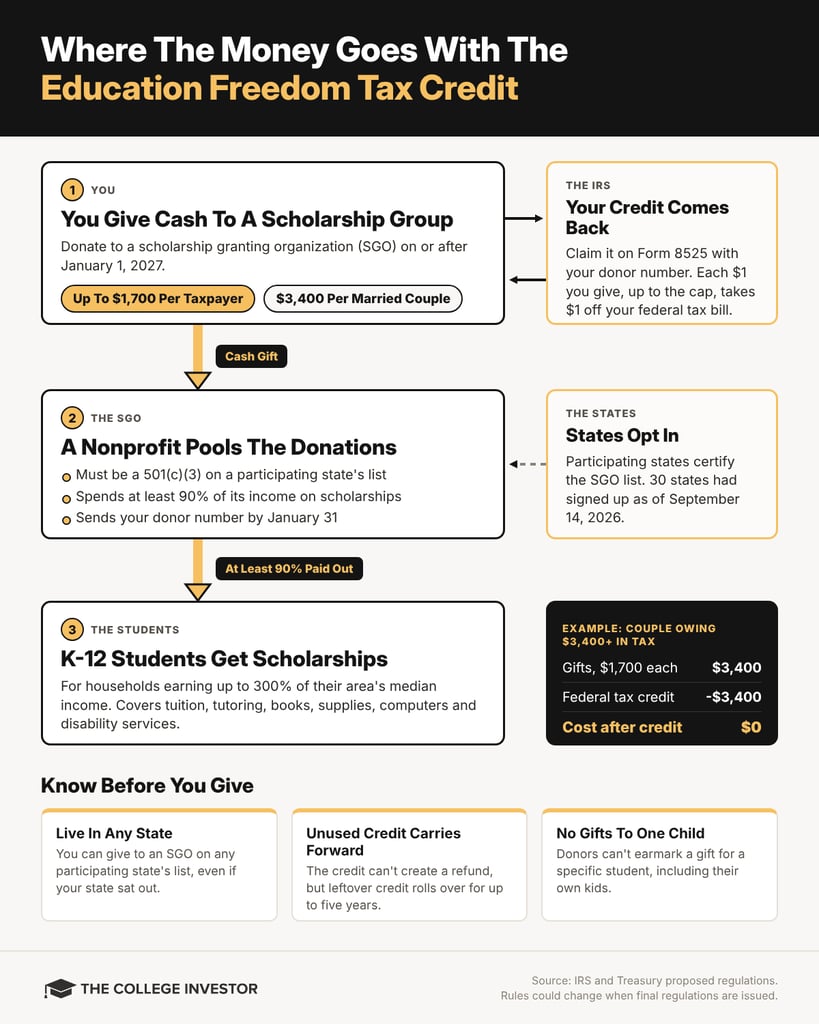
- Starting January 1, 2027, a cash gift to an approved scholarship granting organization earns a dollar-for-dollar federal tax credit of up to $1,700 per taxpayer, or $3,400 for a married couple when each spouse gives $1,700.
- You can donate from any state, but the organization must be on a participating state’s list. Thirty states had opted in as of September 14, 2026.
- The credit is nonrefundable, unused amounts carry forward five years, and you claim it on Form 8525 using a donor number the organization sends you.
Beginning January 1, 2027, the federal government will give taxpayers a full dollar back for every dollar they donate to a K-12 scholarship organization, up to $1,700 per person.
Congress created the Federal Scholarship Tax Credit in the One Big Beautiful Bill Act, and it’s often called the Education Freedom Tax Credit. This fall, Treasury and the IRS released proposed regulations and temporary regulations that spell out how donors actually claim it.
In partnership with American Federation for Children, here’s what to know about the new Education Freedom Tax Credit, and how you can make it work for your family. Sign up to stay informed on the latest here >>
Would you like to save this?
What Is The Education Freedom Tax Credit?
The Education Freedom Tax Credit is a nonrefundable federal tax credit equal to the cash you give to an eligible scholarship granting organization (SGO), capped at $1,700 per taxpayer per year. A $1,000 gift cuts your federal tax bill by $1,000, and the benefit grows dollar for dollar until it hits the $1,700 cap.
That makes it far more valuable than a normal charitable gift. A tax credit beats a tax deduction because it comes straight off your bill. A $1,700 deduction saves a donor in the 22% bracket just $374, while a $1,700 credit saves the full $1,700.
How Does A Married Couple Reach $3,400?
A married couple filing jointly can claim up to $3,400, because the proposed rules apply the $1,700 limit to each individual taxpayer. Journal of Accountancy confirms the $3,400 joint figure from the Treasury guidance.
The catch is that each spouse’s credit is based on that spouse’s own contributions. The cleanest approach is for each spouse to give $1,700 in their own name and get their own donor number. One $3,400 gift from one spouse may only produce a $1,700 credit. With this credit, the paperwork matters as much as the credit-versus-deduction math.
What Does A Scholarship Gift Actually Cost You?
For most donors who owe at least $1,700 in federal income tax, a $1,700 gift costs nothing after the credit. The table below shows how the math changes when your tax bill is small, when a state credit also applies, or when you give more than the cap.
| Donor Scenario | Gift | Federal Credit | Cost After Credits |
|---|---|---|---|
| Single Filer, Owes At Least $1,700 | $1,700 | $1,700 | $0 |
| Married Couple, Each Spouse Gives $1,700 | $3,400 | $3,400 | $0 |
| Single Filer, Owes Only $1,000 | $1,700 | $1,000 now, $700 carried forward | $700 until used |
| State Credit Of $500 Also Applies | $2,500 | $1,700 | $300 |
| Single Filer Gives Above The Cap | $5,000 | $1,700 | $3,300, before any deduction |
Source: IRS and Treasury proposed regulations. The College Investor.
Three rules matter here:
- The credit is nonrefundable, so like most federal tax credits it can cut your tax to zero but won’t produce a refund, and any unused amount carries forward for up to five years.
- If your state offers its own scholarship credit, the proposed rules subtract the state credit from your gift before applying the $1,700 cap, which protects the full federal credit when you give a little more.
- Anything you give above the cap may still count as a regular charitable deduction if you itemize, but the credited portion can’t be deducted twice.
Can You Donate If Your State Didn’t Opt In?
Yes. The proposed rules let a taxpayer give to an eligible SGO “without regard to the taxpayer’s residence,” as long as that organization appears on a participating state’s list. A donor in California could claim the credit for a gift to an SGO certified by Texas. For donors, the list of participating states matters because it decides which SGOs qualify, not whether you can give.
The IRS lists 30 states that made an advance election for 2027 as of September 14, 2026, up from the 27 we reported in June. States have until January 1, 2027 to opt in and until February 15, 2027 to submit their SGO lists.
Governors in Hawaii, Minnesota, New Mexico, and Oregon have said their states won’t participate, according to States Newsroom.
Where Does Your Donation Go?
Your gift funds K-12 scholarships for students from households earning up to 300% of their area’s median income. AFC’s eligibility research found that nearly 92% of U.S. children fall under that limit.
Scholarships can cover private school tuition, tutoring, books, supplies, computers, and services for students with disabilities, including for kids who stay in public school. SGOs must be 501(c)(3) public charities, spend at least 90% of their income on scholarships, and serve at least 10 students who don’t all attend the same school. You can’t earmark a gift for a specific child, which means a family can’t use the credit to pay their own kid’s private school tuition. A 529 plan is the better tool for that.
How Do You Claim The Education Freedom Tax Credit?
You claim the credit on Form 8525, attached to your federal return, using the unique donor number your SGO provides. Only cash gifts made on or after January 1, 2027 count, so a donation in December 2026 won’t qualify for the Education Freedom Tax Credit.
The timeline for a 2027 gift works like this. Your SGO must send a written acknowledgment with your donor number by January 31, 2028. You then report that number on Form 8525 with your 2027 return, filed in early 2028. Leaving the donor number off creates a presumption that the credit is disallowed, so keep the acknowledgment with your tax records.
What Should Donors Watch Before Giving?
Comments are due December 1, 2026, and taxpayers can rely on the proposed regulations for 2027 gifts if they follow them in full. Details such as the joint-filer treatment could change in the final version, so check the latest Education Freedom Tax Credit rules before you give.
The credit also carries political risk. Senate Democrats introduced a bill in April 2026 to repeal the Education Freedom Tax Credit before launch, though it faces long odds in a Republican-controlled Congress. Donors with very low federal tax bills should check whether they’ll owe enough to use the credit within five years.
How To Find A Scholarship Granting Organization
We are partnering with the American Federation for Children, a national organization that supports K-12 scholarship programs and helps donors connect with eligible scholarship granting organizations.
Before you give, confirm the SGO appears on the IRS list and a participating state’s list, then give in your own name so you receive your own donor number. Married couples should each give separately to reach the full $3,400. Start with the Education Freedom Tax Credit basics, then visit AFC to find a scholarship organization.
FAQs
Is The $3,400 Credit Available To Single Filers?
No. A single filer can claim up to $1,700 per year. The $3,400 figure applies only to a married couple filing jointly when each spouse contributes $1,700 of their own money, as our Education Freedom Tax Credit explainer covers.
Can I Give Stock Instead Of Cash?
Only cash counts. The proposed rules limit the credit to irrevocable cash gifts in U.S. dollars, so stock, property, and digital assets don’t qualify for the Education Freedom Tax Credit.
What Happens If I Give More Than $1,700?
Your federal credit stays capped at $1,700 per taxpayer. The amount above the cap may be deductible as a regular charitable contribution if you itemize and meet the usual IRS rules, though a deduction is worth far less than a tax credit.
Editor: Colin Graves

Robert Farrington is the founder of The College Investor and is widely recognized as one of the nation’s leading voices on student loan debt and saving for college. He holds an MBA from UC San Diego Rady School of Management and has spent over 15 years researching, writing, and advising on student loans, 529 plans, financial aid programs, and saving and investing for young professionals.
Robert has been featured in the The New York Times, The Wall Street Journal, The Washington Post, NBC News, and Forbes, where he has been a regular personal finance contributor for over a decade. His work combines both professional expertise and personal experience – he successfully navigated his own student loan repayment journey and has helped thousands of readers do the same.
He is committed to making the intersection of personal finance and education transparent and accessible. You can learn more about Robert on the About Page or on his personal site RobertFarrington.com.