• Skip to primary navigation
  • Skip to main content
  • Skip to primary sidebar
  • Skip to footer

Navigating Money And Education

  • About
  • Podcasts
  • Social
  • Newsletter
  • Save For College
  • Student Loans
  • Investing
  • Banking
  • Taxes
  • Scholarships
  • Forum
  • Search
Home / News / Proposed Bill Would Cut Off Federal Student Aid To For-Profit Colleges

Proposed Bill Would Cut Off Federal Student Aid To For-Profit Colleges

By Robert Farrington

Published October 22, 2026•6 Min Read

Add on Google
Share
  • Email
  • Facebook
  • X
  • LinkedIn
  • Bluesky
  • Flipboard
  • Pinterest
  • Reddit
0
Many or all of the products featured here may be from our partners who compensate us. This doesn't influence our evaluations or reviews. Our opinions are our own. Investing information is for educational purposes only. Learn more here.Advertiser Disclosure

There are thousands of financial products and services out there, and we believe in helping you understand which is best for you, how it works, and will it actually help you achieve your financial goals. We're proud of our content and guidance, and the information we provide is objective, independent, and free.

But we do have to make money to pay our team and keep this website running! Our partners compensate us. TheCollegeInvestor.com has an advertising relationship with some or all of the offers included on this page, which may impact how, where, and in what order products and services may appear. The College Investor does not include all companies or offers available in the marketplace. And our partners can never pay us to guarantee favorable reviews (or even pay for a review of their product to begin with).

For more information and a complete list of our advertising partners, please check out our full Advertising Disclosure. TheCollegeInvestor.com strives to keep its information accurate and up to date. The information in our reviews could be different from what you find when visiting a financial institution, service provider or a specific product's website. All products and services are presented without warranty.

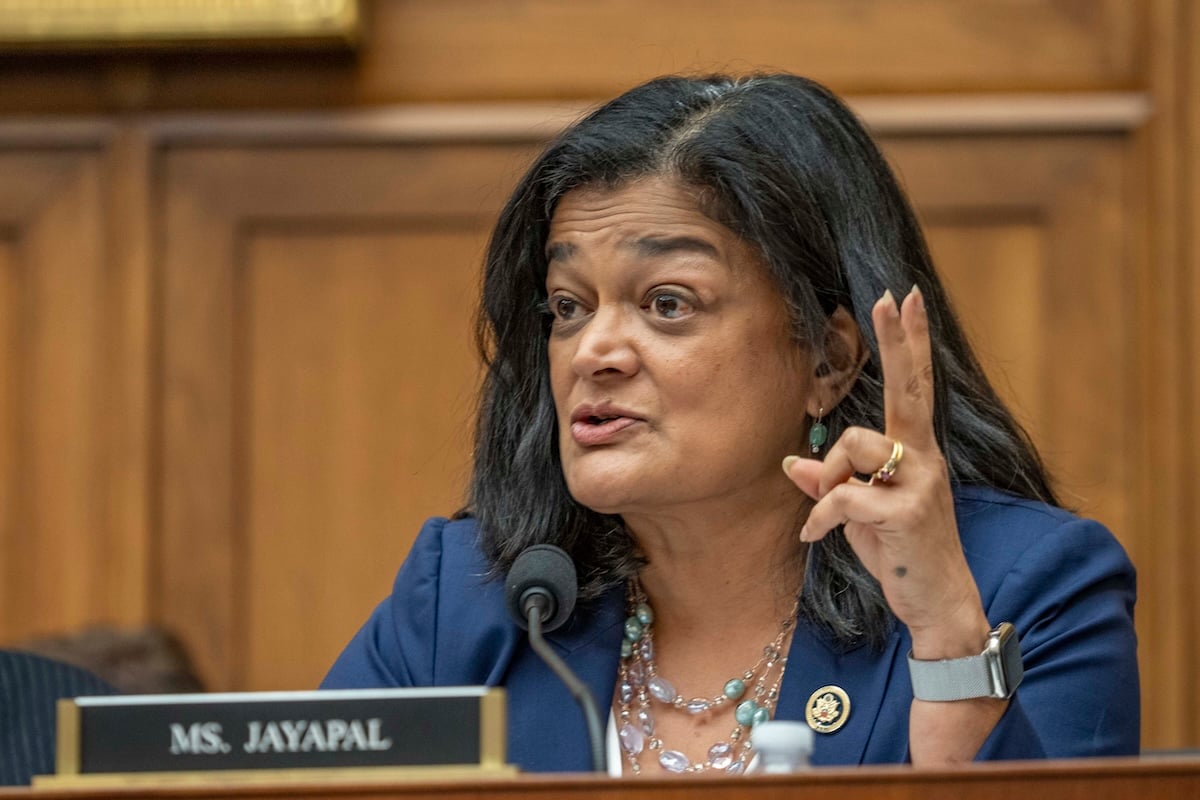
Rep. PRAMILA JAYAPAL (D-WA) raises a question during the hearing of the House Subcommittee on the Constitution and Limited Government on the activities of the Southern Poverty Law Center and its influence on federal civil law policy. (Credit Image: © Sue Dorfman/ZUMA Press Wire)

Key Points

  • The Students Not Profits Act of 2026, would remove for-profit colleges from the federal definition of an eligible school, ending their access to Pell Grants and federal student loans.
  • The bill would also tighten the rules for for-profit schools that convert to nonprofit status, cap distance education enrollment at 50%, and make some school owners personally liable for closure and fraud losses.
  • About 1.1 million students attended for-profit colleges in fall 2024, but the bill has no Republican cosponsors and dies if it doesn’t pass by January 3, 2027.

Rep. Pramila Jayapal (D-WA) introduced the Students Not Profits Act of 2026 (H.R. 10562) on September 24, 2026. The bill would strike the “proprietary institution” category from the Higher Education Act, which is how for-profit colleges qualify for federal student aid today. Without that category, for-profit schools could no longer receive Pell Grants or Direct Student Loans on behalf of their students.

In her announcement, Jayapal said Congress “must act to protect students from the exploitative practices of for-profit corporate universities.” Reps. Jesús “Chuy” García, Chellie Pingree, Ayanna Pressley, and Rashida Tlaib signed on as cosponsors.

The American Federation of Teachers, The Century Foundation, and Protect Borrowers endorsed it, groups that have long pushed for stronger borrower defense to repayment rules.

Save For Later

Would you like to save this?

We'll email this article to you, so you can come back to it later!

Why It Matters

For-profit colleges enrolled 1,111,466 students in fall 2024, or 5.6% of U.S. college enrollment, according to IPEDS data. Those students lean on federal student aid far more than the average student. Among first-time, full-time undergraduates in 2023-24, 70.2% of for-profit students received a Pell Grant to help cover college costs, compared with 41.3% across all colleges.

Student loan borrowing follows the same pattern. Nearly 70% of those for-profit students took federal loans, with an average loan of $7,149, compared with $5,479 at all colleges.

For-profit students have also filed the bulk of fraud claims. The Century Foundation found that 98.6% of borrower defense claims filed through August 2017 involved for-profit schools. Many of those schools appear on our list of for-profit colleges tied to loan forgiveness.

What The Bill Would Change

The bill text goes beyond ending for-profit eligibility. It also rewrites the rules for the nonprofit and public schools that remain, including some practices that have long set for-profit colleges apart from nonprofits:

  • Enrollment caps: Schools could enroll no more than 50% of students in distance education, no more than 25% incarcerated students, and no more than 50% students without a high school diploma or equivalent.
  • Bankruptcy and fraud: A school would lose eligibility if it or certain affiliates filed for bankruptcy, or if owners or executives had findings of fraud, misrepresentation, or predatory practices.
  • Tuition sharing: Schools would face limits on paying outside recruiters a share of tuition.
  • Personal liability: People with substantial control over a school would be personally liable for certain losses from closures and successful borrower defense claims.
For-Profit College Students And Federal Aid
MeasureFor-Profit CollegesAll Colleges
Received Pell Grant70.2%41.3%
Took Federal Loans69.8%41.3%
Average Federal Loan$7,149$5,479
First-time, full-time undergraduates, 2023-24. Source: IPEDS via PNPI. The College Investor.

What Would Happen To Current For-Profit Students?

The bill doesn’t say. H.R. 10562 has no teach-out, grandfathering, or phase-in language for the roughly 1.1 million students now enrolled at for-profit schools. Without federal aid, most of those schools would have to cut prices sharply, convert to a non-profit under the new rules, or close. Students would then face the same choices as those at a college that shuts down or misleads its students.

Losing federal financial aid eligibility is different from a closure under current law. A closed school discharge wipes out federal loans only when a school closes while the student is enrolled or shortly after they leave.

A school that stays open without federal aid wouldn’t trigger it, so students would likely need to transfer, and credits from for-profit schools don’t always carry over.

A student who used Pell at a for-profit school would keep their remaining lifetime Pell eligibility for a public or nonprofit college. Any version that advances would need transition rules to address those students.

How Would It Treat For-Profit Conversions?

Converting to nonprofit status would no longer be an easy escape hatch. A GAO review found 59 for-profit-to-nonprofit conversions between January 2011 and August 2020, and about one-third involved insiders who kept a financial stake. The Century Foundation calls these schools covert for-profits, and fraud claims at former for-profit schools have pushed up loan forgiveness claims at nonprofit colleges.

Under H.R. 10562, a converting school would need to prove it is a 501(c)(3) and that it didn’t overpay former owners for assets or services. No board member could receive a substantial economic benefit, and no outside for-profit company could control core functions like recruiting or curriculum.

Approved converters would stay under for-profit rules for at least five years, and they couldn’t call themselves nonprofit until the Education Department, accreditor, state, and IRS all signed off. Students weighing a recently converted school can check how it ranks in borrower fraud claims by college.

How This Connects

The Education Department is already moving on for-profit accountability, though in a different direction. Its earnings accountability rule, finalized in 2026, replaces gainful employment with a single earnings test that covers every for-profit program, with the first loss of loan eligibility expected in 2028. The department also loosened its 90/10 rule guidance in March 2026. Those program-level tests matter for students weighing short-term options like Workforce Pell Grants, which can fund programs at for-profit schools.

What’s Next

H.R. 10562 went to the House Education and Workforce Committee, which Republicans control. Jayapal introduced an earlier version in 2019, and it never received a vote, though its conversion provisions went into House Democrats’ 2019 Higher Education Act rewrite.

With no Republican cosponsors and the 119th Congress ending January 3, 2027, this version is unlikely to advance. Students at for-profit schools today should check how their school ranks in student loan forgiveness claims by college before borrowing more.

Editor: Colin Graves

Robert Farrington
Robert Farrington

Robert Farrington is the founder of The College Investor and is widely recognized as one of the nation’s leading voices on student loan debt and saving for college. He holds an MBA from UC San Diego Rady School of Management and has spent over 15 years researching, writing, and advising on student loans, 529 plans, financial aid programs, and saving and investing for young professionals.

Robert has been featured in the The New York Times, The Wall Street Journal, The Washington Post, NBC News, and Forbes, where he has been a regular personal finance contributor for over a decade. His work combines both professional expertise and personal experience – he successfully navigated his own student loan repayment journey and has helped thousands of readers do the same.

He is committed to making the intersection of personal finance and education transparent and accessible. You can learn more about Robert on the About Page or on his personal site RobertFarrington.com.

Editorial Disclaimer: Opinions expressed here are author’s alone, not those of any bank, credit card issuer, airlines or hotel chain, or other advertiser and have not been reviewed, approved or otherwise endorsed by any of these entities.
Comment Policy: We invite readers to respond with questions or comments. Comments may be held for moderation and are subject to approval. Comments are solely the opinions of their authors'. The responses in the comments below are not provided or commissioned by any advertiser. Responses have not been reviewed, approved or otherwise endorsed by any company. It is not anyone's responsibility to ensure all posts and/or questions are answered.
Subscribe
Notify of
0 Comments
Oldest
Newest Most Voted

Primary Sidebar


Add The College Investor as a Preferred Source on Google
As Featured In

Social Media

Popular Posts

wait to repay your student loans

For-Profit College Student Loan Forgiveness List

Student Loan Forgiveness Programs

Student Loan Forgiveness Programs In 2026: Every Way To Qualify

529 Plan By Age

How Much Should You Have In A 529 Plan By Age

SAI Chart EFC Chart

2027 – 2028 Student Aid Index (SAI) Chart And Calculator

Net Worth of Millennials

Average Net Worth Of Millennials By Age (2026 Update)

A dynamic infographic illustration titled "The College Investor: Best Side Hustles" features a stylized figure of a man in a black shirt on the lower center, gesturing with an open hand towards a list of icons on a light blue panel on the right. The background is a mix of white and light blue, adorned with scattered light blue polka dots and minimalist black line art shapes like plus signs and triangles. The man's gesture highlights three black icons arranged vertically: a funnel, a camera, and a chef's hat, each accompanied by five blue stars, suggesting high ratings for these side hustle categories. This visual aims to help readers identify worthwhile side hustles with high earning potential, good scheduling flexibility, and growth opportunities, tying into the article's focus on effective ways to earn extra money to achieve financial goals like paying off student loans or saving for retirement.

20 Best Side Hustles of 2026: Ranked by Earnings, Flexibility, and Growth

Photograph of the historic Vassar College, a private, coeducational, liberal arts college in the town of Poughkeepsie, New York. Founded in 1861 by Matthew Vassar

30 Most Expensive Colleges in 2026: Tuition Tops $72,000 at Every School on the List

A man with blonde hair, dressed in a white collared shirt, sits relaxed on a wooden bench with his hands clasped behind his head, gazing out over a calm body of water at sunset. A silver laptop is visible next to him on the bench, suggesting he has just finished working or is taking a break while his investments generate passive income. The warm, soft light of the setting sun creates a tranquil atmosphere, emphasizing the freedom and peace of mind associated with achieving financial independence through passive income streams. This image perfectly illustrates the article's core message about earning money without continuous active effort, highlighting the desired outcome of strategic monetary or time investments.

30 Passive Income Ideas To Build Wealth In 2026

IRS Refund Schedule

IRS Tax Refund Calendar And Schedule 2026 (Updated)

Side Hustle Ideas

54 Side Hustle Ideas To Make Money Fast

Ultimate Guides

How To Fill Out The FAFSA | Source: The College Investor

How To Fill Out The FAFSA: 2027-28 Step-By-Step Guide

Student Loan Forgiveness

The Full List Of Student Loan Forgiveness Programs By State

Using a 529 Plan For yourself

529 Plans: The Ultimate Guide To College Savings Plans

Student Loans and Financial Aid By State

Student Loan And Financial Aid Programs By State

Student Loan Advice

The Definitive Guide To Student Loan Debt

Latest Research

MINNEAPOLIS/USA - July 23: Tate Labratory on the campus of the University of Minnesota. The University of Minnesota is a university in Minneapolis and St. Paul, MN and the 6th largest university in the USA.

Why Is College So Expensive? 5 Forces Behind Rising Tuition Costs

EVANSTON, IL,USA - JUNE 20, 2021 - Entrance sign and gardens to Northwestern University.

Are Expensive Colleges Worth It? New Data on Price, Selectivity, and Graduation Rates

Profile views of a young woman and a young man facing each other, set against a grey background adorned with hand-drawn lightbulbs. A single bright yellow lightbulb glows centrally between them, symbolizing the realization or "bright idea" regarding the shifting gender dynamics in higher education. This visual metaphor accompanies an analysis of the growing gender gap in college degree attainment, where women now outpace men in earning Associate's, Bachelor's, Master's, and Doctoral degrees. Source: The College Investor

Gender Gap in College Degrees: 50 Years of Data Explained

Institutional Merit Grants

Who Gets Merit Based Scholarships At Private Colleges?

This image depicts a stylized graphic representing college education and its perceived value, set against a dynamic background of gold and black shapes. A prominent white circular icon in the center showcases a black graduation cap with a tassel, positioned above a rolled-up diploma tied with a ribbon, symbolizing academic achievement and a college degree. To the left, the top of a person's head and shoulders are visible, suggesting a student or individual considering their educational path. The background features various abstract shapes, including long, rounded rectangles in black and gold, smaller white dots, and thin diagonal lines, creating a sense of movement and modern relevance. This visual reinforces the article's theme about Americans weighing in on college costs, education policy, and the worth of a college degree in 2025, particularly given that public sentiment on college value is currently low.

New Poll Reveals How Americans Feel About College

Footer

Who We Are

The College Investor® provides the latest news and analysis for saving and paying for college, student loan debt, personal finance, banking, and college admissions.

Connect

  • Social
  • Contact
  • Newsletter
  • Advertise
  • Press & Media
  • Helpful Calculators

About

  • About
  • In The News
  • Research
  • Editorial Guidelines
  • How We Make Money
  • Archives

Social

Copyright © 2026 · The College Investor® · 2514 Jamacha Rd, Ste 502, El Cajon, CA 92019

Privacy Policy ·Terms of Service · Do Not Sell or Share My Personal Information

wpDiscuz