Key Points
- Syracuse University will miss its Fall 2026 undergraduate enrollment target and run its first budget deficit in years, Chancellor J. Michael Haynie told faculty and staff in a June 11 email that leaned heavily on national "headwinds."
- The shortfall follows a multi-year self-inflicted financial aid debacle, in which Syracuse lowballed committed families, then dangled merit packages worth up to $200,000 to students who had already turned the school down.
- Even with a cost of attendance nearing $95,000 a year, the university is already cutting programs and laying off faculty, leaving current families to absorb the consequences of leadership's miscalculations.
Syracuse University Chancellor J. Michael Haynie told the community last week that it will not hit its undergraduate enrollment target for the fall and, as a result, will run a budget deficit "something the University has not experienced in quite some time."
His letter framed the shortfall as the product of national forces: a shrinking pool of 18-year-olds, fierce competition for students, and a drop in international applications tied to visa problems and federal policy.
While that backdrop is true, we believe it to be only partly responsible for Syracuse's downfall. Haynie's letter casts the deficit as the "new normal" for "even strong, well-resourced universities" — a framing that quietly recasts a Syracuse problem as everyone's problem.
Syracuse spent the past several years making a series of financial and communication decisions that alienated the very families it now needs. Plenty of peer schools face the same demographic and policy headwinds, but have been seeing record applications and normal enrollment.
The "new normal" is true and smaller private universities do face headwinds and risks, but much of what Syracuse is facing is self-inflicted.
Would you like to save this?
A Deficit Years In The Making
Undergraduate tuition is the university's primary source of revenue, and missing the enrollment target means Syracuse "will not bring in enough revenue to cover its spending." Haynie urged "urgency and purpose, not panic," and said enrollment volatility has become the "new normal" even for strong, well-resourced schools.
Our take is this: some of Syracuse's shortfall is the new normal but a lot of their issues is due to a string of decisions other schools simply didn't make. It's telling that this letter is from a chancellor who's only been in position for a few months, at a college that's seen a slate of public gaffes.
The exposure is structural. Student services revenue (including room and board for sophomores and up, plus athletic ticket sales) accounts for 65% of Syracuse's operating income, according to Syracuse.com. When headcount drops, the financial hit lands immediately.
The slide has been building for more than a year. In fall 2025, the university reported overall enrollment falling roughly 3.5%, driven largely by declines in international and master's students, then-Chancellor Kent Syverud said.
International students historically made up about 15% of Syracuse's student body and typically pay the full $69,180 annual tuition, so their absence carries outsized weight. Those numbers fell after the Trump administration temporarily suspended visa interviews in mid-2025, and three Syracuse students had their visas abruptly revoked as part of a federal action affecting more than 1,700 students nationwide. Syracuse's Center for International Services, the official liaison with U.S. immigration offices, lost more than a third of its staff over the summer.
The Financial Aid Unforced Error
Syracuse has been the butt of financial aid professional jokes for the last several years.
In spring 2025 (with echoes happening on a smaller scale in 2026), the university lowballed admitted students on merit aid, then reversed course after coming up short on commitments, offering some students who had already declined packages worth up to $200,000 over four years.
The New York Times documented the situation in a June 2025 article headlined "Why Did Syracuse Offer $200,000 Deals to Teens Who Had Turned It Down?"
The fallout, reported by The Daily Orange, fell hardest on families who followed the rules. Parents who committed by the May 1 national decision deadline watched students who waited (or who had declined outright) receive tens of thousands of dollars more.
One parent who appealed said she was offered $2,500 at a time, "which, compared to the $45,000 one could get just by not committing, became a bit of a joke." Another called it "totally a slap in the face." Multiple families said emails to the financial aid office went unanswered.
The episode was not a rounding error. It rewarded indecision, punished loyalty, and signaled to thousands of families that Syracuse's published deadlines and merit criteria were negotiable. Merit aid, one alum told The Daily Orange, "should reward achievement and make a great education accessible — not serve as a last-minute admissions tactic."
For a school whose entire educational pitch rests on trust, the reputational damage arrived just before the very recruiting cycle now coming up short.
What We've Been Hearing From Families
At The College Investor, we spend a lot of time reading what parents and students actually say about paying for college (across our Facebook communities, our comment sections and the questions readers send us directly).
Syracuse has been coming up, and the sentiment is not good.

The near-six-figure sticker price is the first turnoff. Even families who can write the check tell us they see a number close to $95,000 a year and quietly cross the school off the list before they ever weigh the financial aid award. A sticker price that high doesn't just screen out who can pay - it also it shapes who bothers to apply.
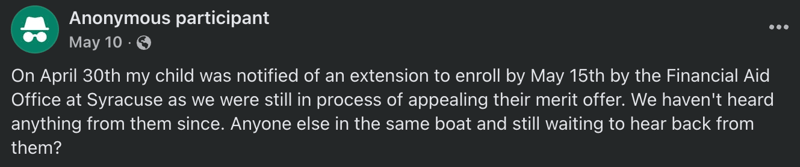
The aid messaging is the second, and in our communities it may be doing more damage than the price. After the 2025 episode became public, the takeaway families repeated was not "Syracuse is generous." It was some variation of "Syracuse plays games."
Parents described feeling like they were dealing with a used-car salesman — that the published deadline and the first offer were openers, not real numbers, and that the family who trusted the process paid more than the family who walked away. And many were now waiting because they felt that Syracuse would wait to offer more aid.

That is a corrosive thing for a college to teach the people considering paying for it. Once families believe the aid number is a tactic rather than an assessment of their student, some stop applying altogether rather than risk being the ones who get played.
This is the part of the story the "new normal" framing misses entirely. National demographics don't explain why our readers specifically distrust Syracuse's financial aid office. That distrust was earned, and it is showing up in the exact behavior a tuition-dependent school can least afford: qualified families choosing not to apply at all.
What This Means For Families Considering Syracuse
For households weighing Syracuse, the lesson is simple: the sticker price is high and the discount system is opaque. Cost of attendance is nearing $95,000 a year, and while the university touted a 7% increase to its aid budget last year, bringing the total to $391 million, families learned that the timing and size of an award could hinge on whether they held out rather than on a student's record.
The deficit also raises practical questions for current students. Budget gaps tend to surface in larger class sizes, thinner student services, deferred maintenance, and pressure on the programs students enrolled to study.
Syracuse has already started some changes: in April, the university announced it would sunset 93 programs through an Academic Portfolio Review — cutting a catalog of roughly 460 degree programs and certificates that Provost Lois Agnew noted was "well above the peer average of roughly 200 programs" at comparable institutions.
The university also offered voluntary retirement packages to about 175 faculty. By the provost's own figures, 55 of the 93 programs had zero students enrolled, and the closures affect 258 students (about 1.2% of the student body) all of whom will be allowed to finish their degrees.
Agnew stressed the review "was not a cost-cutting exercise" and that no positions were slated for elimination, framing it instead as "disciplined stewardship." Even taken at face value, it is a striking amount of institutional restructuring to land in the same window as a budget warning. Families paying near six figures a year have a reasonable expectation that the catalog they chose will still exist at graduation.
For prospective students, the practical move is to treat any single school's financial aid offer as a starting point, not a verdict, and to compare net price across multiple schools.
This cycle once again showed that schools facing enrollment pressure may sweeten offers after May 1 — but counting on that is a gamble.
What Happens Next
Haynie is right that demography is tightening. The number of 18-year-old high school graduates peaked at 3.9 million last year and is projected to decline for the next 15, a squeeze every tuition-dependent school will feel.
But that is precisely why the "new normal" framing deserves scrutiny: if the headwinds are universal, the differentiator is execution — and Syracuse's execution is what failed.
Other expensive institutions face the same demographic cliff without generating headlines about poaching their rivals' declined applicants after the May 1 deadline, ignoring parents' emails, or gutting the office that supports international students. Blaming macroeconomics for an outcome your competitors avoided is not analysis, it's deflection.
The deficit is a moment of accountability for an administration that, over the past year, raised prices, restructured programs, mishandled aid, and let its international-student support erode — then asked families to trust that everything is under control and that the rest of higher education is in the same boat.
Whether Syracuse emerges "stronger," as Haynie predicts, will depend less on the national environment than on whether leadership stops treating the families who pay the bills as variables to be optimized.
One of the biggest reasons families distrust higher education is pricing, and Syracuse is a prime example as to why.
Don't Miss These Other Stories:
Editor: Colin Graves

Robert Farrington is the founder of The College Investor and is widely recognized as one of the nation’s leading voices on student loan debt and saving for college. He holds an MBA from UC San Diego Rady School of Management and has spent over 15 years researching, writing, and advising on student loans, 529 plans, financial aid programs, and saving and investing for young professionals.
Robert has been featured in the The New York Times, The Wall Street Journal, The Washington Post, NBC News, and Forbes, where he has been a regular personal finance contributor for over a decade. His work combines both professional expertise and personal experience – he successfully navigated his own student loan repayment journey and has helped thousands of readers do the same.
He is committed to making the intersection of personal finance and education transparent and accessible. You can learn more about Robert on the About Page or on his personal site RobertFarrington.com.