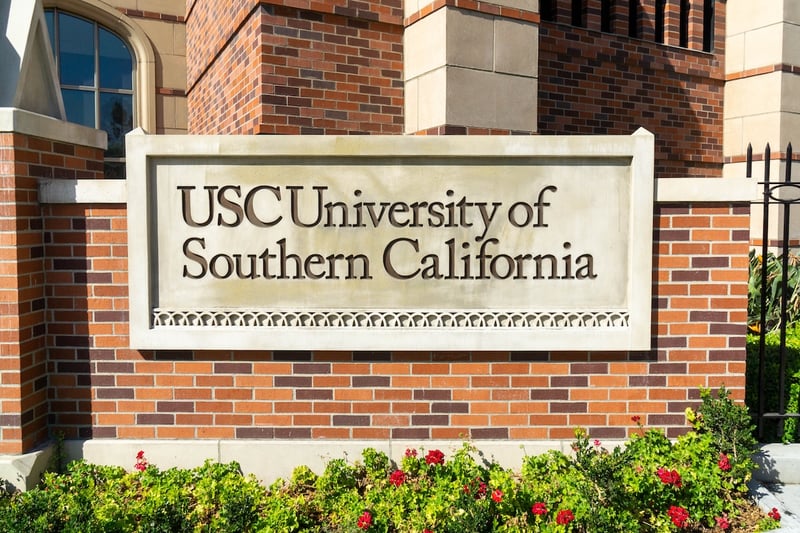
Nearly one-fifth of USC Marshall School of Business's faculty has signed a letter to Dean Geoffrey Garrett warning that one of the country's most recognized business schools is on a "downward trajectory" in academic reputation, research excellence, and student quality.
The 52 faculty members accuse leadership of centralizing decision-making, freezing out faculty input, and producing a revenue shortfall that proposed PhD program cuts alone cannot cover.
Why It Matters: USC Marshall enrolls nearly 7,000 business students. Public faculty letters of this scale at a top business school are rare and they typically signal deeper financial and governance problems than the public sees. The letter lands two weeks after Marshall's full-time MBA program dropped to No. 25 in U.S. News & World Report, down 10 spots in three years.
By The Numbers
- 52 tenured faculty signatories spanning every Marshall department (Marketing, Finance, Accounting, Management, DSO)
- 4 MBA programs flagged for "significant revenue shortfall" in the coming academic year
- 10-point list of demands sent to the Dean
- May 1 deadline for a written response
- May 4 faculty meeting scheduled by Dean Garrett
The Faculty's Concerns: The letter argues Marshall's slide is not just a sector-wide problem. "Many of our peer institutions appear to be weathering these pressures more effectively," the signees wrote, pointing to a "centralization of decision authority and a reduction in the information and consultation provided to the faculty."
The letter also calls out a structural issue: graduate admissions, career services, and program marketing report through Marshall's business-side leadership rather than through senior academic leaders. Faculty say this creates a tension between revenue targets and admissions standards that they want realigned.
What They're Demanding: The 10-point plan includes full budget disclosure with underlying figures, year-over-year admissions data across every program, a written two-year revenue strategy with named accountable leaders, a written expenditure-reduction plan, monthly standing updates to the Faculty Council, and formal faculty consultation before any further cuts.
The Other Side: Some of these requests (particularly access to all enrollment and admissions data and monthly budget briefings) would effectively position faculty as a quasi-board overseeing the dean. That's a structure most university administrations push back on, and one that would generate friction in nearly any private-sector parallel.
How This Connects: The Marshall situation reflects a wider squeeze across higher education. Graduate program revenue, particularly from international MBA and MS students, has propped up many business schools as undergraduate margins thin.
When yield drops and waitlist conversions stall (as the Marshall letter alleges) schools face an immediate hole in operating budgets. This is especially challenging in the current environment for international graduate students.
Students considering an MBA should pay close attention to program stability, faculty turnover, and ranking trends when choosing where to enroll, because these factors directly affect the value of the degree at graduation.
Full Text Of The Letter
Here's the text of the letter as provided to The College Investor:
FACULTY LETTER TO DEAN GARRETT
Dean Geoffrey Garrett
USC Marshall School of Business
cc: Senior Vice Dean Greys Sosic; Vice Dean Patricia Mills; Vice Dean Rahsan Akbulut; Vice Dean Kyle Mayer; Vice Dean Sarah Townsend; CFO Janet Horan; Marshall Faculty Council
Dear Dean Garrett,
We write as tenured members of the Marshall faculty to express serious and shared concerns about the current state of the School, and to request substantive engagement from you and the School’s leadership. The School has proposed cuts to the PhD Program at the Marshall School of Business by reducing funding and operating it at an infeasibly small scale. These changes would place the program at serious risk of elimination and could have significant negative consequences for the School’s academic reputation. The proposed cuts have led to additional discussions among the faculty that have made it clear to us that there are a variety of serious concerns unrelated to the PhD program. Preliminary admissions figures across our four MBA programs point toward a significant revenue shortfall in the coming academic year. While this group acknowledges various external factors that may be shaping enrollments, and this has been communicated, questions have been raised about how these marketing and admissions decisions are being handled and what this means for our financial viability. Waitlisted applicants to our MS programs appear not to be converted to admitted students at rates consistent with market demand. We have lost a number of talented faculty to other institutions. Further, the recent resignations of senior leadership raises serious questions about whether academic leaders at Marshall currently have the authority and visibility needed to manage the programs for which they are held responsible. Taken together, we believe these developments point to a School-wide situation that warrants open, data-driven, and collective discussion that goes beyond conversations about individual cuts to programs and positions.
We believe that there are clear signs of our downwards trajectory in terms of academic reputation, commitment to excellence in research and the demonstrated academic excellence of the students which graduate from our programs. This downward trajectory does not appear to be based only on environmental conditions; Many of our peer institutions appear to be weathering these pressures more effectively. This downward trajectory has coincided with a centralization of decision authority and a reduction in the information and consultation provided to the faculty. The Marshall Faculty Council requested clarification on this issue and was told that this was being communicated. However, the consensus among faculty is that decision authority and information does not rest with those who need to do their jobs, and this is leading to a demonstrated decline in the enrollments and quality of students at our school.
We do not believe this pattern can be addressed without a substantive change in how the School engages with its faculty regarding budget, enrollment, and shared governance. Until now, the faculty have been given neither the information nor the consideration of their input that would be necessary to contribute meaningfully to addressing the challenges faced by the School. In the recent meeting with the Faculty Council, the Dean expressed disappointment when it was indicated that the faculty shared this opinion. However, the faculty continue to feel that there is considerable discussion about what factors are influencing Marshall externally, but limited justification for the factors that are shaping these issues internally. We therefore formally request an immediate and substantial change in approach. As a starting point, we respectfully provide a set of specific requests that we believe are the minimum necessary for responsible faculty engagement.
Budget and Revenue Transparency
1. Full budget disclosure. A written presentation of the current-year budget actuals, the projected shortfall for the coming year, revenue projections by program, and the key assumptions underlying those projections, including sensitivities to enrollment variation. We ask for the underlying figures, not a summary. While we understand that the budget has not yet been approved, it has been made clear that the long term return of the PhD Program would depend on our financial situation in future years and we would like to see clarity on which items the budgeting is currently flowing towards.
2. Enrollment and admissions data. Current application, admit, yield, and waitlist data for all degree programs (full-time MBA, part-time MBA, MS programs, undergraduate, and PhD),with year-over-year comparisons. We would specifically like to understand the rationale for current conversion decisions on waitlisted MS applicants. There have been statements made that this data was publicly available and shared with those in decision making roles, such as program directors, but the sentiment of many in those positions is that they are not receiving the information they deserve.
3. Written revenue strategy. A written statement of the School’s revenue strategy for the next two years, including concrete plans for: fundraising and fundraising goals, graduate admissions and yield, career placement and employer relations, executive education, and corporate partnerships. Each element should identify the accountable leader and a timeline.
4. Written expenditure plan. A written expenditure-reduction plan covering the full School budget, with the projected savings attributed to each element. We note that cuts to the PhD program alone cannot absorb the projected shortfall, and piecemeal announcements do not allow the faculty to evaluate trade-offs in a meaningful way.
Governance and Reporting Structure
5. Review of reporting structures for revenue-critical functions. Graduate admissions, career services, and program marketing are central to the School’s academic mission and financial health, yet currently report through the School’s business-side leadership rather than through senior academic leaders. This structure creates a tension between financial targets and academic standards, especially in admissions decisions. We request (a) a written description of the current reporting structure and the rationale for it, (b) identification of which senior academic leaders hold authority over admissions outcomes and standards for each program, and (c) a proposal to realign reporting so that academic judgment on admissions quality is not subordinated to revenue targets.
6. Clarity on business-side and academic leadership boundaries. A written clarification of the scope of authority of the School’s senior business-side leadership relative to academic leadership, particularly for functions that directly affect academic programs. Recent events suggest this boundary has drifted and that faculty are not sufficiently involved in governance, but are impacted by these decisions. There is also sentiment that had faculty been consulted, better decisions would have been taken and that the School would be in a better position today.
Faculty Consultation and Process Going Forward
7. Communicate the school’s vision clearly. A coherent, forward-looking strategy for the school’s trajectory should be communicated to the faculty. Rather than focusing narrowly on cost-cutting due to external factors, this vision must outline how USC Marshall intends to strengthen and sustain its position as a top-tier institution, including but not limited to its intentions towards investing in research, strategic hiring and retaining of top faculty, and recruitment of high-caliber students. Moreover, it should also indicate how the school will clearly and effectively communicate these priorities to external audiences to reinforce the school’s brand and market its value.
8. Formal faculty consultation before cuts are enacted. Meaningful consultation through the Faculty Council before decisions are finalized, not briefings after the fact. There is sentiment among the faculty that this is not currently being done sufficiently and that faculty feedback is not sufficiently considered. When cuts must be made, faculty are best positioned to advise on which academic capacities are most important to protect.
9. Regular standing updates. At least monthly standing updates to the Faculty Council on budget, enrollment, and the revenue and expenditure plans above, through the end of the fiscal year.
10. Response timeline. A written response to this letter, with the information requested above and a proposed standing meeting to discuss it, by May 1. The faculty plan to discuss this response shortly afterward to determine next steps.
We raise these points because we are committed to Marshall and because we believe our school faces a critical moment in which faculty engagement is needed. We recognize the headwinds faced by higher education. However, these headwinds are not uniformly affecting all institutions. A growing gap in higher education is leaving elite schools relatively secure while pressuring mid-level institutions toward decline. USC sits at a critical juncture where its continued status depends on its reputation which critically depends on its commitment to research and academic excellence. We trust that you share this view and look forward to your response.
Respectfully,
[Signees]
Milan Miric, DSO
Kristin Diehl, MKT
Jinchi Lv, DSO
Clive Lennox, ACC
Nandini Rajagopalan, MOR
Stephanie Tully, MKT
Yingying Fan, DSO
Paat Rusmevichientong, DSO
Dina Mayzlin, MKT
Lan Luo, MKT
Gourab Mukherjee, DSO
Mladen Kolar, DSO
Matteo Sesia, DSO
Davide Proserpio, MKT
Peer Fiss, MOR
Omar El Sawy, DSO
Adel Javanmard, DSO
Scott Wiltermuth, MOR
Leigh Tost, MOR
Şelale Tüzel, FBE
Sivaramakrishnan Siddarth, MKT
Ayse Imrohoroglu, FBE
Kevin Murphy, FBE
Mark Young, ACC
Joseph Nunes, MKT
Shane Heitzman, ACC
Richard Sloan, ACC
Cheryl Wakslak, MOR
Joe Raffiee, MOR
Shantanu Dutta, MKT
Thomas Cummings, MOR
Tom Chang, FBE
Peter Kim, MOR
Jacob Bien, DSO
Xin Tong, DSO
Vishal Gupta, DSO
Anthony Dukes, MKT
Sha Yang, MKT
Joseph Priester, MKT
Jerry Hoberg, FBE
Selahattin Imrohoroglu, FBE
Nan Jia, MOR
Max Wei, MKT
Mark Soliman, ACC
Eric Anicich, MOR
Arvind Bhambri, MOR
Lukas Schmid, FBE
Rodney Ramcharan, FBE
Sriram Dasu, DSO
João Ramos, FBE
Gulden Ulkumen, MKT
T.J. Wong, ACC
Editor's Note: Story has been updated to reflect that the 52 faculty members represent roughly one-fifth of all faculty.
Don't Miss These Other Stories:
Editor: Colin Graves

Robert Farrington is the founder of The College Investor and is widely recognized as one of the nation’s leading voices on student loan debt and saving for college. He holds an MBA from UC San Diego Rady School of Management and has spent over 15 years researching, writing, and advising on student loans, 529 plans, financial aid programs, and saving and investing for young professionals.
Robert has been featured in the The New York Times, The Wall Street Journal, The Washington Post, NBC News, and Forbes, where he has been a regular personal finance contributor for over a decade. His work combines both professional expertise and personal experience – he successfully navigated his own student loan repayment journey and has helped thousands of readers do the same.
He is committed to making the intersection of personal finance and education transparent and accessible. You can learn more about Robert on the About Page or on his personal site RobertFarrington.com.