
When’s the last time you thought about your own memory retention? It probably wasn’t recent. That’s because memory retention is something we all know we can do, but we don’t often think about how we do it or even if there’s a better way to do it.
It turns out there really are ways to enhance our learning and retention. If you need a refresher, memory is the cognitive process that creates the very framework through which we make sense of the world. It’s imperative in learning and using new skills, information, and tactics that help us interact with our surroundings.
So how do you make the knowledge synthesis process easier on yourself? In just a few simple steps, beginning with understanding how your mind actually wants to take in new information.
How The Brain Processes New Information
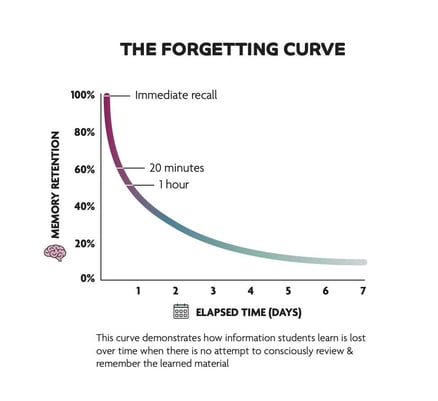
Before diving into any specific learning technique, it’s important to understand how the brain processes new information. Learning organizes and reorganizes the brain, and different parts of the brain want to take in new information at different times. So, in order to retain new information, we need to refresh it periodically.
A common example is trying to remember a new address. Let’s say your best friend moves. Can you immediately repeat their address back to them, or even recall it from memory? Not likely, because if you’re using that information infrequently, your brain files it into the “keep for later” folder.
The problem is that the “keep for later” folder can be hard to find when you do need that information. This phenomenon is referred to as the Forgetting Curve, which predicts the decline of memory retention over time. It’s basically a more scientific way of saying “use it or lose it.”
Interestingly, our memories have two different strengths: storage strength and retrieval strength. Storage strength is an indicator of how well we’ve learned something, whereas retrieval strength indicates how accessible that something is. So, once we’ve acquired new information that the brain deems important, it’s locked inside; however, the ability to access that new information is what needs regular maintenance.
This is where spaced repetition comes in: the more often you encounter the same information, the less often you’ll need to refresh your memory of it.
What Is Spaced Repetition And Does It Really Work?
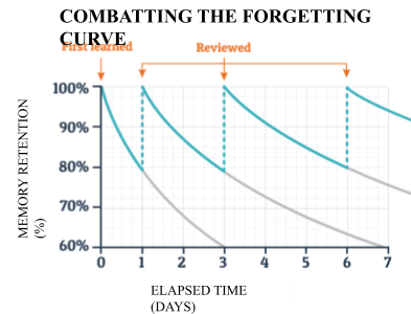
Spaced repetition is an evidence-based learning technique dating back to the late 1800s. It is based on the idea that people tend to forget things over time, and that memory can be improved by reviewing and practicing information at increasing intervals. The technique is widely used in education, language learning, and other areas where there’s a need to optimize long-term information retention.
The concept of spaced repetition works like this: after exposing the brain to new information, you strategically space out review sessions to recall the material you’ve learned. At the beginning of the learning process, intervals are spaced closely together (i.e., one hour or one day). As the material is steadily absorbed, learning intervals are more spaced out (i.e., one or two weeks).
This technique encourages short studying bursts over multiple sessions instead of cramming content into a single studying period. As your time intervals expand, so does your ability to retain information. The effectiveness of spaced repetition is supported by cognitive psychology research and is the basis of several popular learning techniques.
Keep in mind that learning techniques are only helpful as long as they work for you. We all learn in different ways, so plan your study intervals according to your own learning style. That said, a spaced repetition study schedule might look like this:
Time To Test | Study Gap |
|---|---|
1 week | 1-2 days |
1 month | 1 week |
3 months | 2 weeks |
6 months | 3 weeks |
1 year | 1 month |
Besides improving memories, here are some other benefits of spaced repetition:
- Enhanced Retention: You learn to remember information for longer because your memory is reinforced at optimal time intervals.
- Efficient Learning: The time needed to study is reduced by focusing on the information you’re more likely to forget.
- Personalized Learning: Intervals can be adjusted based on your individual learning speed, helping break up larger tasks into smaller segments.
- Long-Term Knowledge: This specific technique helps your brain build memories with high levels of storage strength and retrieval.
- Reduced Cramming (and study-related anxiety): Spreading out your study sessions reduces the need for last-minute cramming.
Eight Ways To Incorporate Spaced Repetition
The most important factor in learning something new is how often you practice remembering it. Luckily, there are multiple ways to implement spaced repetition into your study routine. Here are the most recommended methods:
Delayed Review
Based on the science of memory decay, this technique highlights the need to let new information marinate in the brain. Allow yourself to forget some of the material you learned. The next time you review it, you’ll struggle with it, but your retention will be much higher. Your study schedule should incorporate gaps in each subject that allow you to come back later, i.e., delaying your review to allow for space between repetitions. That might look like this:
Day 1 | Day 2 | Day 3 | Day 4 |
|---|---|---|---|
Math | History | English | Science |
Science | Math | History | Engllish |
English | Science | Math | History |
Interleaving Topics
When you are learning two or more related topics, instead of focusing only on one at a time, it can be helpful to alternate between the two. This method is similar to Delayed Review, but instead of spacing your subjects across multiple days, it spaces subjects across a single study day. This technique helps you build connections among your subject areas.
End-Of-Day Review
The science of memory shows that people tend to forget half of what they learn in a day. So a good time to review newly learned material is at the end of the day, which boosts your mind’s ability to engage in active recall.
Shoebox Method (Leitner System)
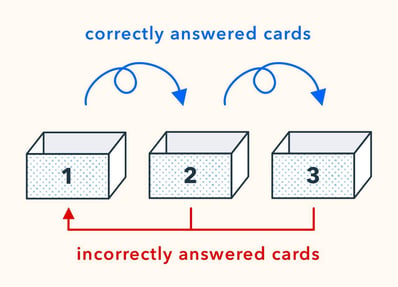
This method is designed to focus on subjects that are more challenging to recall, while minimizing repetitive study of subjects that are well understood. Not only does this reduce total study time, but it allows you to observe your progress and improvement. To use this method, start by building a deck of flashcards using the material you are studying. Write a phrase or concept on one side and the explanation on the other. Next, find 3-5 containers that will be used to house your flashcards as you work through them. (This can be something as simple as a shoebox!)
Give each container a label with a designated study time: Box 1 = every day, Box 2 = every other day, Box 3 = once a week, etc. With all flashcards beginning in Box 1, review each card for information recall. If you answer a card correctly, move it into Box 2 to review later. If you answer incorrectly, place the card back in Box 1. The goal is to work through all of the cards until you can comfortably answer each one correctly.
Kanban Board
The Kanban Board is intended to be an agile work management method, built on the philosophy of continuous improvement. This is similar to the Shoebox Method, but it is done on an electronic device instead of with physical flashcards. Popular apps that integrate this method are Trello and Notion.
Study Timetable And Retrospective Revision
A Prospective Study Timetable is basically just a calendar, but instead of displaying holidays and events, it lists the subjects you need to review on specific days. Essentially, you are scheduling your repetitions ahead of time. A common spacing interval here is to double the time you start with. For example, if you schedule review time two days after learning new material, then schedule another review four days after that, eight days after that, and so on.
The Retrospective Timetable leads with the subject instead of the date: repetitions aren’t planned out on a calendar, rather you choose what you want to study based on your areas of weakness. Color-code your study schedule based on how comfortable you feel with the material as you review it (see example below), then focus on tougher subjects as you progress.
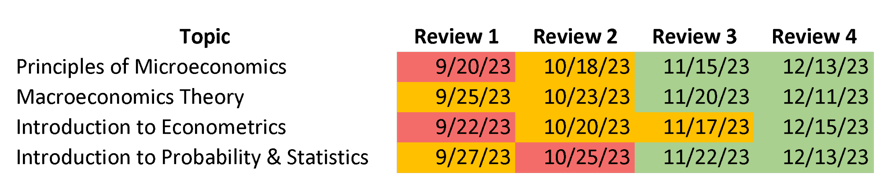
Retrospective Outliner
Similar to Retrospective Revision, repetitions aren’t just applied to your study topics but to individual concepts within the topic. For example, instead of studying for the topic of business management, zoom in and study individual facts about the current course material, such as corporate social responsibility, consumer risk, bankruptcy, or whatever it may be. This method works well with note-taking apps like RemNote.
Apps With Built-In Space Repetition Algorithms
I’ve mentioned a few useful apps already, but there are many more available to support your studying and memory retention needs. Newer options include Brainscape, Quizlet, Clever Deck, Duolingo, and Memrise. These apps essentially gamify the act of studying through spaced repetition.
Related: Best Flashcard Apps For Students
The Takeaway
When our brains take in large amounts of new information at once, the rate at which we forget that information varies based on a few factors. First and foremost is your studying technique, but an important and often overlooked aspect is your study environment. My advice to you: as you think about your next study session, plan to do it in a new location.
There is evidence that changing the location from where material is first studied to where it is reviewed actually enhances learning – and especially recall. Integrating spaced repetition is almost nothing without engaging active recall. Remember, your brain needs training in both storage strength and retrieval strength, so make sure to combine spaced repetition work with active recall activities.
By now, you’ve hopefully pinpointed at least one method of spaced repetition to integrate into your own study habits and help enhance your long-term retention. Regardless of which one you choose, be sure to start the process early to ensure it works with your schedule and learning style. Break the material into bite-sized pieces, vary your study sessions, use study apps where possible, and – above all – take breaks! Your brain is working hard for you, so pencil in some time to let it rest, too. Happy studying!
Editor: Ashley Barnett Reviewed by: Robert Farrington

Allison is a policy- and budget-analyst turned personal finance writer with a strong interdisciplinary background in science, government policy and quantitative research.
Based in the Pacific Northwest (by way of being a self-acknowledged transplant), she writes about finance, education, student debt and public policy issues. She uses her analytical foundation to ask the big questions behind personal finance trends, tax rules and student aid policy — and brings actionable insights to readers.
Outside her policy and finance work, Allison also writes about fitness, wellness and curiosity-driven topics that spark discussion.