
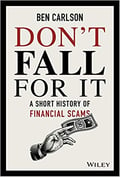
Don’t Fall For It: A Short History of Financial Scams examines not only how scam artists carry out their fraudulent schemes but also gets into the psychology behind why victims fall prey to begin with.
Author Ben Carlson tells the real-life stories of some of the most notorious hucksters and charlatans, along with the impact their scams had on their victims.
From the story of Ivar Kreuger, also known as the Match King from Sweden, to the horrific deception of Bernie Madoff and his multimillion-dollar Ponzi scheme, Carlson tells the sensational stories of con artists that rocked history.
Quick Summary
- Read the stories behind history's biggest financial scams.
- Discover the tried-and-true tactics most fraudsters rely upon.
- Learn how to avoid falling prey to scams in your own financial life.
Overall Summary
Carlson puts a spotlight on the scams that stand out in history, breaking down the events and wrapping up the stories in neatly defined independent chapters. This allows the reader the option to skip ahead to the stories that they find most interesting.
From the story of Ivar Kreuger, the Match King from Sweden, to the devastating impact of Bernie Madoff’s multibillion dollar Ponzi scheme - readers have their pick of some of the most despicable con artists to ever live.
Beyond being a good read on some of history’s most notorious bad guys, Don't Fall For It also delves into the reasons why people buy in to seemingly obvious scams. And it also shows how these scams have been able to dupe a wide cross-section of society -- including the rich and famous and even sitting presidents!
Chapter Summary
Chapter 1: No One Sells Miracles
Don’t Fall For It starts off with describing how medicine and fraud have long gone hand-in-hand throughout American history. Rather than preying on greed as many scams are prone to do, medical quackery involves promising to alleviate disease and bring on healing. And they play up to one of our worst fears - death.
Before penicillin was discovered in 1928, the general public knew little about their healthcare options. As a result, quacks, hucksters and charlatans had an open playing field to scam their way into the lives of millions.
Many Americans were taken advantage of by the medical quacks and snake oil salesmen of the early 19th century. One such quack was John Brinkley. Brinkley was an unscrupulous man who never finished medical school but set up practice in South Carolina with a partner after buying a diploma for $100.
Brinkley’s scam was quite gruesome. He convinced vulnerable patients that implanting goat’s testes into their scrotums would increase their fertility and virility. In the 1920s, he was charging $750 a procedure - a tremendous amount of money in that day.
By becoming an early radio darling, he was able to charm the masses and essentially made millions in advertising his procedure. Dozens of victims died at the hands of his fake medicine.
Chapter 2: How To Sell Anything
Gustav Eiffel designed his namesake tower as a temporary landmark, erected for recognition at the World’s Fair of 1889. It was originally intended to stand only for two decades, after which it was to be taken apart piece by piece.
The con artist Victor Lustig, a man with 45 aliases, decided to fraudulently sell the Eiffel Tower. As a young man traveling on an ocean liner from Europe to America, he had started out as a gambler but became a student of the wealthy elite.
In Paris, he created a fake government role for himself. He had stationary and cards printed complete with an embossed French seal to cement his legitimacy. His newly created (and absolutely fake) government title was born: “Deputy Director General of the Ministry of Posts and Telegraphs.”
Setting up shop at the haughty Hotel de Crillon, Lustwig attempted to sell the Eiffel Tower off for scrap metal, claiming the French government was tearing down the poorly maintained structure. Lustig sold the Eiffel Tower to Andre Paisson, a naive newcomer to the scrap business, and fled the country soon thereafter.
Chapter 3: Fast Money
Carlson delves into the behavioral and psychological reasons behind America’s love of acquiring money with little effort. He goes into detail on how near misses and actual success register similarly in the brain. And that's one reason why so many gamble, even when the odds are stacked heavily against them.
But what about the few that hit it big with a lottery win or when young athletes sign lucrative contracts? Carlson covers how fast money often leads to disastrous outcomes. The fast wealth often leads to dramatic lifestyle creep almost instantaneously. Many of the people he wrote about in this chapter lost everything from relationships to financial security.
Often impressionable and without any financial guidance, these victims were soft targets for opportunistic scam artists. Don't Fall For It warns readers against trusting "advisors" or "consultants" too easily. And always do your homework before making major financial decisions.
Chapter 4: It’s The End Of The World As We Know It
From the end of the world to the next bull market, Carlson reminds his readers that no one can predict what lies in the future.
Don't Fall For It details how pessimism sells better than optimism. A morbid interest in what can go wrong creates a thriving market. Negative stories stick better than positive ones. And the press reports on good news gradually, while bad news hits quickly.
Carlson also reminds readers that our brains naturally fight news and opinions that we don’t agree with. But keeping an open mind is important if you want to avoid being fooled by scams.
Chapter 5: Sleight of Hand
After a successful run on the US ski team, Molly Bloom headed to Hollywood where she oversaw celebrity poker games attended by Hollywood’s elite. One frequent player was hedge fund manager Bradley Ruderman.
While Ruderman wasn't a celebrity, he won a seat at the table thanks to his deep pockets. He was a horrible poker player, earning the name “Bad Brad” for almost constant losses. But the laid-back Ruderman didn’t mind losing because his sole intention was actually hooking wealthy new investors.
As talk around the table would turn to business and financial matters, Ruderman claimed his hedge fund was returning 60% a year. In reality, Ruderman was running a 44 million Ponzi scheme by scamming friends, family and his new rich Hollywood companions out of their money.
By the time his Ponzi scheme came to light, it was determined by the FBI that Ruderman spent 9 million of invested money on his fraud. By losing buckets of money gambling, he presented himself as someone so rich that losses didn’t matter. And this worked very well in luring victims for Ruderman’s fraud.
Chapter 6: When Success Doesn’t Translate
Don't Fall For It stresses that living a rich life and having a high net worth are two very different things. Carlson explains how the human desire for progress keeps many in a constant pursuit for more, regardless of their social standing.
The restlessness that accompanies the need for additional wealth leaves many to risk what they have - done even once, a person can lose everything they have at the hands of a charlatan. Overconfidence in investment skills can bring serious damage to your savings. And trusting in the wrong individual just once can lead to a wrecked financial future.
Carlson stresses that the flipside is also true. Meaning, one only needs to learn how to manage money once for a stable financial future. He explains how diversifying your money is important for everyone, regardless of your level of wealth.
Chapter 7: When Fraud Flourishes
When looking in hindsight at a fraudulent scheme, it's easy to spot the similarities among the hustlers and scammers. Wherever fraud flourishes, you'll find certain common themes and conditions.
Don't Fall For It explains in-depth how greed fuels fraud. The greed phase of the market cycle leaves investors easy marks for con artists. Greed can cloud vision. And con artists move on investors reaching for strategies they shouldn’t be opting for.
Con artists love to strike when things are really bad or really good. Market booms and busts play with our emotions in different ways. It's important to take time and care when making a big financial decision. Charlatans are waiting to pounce on blind confidence. And panic often equals gains for unscrupulous hucksters and con artists.
Chapter 8: The Siren Song of New Technologies
Technological innovation isn’t necessary for fraud to occur. But it can definitely make it a lot easier.
With media coverage now following current events on a 24/7 basis, it's easy to feel overly optimistic or pessimistic about the future. And non-stop access to the news could be blamed for many investment theories that have been blown out of proportion.
Knowing what is going on all the time means we also know when others are getting ahead and growing wealthier. All this can lead to a serious case of FOMO (Fear Of Missing Out) which, in turn, can lead us to overspend to keep up with our peers.
Related: Avoid Overspending By Using These Popular Budget Apps
Chapter 9: The Seductive Power of FOMO
Carlson writes of the one defining characteristic of someone who takes advantage of others financially. It's the ability to make people believe what you are saying.
Ivar Kreuger, a wealthy businessman from Sweden controlled 75% of all matches being produced in the 1920s. This meant he held power and prestige. And Kreuger moved in prestigious circles and even owned a private island in the North Sea.
Eventually, Kreuger transitioned from Match King to stock promoter. Again, this was in the 1920s when investors were going crazy for anything Wall Street based. So the mysterious Swedish businessman was unstoppable. He opened companies that had no assets and lied to investors about their returns.
By 1932, Krueger not only controlled the largest match company in the world, but also owned newspapers, real estate, telephone companies and banks. Unfortunately, he had built up a house of cards. He had $1 billion worth of fraud claims at the time of his suicide that same year.
Chapter 10: Type I Charlatan
Type I Charlatans are sincere out the gate. But they wind up ruining their investors due to unintended consequences. These charlatans are visionaries and are usually very passionate about their ideas. And even when things begin to fail they have trouble pulling the reins in.
But, as Don't Fall For It explains, when you combine intellect and passion with people who would like to make a boatload of money, it's easy to develop blind spots to potential risks in their schemes.
Chapter 11: Type II Charlatan
Type II Charlatans are outright fraudsters who want to take people for all they're worth. They have no cares whatsoever when it comes to hurting their victims. Type IIs know how to swindle, telling you exactly what you want to hear.
These types of fraudsters often develop well thought-out schemes that are excellently presented. Make no mistake, a Type II Charlatan knows exactly how to sell you.
In this chapter, Carlson explains how John Blunt was the personification of a Type II Charlatan. Blunt was the founding director of the South Sea Company. He used its unique corporate structure to seduce the wealthy into a get-rich-quick scheme.
Blunt was not an intellectual. But he was determined and was an excellent salesman. His one aim in life was to become rich as swiftly as humanly possible. Blunt bribed the courts, lied to royalty, bribed the Secretary of Treasury and spread rumors to increase his stocks price.
Chapter 12: Fooled by Intelligence
Sir Isaac Newton is arguably the most important figure of the scientific revolution. As an early investor in The South Sea Company, he was also a venture capital pioneer.
Newton saw profits from his investing with Blunt’s fraudulent company early on. But he lost it all when using his profits to jump back in later.
Don't Fall For It details the story of Theranos, a fraudulent Silicon Valley healthcare company that was led by the modern-day fraudster Elizabeth Holmes.
Investors never thought to question Holmes, as she was backed by so many prestigious individuals including former Secretary of State Henry Kissinger and Former Secretary of State George Shultz. Holmes even had the audacity to walk Joe Biden through a fake facility!
Chapter 13: How Gullible Are You?
Psychologist Stephen Greenspan is an expert on human gullibility. He explains how a gullible outcome is the result of interaction between the following four factors: The Situation, Cognitive Processes, Personality and Emotional State.
Carlson writes about the importance of understanding the sacred relationship between risk and return. He explains how Bernie Madoff promised consistent returns of 10% to 12%, which is not extraordinarily higher than the average return of the S&P 500.
Madoff didn't advertise higher returns because he wanted his false promises to be believable. And that's a major reason why his well-educated investors remained gullible and bought into his scheme.
Chapter 14: The Easiest Person to Fool
Don’t Fall For It covers the topic of how easy it is to lose a fortune. Carlson acknowledges that it takes hard work to amass large fortunes. And the biggest fraud of all is often the financial pain we inflict on ourselves via poor decisions.
From George Vanderbilt’s excessive lifestyle at the Biltmore, to Johnny Depp’s eccentric spending habits are cited as examples of what not to do with tremendous personal wealth.
Carlson ends his book with a solid warning - “If you can’t prioritize your spending habits, you will never be able to save enough to get ahead, no matter how much money you earn.”
About The Author
Ben Carlson previously authored A Wealth of Common Sense: Why Simplicity Trumps Complexity in Any Investment Plan, and Organizational Alpha: How to Add Value in Institutional Asset Management.
Carlson spent his career helping various nonprofit, institutional, and high-net-worth clients with investment planning. He is currently the Director of Institutional Asset Management at Ritholtz Wealth Management and is the creator of a financial blog and podcast.
We consistently list his financial blog, A Wealth of Common Sense, one of our top picks of best investing blogs for the past five years.
Final Thoughts
Carlson described the historical events and the colorful characters in the book with excellent detail and clarity. Don’t Fall For It is an interesting and enlightening read about history's most notorious charlatans driven by extreme greed, sociopathy and a penchant for power.

Teresa Stack Hunter is a freelance writer with two decades of journalistic expertise, and earned dozens of bylines with Thrive Global, The Reston Times, The Washington Citizen and The Kent County News. Teresa also worked as a writer-editor for The Department of Treasury, where she had the great honor of serving Under Secretary of Enforcement Ronald K. Noble, and his equally impressive replacement, Under Secretary of Enforcement Raymond W. Kelly. She holds a B.A. in Communications from Marymount University.
Teresa’s editorial background spans some of the most consequential sectors in modern life: technology, finance, healthcare, biotech, and higher education. That breadth gives her writing an unusual quality — she can connect the dots between, say, a new fintech product, the regulatory environment around it, and the real-world impact it might have on a consumer’s financial life. She approaches personal finance topics with the same journalistic rigor she would bring to a hard news story: verify the facts, interrogate the claims, and put the reader first.