
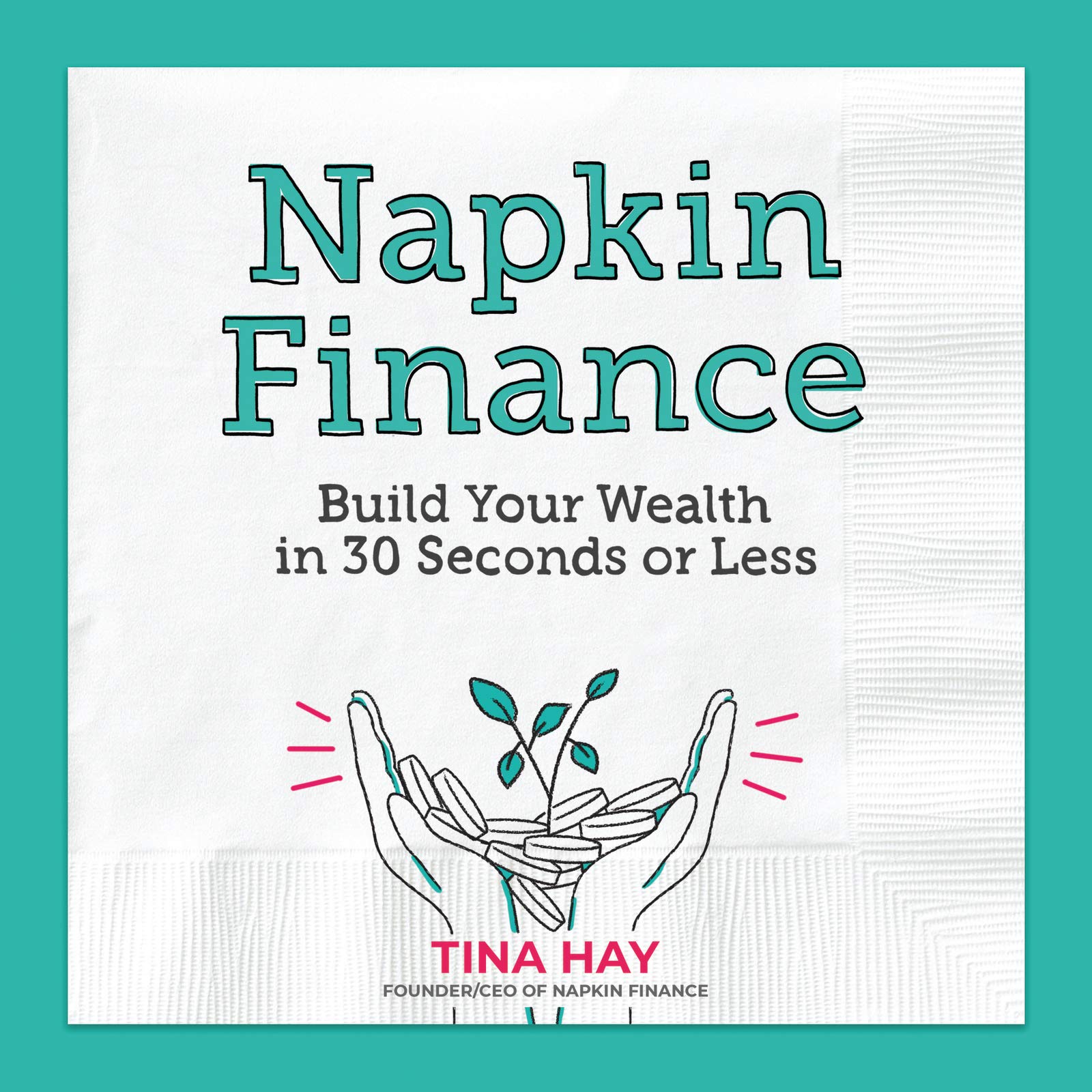
Napkin Finance by Tina Hay provides a fresh perspective on all things money, outlining the basics of personal finance and investing. It packs a tremendous amount of information into one entertaining read, delivering the material in an easy to understand format.
Napkin Finance stands apart from the dozens of others on personal finance and investing in that it is written with simplicity in mind. A real gift for people who struggle with the often complex and complicated matters surrounding the subject. However, some may find it too basic for their tastes.
Quick Summary
- A book focused on the basics of personal finance and money
- Uses graphs and illustrations to explain financial concepts
- A compact reference book for money and wealth building
Overall Summary
Given that the lack of financial literacy is a widespread problem worldwide, Napkin Finance fills a significant need to raise awareness on critical issues pertaining to saving, budgeting and investing money.
The information is presented in a clear, concise and straightforward manner, with Hay using humor and illustrations to keep Napkin Finance an enjoyable and engaging read. This book offers great reach, and is a valuable tool for people of all ages wishing to know more about how to save and invest their money.
Chapter Summary
Chapter 1 - Compound Interest
Hay opens the book with an easy to comprehend lesson on compound interest. What better way to attract the attention of her readers than by showing them the magic of compound interest and its role in growing wealth! This first important lesson lays the groundwork for saving a percentage of your earnings as a means to establish financial security from the start of your career.
This leaves the perfect opportunity to address the basics - budgeting, the power of compound interest in saving, the difference between good and bad debt, and the critical importance of building up an emergency fund.
Chapter 2 - Credit
After explaining how to grow your money, chapter two tackles the all important topic of credit - what it is, how it works and why it is of the utmost importance in life. Napkin Finance outlines what a credit report entails, and how the information contained within impacts your ability to land a job and/or secure consumer loans in the future. Readers are reminded that using credit is essentially taking out a loan with accruing interest, and as a result, Hay strongly advises paying off the balance at the end of each month.
Adhering to a personal budget is spelled out in clear terms, with the 50-20-30 plan explained as a solid option for covering basic living essentials, savings and retirement, and entertainment spending. Hay also outlines how much a person should set aside in emergency savings (3-6 months is her minimum recommendation) and stresses the importance of making sure your savings institution is FDIC insured.
Chapter 3 - Investing Basics
The third chapter of Napkin Finance delves into the basics of investing, and covers the risks and rewards in putting your money to work via stocks, bonds and other investment products. Hay explains how investments grow with time - hence the importance of having a long term plan for a winning portfolio. By breaking down the asset classes into easy to understand categories, Hay outlines the risks involved and the potential for profit.
Hay explains in detail the benefits of owning stocks (part owner of a company, anyone?) and explains how most but not all trade on stock exchanges, and that some pay dividends. Bonds are also fully explained in a clear and concise way, as are the alternative investments of hedge funds, private equity, cryptocurrencies and commodities.
The many options are clearly laid out in Napkin Finance, as well as the importance of diversifying one’s portfolio to reduce risk - Hay strongly suggests spreading money over stock, bonds and cash holdings. The risk of investing is clearly explained, with price swings being just one of them. And while riskier investments yield higher returns, the right asset allocation can help secure your returns.
Chapter 4 - Paying For College
Paying for college and graduating with the least amount of debt is well covered in chapter four of Napkin Finance. Hay advises on the many options for finding college money outside of loans - informing the college bound of the many grants and scholarships that are available, as well as addressing work study programs.
Hay does a great job of explaining the often intimidating and overwhelming Free Application for Student Aid (FAFSA) process, letting readers know that they will need to prove financial need, creditworthiness, and student status. Napkin Finance also lays out the options when it comes time to paying back the borrowed money, including encouraging words on how to max payments to break free of your college debt well ahead of the 10 year repayment arrangement.
The 529 plan is covered, and Hay explains the federal tax savings involved for parents saving for their children’s future education needs. The tax savings and no account minimum to get started makes the 529 a great option for many.
Chapter 5 - Retirement Savings
Napkin Finance does a solid job outlining retirement savings, estate planning and preparing financially for what will happen after you die in chapter five. Hay lays out the various kinds of investments available, and breaks down the difference between an IRA (tax deferred account you fund on your own) and a 401(k), which is a tax deferred account offered by employers.
The need for estate planning and securing life insurance is also well covered. Things like disability and survivor benefits, and medicare are broken down in plain english.
Napkin Finance explains the many government benefits, and what is needed to qualify for them.
Chapter 6 - The Stock Market
Chapter six gives a closer and more detailed run down of the stock market, offering a deeper dive into the workings and wild ride of a bull and bear market. Hay gives readers a window into the New York Stock Exchange (NYSE) and the Nasdaq - with the first offering a physical trading floor and electronic trading, while the latter is all electronic.
Mutual Funds and their benefits are explained - professional management, easy diversification, comparatively low fees, and strong regulatory oversight.
Hay also explains Exchange-Traded Funds (ETFs), and how a big part of their appeal is in the relatively lower cost and tax advantages when compared to mutual funds. Bonds are also covered briefly, and the fact that they are generally less risky than stocks, and involve a set interest rate.
And lastly, Hay explains what an Initial Public Offering (IPO) is, and why companies go public to raise funds.
Chapter 7 - Taxes
Chapter seven finds Hay going deep into the world of taxes. From income tax to property tax, along with a run down on capital gains and estate tax.
Hay explains the ins and outs of filing taxes as a contract employee vs. a W-2 employee. This is important, given that there are different pay schedules and deadlines for both kinds of filings.
Tax deductions are also outlined in this important chapter, with careful attention paid to the larger and more complicated ones some people may opt to list on their tax returns.
Chapter 8 - Entrepreneurship
In chapter eight, Hay approaches the risks and rewards of entrepreneurship. Napkin Finance lays out the process in bringing a business idea to life, and negates the myths of entrepreneurs needing to be rich or in possession of a completely brilliant or unique idea to get started.
A step by step approach to life as an entrepreneur is presented - for starters, coming up with an idea, a team, a product and legal help.
Hay explains that a business plan is essentially a company roadmap, and can be anything from extremely detailed or as simple as a basic mission statement. Napkin Finance breaks down how to finance your business, from bootstrapping with personal funds to seeking investors, and explains how to bring your idea into a business reality.
After a business is profitable, Hay explains the path to an IPO and about issuing bonds.
Chapter 9 - The Economy
Hay covers the many factors that affect the economy in both boom times and in periods of depression. Napkin Finance offers an overview of the gross domestic product (GDP), and explains how it measures the size of the economy and whether it is growing or shrinking at any given time.
GDP is measured by consumption, investment, government spending and exports minus imports. Investors keep a keen eye on GDP to gauge the health of the economy, and assess and analyze the signals as a means to keep on top of the market.
Chapter 10 - Business Fundamentals
Chapter ten breaks down the technical aspects of a business, and explains the role of business statements. Hay explains in very simple terms how profits and losses are measured for a company's financial performance.
This is valuable information, particularly for potential investors trying to better ascertain the health of a company.
Chapter 11 - The Future Of Money
Chapter eleven addresses the future of money, particularly addressing cryptocurrency, and how it is not controlled by a government or central entity.
Hay outlines the very real risks of these alternative currencies, and shares that while they are accepted by some companies, it is still not widely accepted. Hay explains the technology behind cryptocurrency and the implications of their use on voting, contracts and the music industry.
Chapter 12 - Rule of 72
Hay wraps up Napkin Finance with an explanation of the Rule of 72 - dividing 72 by your interest rate to figure out how long it will take to double your money.
She also writes on the importance of paying it forward, and the tax breaks that making such charitable donations bring. And a quick nod to the economic theory developed by Adam Smith known as the Invisible Hand. Essentially that when people act in their own best interest, it unintentionally benefits society at large.
About The Author - Tina Hay

Tina Hay is the CEO of NapkinFinance.com, a finance education platform that reaches over 80 million households in collaboration with partners including UBS and JP Morgan Chase.
Hay earned a B.A. from UCLA and an M.B.A. from Harvard University.
Hailing from a diverse background of film, technology and finance, Hay is now a successful entrepreneur as the head of a multimedia effort to engage, educate and inform people on financial literacy.
Final Thoughts
Breaking down the basics of finance and investing can be tricky, but Hay succeeds in keeping it simple and succinct.
As a student at Harvard Business School, Hay used graphs and illustrations to better comprehend complex financial concepts. Her past struggles at university led to the idea that a book filled with engaging visuals of graphs and illustrations would better reach the masses.
Mission accomplished - Napkin Finance packs tons of information into one compact reference book.

Teresa Stack Hunter is a freelance writer with two decades of journalistic expertise, and earned dozens of bylines with Thrive Global, The Reston Times, The Washington Citizen and The Kent County News. Teresa also worked as a writer-editor for The Department of Treasury, where she had the great honor of serving Under Secretary of Enforcement Ronald K. Noble, and his equally impressive replacement, Under Secretary of Enforcement Raymond W. Kelly. She holds a B.A. in Communications from Marymount University.
Teresa’s editorial background spans some of the most consequential sectors in modern life: technology, finance, healthcare, biotech, and higher education. That breadth gives her writing an unusual quality — she can connect the dots between, say, a new fintech product, the regulatory environment around it, and the real-world impact it might have on a consumer’s financial life. She approaches personal finance topics with the same journalistic rigor she would bring to a hard news story: verify the facts, interrogate the claims, and put the reader first.