• Skip to primary navigation
  • Skip to main content
  • Skip to primary sidebar
  • Skip to footer

Navigating Money And Education

  • About
  • Podcasts
  • Social
  • Newsletter
  • Save For College
  • Student Loans
  • Investing
  • Earn More Money
  • Banking
  • Taxes
  • Forum
  • Search
Home / Podcast / Under Secretary of Education Nicholas Kent Explains the July 1 Student Loan Changes

Under Secretary of Education Nicholas Kent Explains the July 1 Student Loan Changes

Updated: June 10, 2026 By Colin Graves | 6 Min Read Leave a Comment

Many or all of the products featured here may be from our partners who compensate us. This doesn't influence our evaluations or reviews. Our opinions are our own. Investing information is for educational purposes only. Learn more here.Advertiser Disclosure

There are thousands of financial products and services out there, and we believe in helping you understand which is best for you, how it works, and will it actually help you achieve your financial goals. We're proud of our content and guidance, and the information we provide is objective, independent, and free.

But we do have to make money to pay our team and keep this website running! Our partners compensate us. TheCollegeInvestor.com has an advertising relationship with some or all of the offers included on this page, which may impact how, where, and in what order products and services may appear. The College Investor does not include all companies or offers available in the marketplace. And our partners can never pay us to guarantee favorable reviews (or even pay for a review of their product to begin with).

For more information and a complete list of our advertising partners, please check out our full Advertising Disclosure. TheCollegeInvestor.com strives to keep its information accurate and up to date. The information in our reviews could be different from what you find when visiting a financial institution, service provider or a specific product's website. All products and services are presented without warranty.

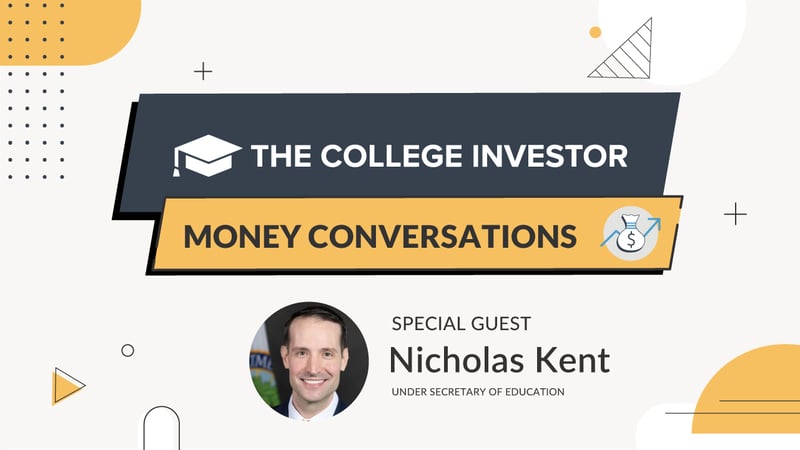
Under Secretary of Education Nicholas Kent

Key Points

  • Under Secretary of Education Nicholas Kent explains how the Working Families Tax Cuts Act simplifies the federal student aid system, cutting more than 40 repayment and discharge options down to two new plans starting July 1.
  • Kent breaks down what SAVE borrowers must do now, the 90-day transition clock, and why the new Repayment Assistance Plan (RAP) is designed so on-time payments always lower your balance.
  • Kent shares the new graduate and Parent PLUS borrowing limits and how some schools are already cutting program costs in response.

The federal student loan system is heading into the largest set of changes to borrowing and repayment in decades and most borrowers don't yet know what they need to do before July 1.

In this episode, Robert Farrington sits down with Department of Education Under Secretary Nicholas Kent, the top federal policy official overseeing postsecondary education, career and technical education, adult education, and the $1.7 trillion federal student aid portfolio. Together they unpack how we got here, what's changing, and the practical steps borrowers should take in the weeks ahead.

Kent talks about his path from a first-generation Pell Grant student in rural West Virginia to the Under Secretary's office, and why that background shapes how he thinks about the more than 40 million Americans affected by federal student aid policy. He explains why he describes today's system as a "patchwork" (or even a "Frankenstein") and how the new law aims to streamline it.

The conversation also digs into the end of the SAVE plan, the rollout of the new Repayment Assistance Plan and tiered standard plan, and a first-ever set of borrowing limits for graduate and Parent PLUS borrowers. Kent makes the case that these caps are designed to put downward pressure on the cost of higher education and points to early examples of schools already responding.

This conversation offers timely takeaways for borrowers, parents, and anyone trying to navigate the student loan changes taking effect July 1.

Would you like to save this?

We'll email this article to you, so you can come back to it later!

Episode Summary

Robert speaks with Under Secretary of Education Nicholas Kent about the sweeping student loan borrowing and repayment changes arriving July 1 under the Working Families Tax Cuts Act. The conversation explores:

  • What an Under Secretary of Education does and the higher education portfolio they oversee
  • Why the current federal student aid system is a "patchwork" being simplified
  • The end of the SAVE plan and the 90-day transition clock for borrowers
  • The new Repayment Assistance Plan (RAP) and the new tiered standard plan
  • How the RAP interest subsidy and principal matching payment can lower balances
  • New short-term Pell Grant access for high-value programs as short as eight weeks
  • First-ever borrowing limits for graduate and Parent PLUS loans
  • How loan caps are meant to lower the cost of attendance with early examples from schools
  • The "professional" vs. "graduate" program designation 
  • Degree inflation, accreditation, and program accountability
  • What borrowers should do right now to be ready for July 1

Key Moments And Topics Covered

Looking for a specific moment?

1:46 — What is an Under Secretary of Education? Kent explains the office and the Federal Student Aid, Postsecondary Education, and Career and Technical Education portfolios.

3:00 — "The who drives the what." Kent shares his story as a first-generation, low-income Pell Grant student from rural West Virginia.

4:59 — Why education isn't just a four-year degree, and championing two-year, vocational, and career and technical pathways.

6:08 — How we got here: the "patchwork" or "Frankenstein" federal student aid system and the goal of simplifying it.

9:00 — Simplifying more than 40 repayment and discharge options down to two new plans, plus the new short-term Pell program and program accountability.

10:25 — Turning to repayment: SAVE winding down and the moving parts of the transition.

11:02 — Why the SAVE plan is "dead," how the department has been communicating with borrowers, and how servicers will notify borrowers in tranches.

13:00 — The 90-day clock: how it works, why July 1 is the key date, and why borrowers are notified in groups.

15:17 — Is there a final deadline? Kent's advice on timing and why borrowers shouldn't wait.

15:37 — "Don't wait until July 2nd." Plus the 300,000+ SAVE borrowers who have already moved and the roughly 7 million who still need to leave SAVE.

17:22 — RAP vs. the tiered standard plan: who fits into each and how to think about the decision.

19:00 — The "game changer": how the RAP interest subsidy and principal matching payment solve negative amortization so your balance always goes down.

21:00 — How the tiered standard plan works, with repayment terms tied to your starting balance.

23:00 — Turning to borrowing: major changes coming to graduate and Parent PLUS loan limits.

24:13 — Why borrowers should treat new loan limits as a "stop sign," and a new tool letting financial aid offices cap borrowing by program type.

26:00 — How 2006 opened the door to unlimited graduate lending up to the cost of attendance, with price tags set by the institutions themselves.

27:30 — Stopping the "cash cow": the new $100,000 limit for most graduate programs and $200,000 for programs like law and medicine.

29:00 — Early evidence schools are responding: Purdue, UC Irvine, and Santa Clara Law School reducing costs or offering scholarships.

30:09 — "Professional" vs. "graduate" program designations — why it's a technical label, not a value judgment.

33:24 — Inside negotiated rulemaking: how a wide range of stakeholders reached consensus on the professional program definition.

33:47 — State licensing requirements, degree inflation, and accreditation reform.

35:33 — What should borrowers do right now to be ready for July 1?

38:07 — Why broad student loan forgiveness "is not going to happen," and the cost of staying in default.

38:54 — Where to find the new tools: StudentAid.gov.

Don't Miss These Other Stories:

Repayment Assistance Plan (RAP) Student Loan Calculator

Repayment Assistance Plan (RAP) Student Loan Calculator

Education Department Tells Borrowers To Expect Repayment, Not Forgiveness

Education Department Tells Borrowers To Expect Repayment, Not Forgiveness

Treasurer Fiona Ma on College Savings, CalABLE, and More

Treasurer Fiona Ma on College Savings, CalABLE, and More
Colin Graves Editor
Colin Graves

Colin Graves is a financial writer and editor with more than 20 years of experience in banking and wealth management. Before joining The College Investor, he managed retail and commercial portfolios exceeding $1 billion, earning multiple awards for leadership and customer service. Colin holds several credentials from the Canadian Securities Institute, including the Canadian Securities Course, Professional Financial Planning Course, and the Certificate of Financial Services Advice.

Today, he applies that expertise to editing and writing about investing, credit, and money management for readers seeking practical, trustworthy financial information. Colin also writes at ColinGraves.com, where he helps people transition from traditional employment to self-employment through financial literacy and business coaching.

Please Share And Support

  • Facebook
  • X
  • LinkedIn
  • Reddit
  • Flipboard
  • Bluesky
  • Print
  • Email
Editorial Disclaimer: Opinions expressed here are author’s alone, not those of any bank, credit card issuer, airlines or hotel chain, or other advertiser and have not been reviewed, approved or otherwise endorsed by any of these entities.
Comment Policy: We invite readers to respond with questions or comments. Comments may be held for moderation and are subject to approval. Comments are solely the opinions of their authors'. The responses in the comments below are not provided or commissioned by any advertiser. Responses have not been reviewed, approved or otherwise endorsed by any company. It is not anyone's responsibility to ensure all posts and/or questions are answered.
Subscribe
Notify of
0 Comments
Oldest
Newest Most Voted

Primary Sidebar


Add The College Investor as a Preferred Source on Google
As Featured In

Social Media

Popular Posts

Photograph of the historic Vassar College, a private, coeducational, liberal arts college in the town of Poughkeepsie, New York. Founded in 1861 by Matthew Vassar

30 Most Expensive Colleges in 2026: Tuition Tops $72,000 at Every School on the List

A man with blonde hair, dressed in a white collared shirt, sits relaxed on a wooden bench with his hands clasped behind his head, gazing out over a calm body of water at sunset. A silver laptop is visible next to him on the bench, suggesting he has just finished working or is taking a break while his investments generate passive income. The warm, soft light of the setting sun creates a tranquil atmosphere, emphasizing the freedom and peace of mind associated with achieving financial independence through passive income streams. This image perfectly illustrates the article's core message about earning money without continuous active effort, highlighting the desired outcome of strategic monetary or time investments.

30 Passive Income Ideas To Build Wealth In 2026

IRS Refund Schedule

IRS Tax Refund Calendar And Schedule 2026 (Updated)

529 Plan By Age

How Much Should You Have In A 529 Plan By Age

SAI Chart EFC Chart

2026 – 2027 Student Aid Index (SAI) Chart And Calculator

Side Hustle Ideas

54 Side Hustle Ideas To Make Money Fast

Student Loan Forgiveness Programs

How To Get Student Loan Forgiveness [Full Program List]

wait to repay your student loans

For-Profit College Student Loan Forgiveness List

A dynamic infographic illustration titled "The College Investor: Best Side Hustles" features a stylized figure of a man in a black shirt on the lower center, gesturing with an open hand towards a list of icons on a light blue panel on the right. The background is a mix of white and light blue, adorned with scattered light blue polka dots and minimalist black line art shapes like plus signs and triangles. The man's gesture highlights three black icons arranged vertically: a funnel, a camera, and a chef's hat, each accompanied by five blue stars, suggesting high ratings for these side hustle categories. This visual aims to help readers identify worthwhile side hustles with high earning potential, good scheduling flexibility, and growth opportunities, tying into the article's focus on effective ways to earn extra money to achieve financial goals like paying off student loans or saving for retirement.

20 Best Side Hustles To Earn Money In 2026

Net Worth of Millennials

Average Net Worth Of Millennials By Age

Ultimate Guides

How To Fill Out The FAFSA | Source: The College Investor

How To Fill Out The FAFSA: 2026-27 Step-By-Step Guide

Student Loan Forgiveness Programs By State

The Full List Of Student Loan Forgiveness Programs By State

529 Plan Guide

529 Plans: The Ultimate Guide To College Savings Plans

Student Loans and Financial Aid By State

Student Loan And Financial Aid Programs By State

Student Loan Advice

The Definitive Guide To Student Loan Debt

Latest Research

MINNEAPOLIS/USA - July 23: Tate Labratory on the campus of the University of Minnesota. The University of Minnesota is a university in Minneapolis and St. Paul, MN and the 6th largest university in the USA.

Why Is College So Expensive? 5 Forces Behind Rising Tuition Costs

EVANSTON, IL,USA - JUNE 20, 2021 - Entrance sign and gardens to Northwestern University.

Are Expensive Colleges Worth It? New Data on Price, Selectivity, and Graduation Rates

Profile views of a young woman and a young man facing each other, set against a grey background adorned with hand-drawn lightbulbs. A single bright yellow lightbulb glows centrally between them, symbolizing the realization or "bright idea" regarding the shifting gender dynamics in higher education. This visual metaphor accompanies an analysis of the growing gender gap in college degree attainment, where women now outpace men in earning Associate's, Bachelor's, Master's, and Doctoral degrees. Source: The College Investor

Gender Gap in College Degrees: 50 Years of Data Explained

Institutional Merit Grants

Who Gets Merit Based Scholarships At Private Colleges?

This image depicts a stylized graphic representing college education and its perceived value, set against a dynamic background of gold and black shapes. A prominent white circular icon in the center showcases a black graduation cap with a tassel, positioned above a rolled-up diploma tied with a ribbon, symbolizing academic achievement and a college degree. To the left, the top of a person's head and shoulders are visible, suggesting a student or individual considering their educational path. The background features various abstract shapes, including long, rounded rectangles in black and gold, smaller white dots, and thin diagonal lines, creating a sense of movement and modern relevance. This visual reinforces the article's theme about Americans weighing in on college costs, education policy, and the worth of a college degree in 2025, particularly given that public sentiment on college value is currently low.

New Poll Reveals How Americans Feel About College

Footer

Who We Are

The College Investor® provides the latest news and analysis for saving and paying for college, student loan debt, personal finance, banking, and college admissions.

Connect

  • Social
  • Contact
  • Newsletter
  • Advertise
  • Press & Media
  • Helpful Calculators

About

  • About
  • In The News
  • Research
  • Editorial Guidelines
  • How We Make Money
  • Archives

Social

Copyright © 2026 · The College Investor® · 2514 Jamacha Rd, Ste 502, El Cajon, CA 92019

Privacy Policy ·Terms of Service · DO NOT Sell My Personal Information

wpDiscuz