Rhode Island Student Loans, Financial Aid & College Costs
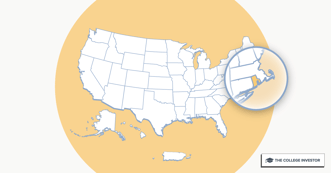
Rhode Island College Cost Snapshot (2025-26)
Published tuition and cost-of-attendance averages across Rhode Island institutions.
Top Rhode Island Colleges by Published Tuition (2025-26)
Tuition and fees only. Click any column header to sort.
| School ↕ | Type ↕ | In-state T&F ↕ | Out-of-state T&F ↕ | Undergrad Enroll. ↕ |
|---|---|---|---|---|
| University of Rhode Island | Public 4-yr | $16,408 | $35,368 | 13,900 |
| Rhode Island College | Public 4-yr | $11,420 | $28,574 | 5,900 |
| Brown University | Private | $68,612 | $68,612 | 7,300 |
| Providence College | Private | $63,770 | $63,770 | 4,200 |
| Bryant University | Private | $54,106 | $54,106 | 3,200 |
| Johnson & Wales University | Private | $38,120 | $38,120 | 4,600 |
| Salve Regina University | Private | $49,670 | $49,670 | 2,300 |
| Community College of Rhode Island | Community | $4,828 | $13,672 | 12,600 |
Rhode Island State-Funded Aid Programs
Administered by the Rhode Island Office of Postsecondary Commissioner and RISLA.
RI Promise
Two years of tuition-free education at the Community College of Rhode Island for recent high school grads.
Hope Scholarship
Free tuition for junior and senior years at URI and Rhode Island College for Pell-eligible RI residents meeting GPA and credit requirements.
Rhode Island Supplemental Grant
Need-based grant for full-time RI residents at eligible in-state or out-of-state institutions.
Student Loan Options for Rhode Island Students
Start with federal aid before considering private loans. Federal borrower protections are stronger and rates are fixed.
Does Rhode Island have a state student loan program?
Yes. Rhode Island offers the RISLA Student Loan — a state-affiliated nonprofit lender. The Rhode Island Student Loan Authority (RISLA) is a self-sustaining nonprofit state authority offering some of the lowest fixed-rate student loans in the U.S. — often priced below MEFA, Sallie Mae, and major banks. RISLA also offers income-based repayment on its private loans, which is rare. Rhode Island residents should still start with federal loans through the FAFSA, but the RISLA is worth comparing alongside national private lenders.
The order to follow
- File the FAFSA to unlock federal Pell Grants, Rhode Island state grants, and Direct Subsidized/Unsubsidized loans.
- Apply scholarships and 529 savings before borrowing a dollar. Every $1,000 in free aid saves roughly $1,400 in total loan cost over 10 years.
- Max federal Direct Loans next. Fixed rates, income-driven repayment, and forgiveness programs aren't available on private loans.
- Compare private student loans only for any remaining gap. Shop at least 3 lenders; cosigner rates typically run 1-3 points lower.
Private Student Loan Lenders We Recommend
If you've exhausted federal aid and still need to borrow, these are the lenders we track for rates and terms.
Credible
One form, prequalified offers from multiple private lenders. Shop rates without multiple hard credit pulls.
Compare Rates at Credible →College Ave
Flexible term lengths, no application or origination fees, and fast decisions.
Get A Quote At College Ave →Sallie Mae
Long-established lender with options for undergraduate, graduate, and career training programs.
See Sallie Mae Rates →Advertiser disclosure: The College Investor earns a commission from some of the lenders listed above. Our rankings are independent — compensation does not influence order or editorial recommendations.
Frequently Asked Questions
Common questions from Rhode Island students and families.
How much does college cost in Rhode Island?
Average in-state tuition and fees at Rhode Island public four-year universities is about $14,500 for 2025-26. Total cost of attendance (tuition, fees, room and board, books, and personal expenses) averages roughly $28,900 on campus for Rhode Island residents and $40,800 for non-residents.
What is the average student loan debt in Rhode Island?
Rhode Island borrowers carry an average federal student loan balance of roughly $32,900. Total outstanding federal student debt for Rhode Island residents is approximately $4.8 billion.
Does Rhode Island offer state-funded college grants?
Yes. The primary programs are RI Promise (free community college for recent grads), the Hope Scholarship (free junior and senior year at URI and RIC), and the RI State Grant (up to $2,250 per year, need-based).
Does Rhode Island have a state student loan program?
Yes. RISLA Student Loan is a state-affiliated nonprofit lender serving Rhode Island residents. The Rhode Island Student Loan Authority (RISLA) is a self-sustaining nonprofit state authority offering some of the lowest fixed-rate student loans in the U.S. — often priced below MEFA, Sallie Mae, and major banks. RISLA also offers income-based repayment on its private loans, which is rare.
Which Rhode Island colleges have the lowest in-state tuition?
The Community College of Rhode Island has the lowest cost at $4,828 per year, and is tuition-free for recent grads through RI Promise. Rhode Island College is lowest among four-year publics at $11,420, followed by URI at $16,408.
What scholarships are available for Rhode Island residents?
Key awards include RI Promise, the Hope Scholarship, the RI State Grant, and RISLA's nonprofit student loans. Brown and Providence College offer substantial institutional aid with need-based financial aid programs.
Related Rhode Island Resources
How We Sourced This Data
- Institutional cost pages at Rhode Island public universities (2025-26 published rates)
- Education Data Initiative state-level debt and cost tables
- RI OPC and RISLA program pages
- NCES IPEDS data for enrollment and institutional cost profiles
Editor: Colin Graves Reviewed by: Chris Muller