Minnesota Student Loans, Financial Aid & College Costs
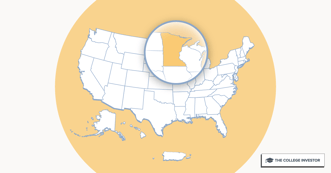
Minnesota College Cost Snapshot (2025-26)
Published tuition and cost-of-attendance averages across Minnesota institutions.
Top Minnesota Colleges by Published Tuition (2025-26)
Tuition and fees only. Click any column header to sort.
| School ↕ | Type ↕ | In-state T&F ↕ | Out-of-state T&F ↕ | Undergrad Enroll. ↕ |
|---|---|---|---|---|
| University of Minnesota Twin Cities | Public 4-yr | $15,806 | $36,402 | 34,100 |
| U of M Duluth | Public 4-yr | $14,700 | $18,900 | 8,800 |
| St. Cloud State University | Public 4-yr | $8,810 | $17,488 | 10,700 |
| Minnesota State Mankato | Public 4-yr | $9,800 | $18,400 | 12,900 |
| Winona State University | Public 4-yr | $10,650 | $18,070 | 6,800 |
| Bemidji State University | Public 4-yr | $9,250 | $9,250 | 4,500 |
| Carleton College | Private | $68,430 | $68,430 | 2,000 |
| Macalester College | Private | $66,968 | $66,968 | 2,100 |
| University of St. Thomas | Private | $52,890 | $52,890 | 5,900 |
| Minneapolis Community & Technical College | Community | $5,600 | $5,600 | 8,000 |
Minnesota State-Funded Aid Programs
Administered by the Minnesota Office of Higher Education (OHE).
Minnesota State Grant
Need-based grant for MN residents at eligible MN institutions. Covers portion of the cost after Pell and family contribution.
North Star Promise Scholarship
Last-dollar tuition-free program at MN public colleges for families earning under $80,000.
Minnesota Indian Scholarship
Supplemental scholarship for enrolled MN American Indian students.
Student Loan Options for Minnesota Students
Start with federal aid before considering private loans. Federal borrower protections are stronger and rates are fixed.
Does Minnesota have a state student loan program?
Yes. Minnesota offers the SELF Loan — a state-affiliated nonprofit lender. The Student Educational Loan Fund (SELF) is administered by the Minnesota Office of Higher Education. Fixed-rate loans for MN residents at eligible schools nationwide, and for non-residents attending MN schools. Minnesota residents should still start with federal loans through the FAFSA, but the SELF is worth comparing alongside national private lenders.
The order to follow
- File the FAFSA to unlock federal Pell Grants, Minnesota state grants, and Direct Subsidized/Unsubsidized loans.
- Apply scholarships and 529 savings before borrowing a dollar. Every $1,000 in free aid saves roughly $1,400 in total loan cost over 10 years.
- Max federal Direct Loans next. Fixed rates, income-driven repayment, and forgiveness programs aren't available on private loans.
- Compare private student loans only for any remaining gap. Shop at least 3 lenders; cosigner rates typically run 1-3 points lower.
Private Student Loan Lenders We Recommend
If you've exhausted federal aid and still need to borrow, these are the lenders we track for rates and terms.
Credible
One form, prequalified offers from multiple private lenders. Shop rates without multiple hard credit pulls.
Compare Rates at Credible →College Ave
Flexible term lengths, no application or origination fees, and fast decisions.
Get A Quote At College Ave →Sallie Mae
Long-established lender with options for undergraduate, graduate, and career training programs.
See Sallie Mae Rates →Advertiser disclosure: The College Investor earns a commission from some of the lenders listed above. Our rankings are independent — compensation does not influence order or editorial recommendations.
Frequently Asked Questions
Common questions from Minnesota students and families.
How much does college cost in Minnesota?
Average in-state tuition and fees at Minnesota public four-year universities is about $13,500 for 2025-26. Total cost of attendance (tuition, fees, room and board, books, and personal expenses) averages roughly $27,200 on campus for Minnesota residents and $34,800 for non-residents.
What is the average student loan debt in Minnesota?
Minnesota borrowers carry an average federal student loan balance of roughly $34,800. Total outstanding federal student debt for Minnesota residents is approximately $29.1 billion.
Does Minnesota offer state-funded college grants?
Yes. Minnesota administers the MN State Grant (up to $17,500 per year), the North Star Promise (free tuition for families under $80k), the MN Indian Scholarship, and the MN GI Bill.
Does Minnesota have a state student loan program?
Yes. SELF Loan is a state-affiliated nonprofit lender serving Minnesota residents. The Student Educational Loan Fund (SELF) is administered by the Minnesota Office of Higher Education. Fixed-rate loans for MN residents at eligible schools nationwide, and for non-residents attending MN schools.
Which Minnesota colleges have the lowest in-state tuition?
MN community and technical colleges average $5,600 per year and are free for qualifying families through North Star Promise. Bemidji State is the lowest four-year public at $9,250, followed by St. Cloud State. U of M Twin Cities is highest in-state at $15,806.
What scholarships are available for Minnesota residents?
Key awards include MN State Grant, North Star Promise, MN Indian Scholarship, and the SELF nonprofit loan. Carleton and Macalester offer substantial need-based institutional aid.
Related Minnesota Resources
How We Sourced This Data
- Institutional cost pages at Minnesota public universities (2025-26 published rates)
- Education Data Initiative state-level debt and cost tables
- Minnesota OHE program pages
- NCES IPEDS data for enrollment and institutional cost profiles
Editor: Clint Proctor Reviewed by: Chris Muller

Get the latest financial news and actionable insights.
How it works:
- 1Enter your email and subscribe.
- 2Get the latest personal finance and education news delivered every week.
- 3Take control of your finances with real insights.
- 4We won't spam you, ever!