Kansas 529 Plan Rules And College Savings Options
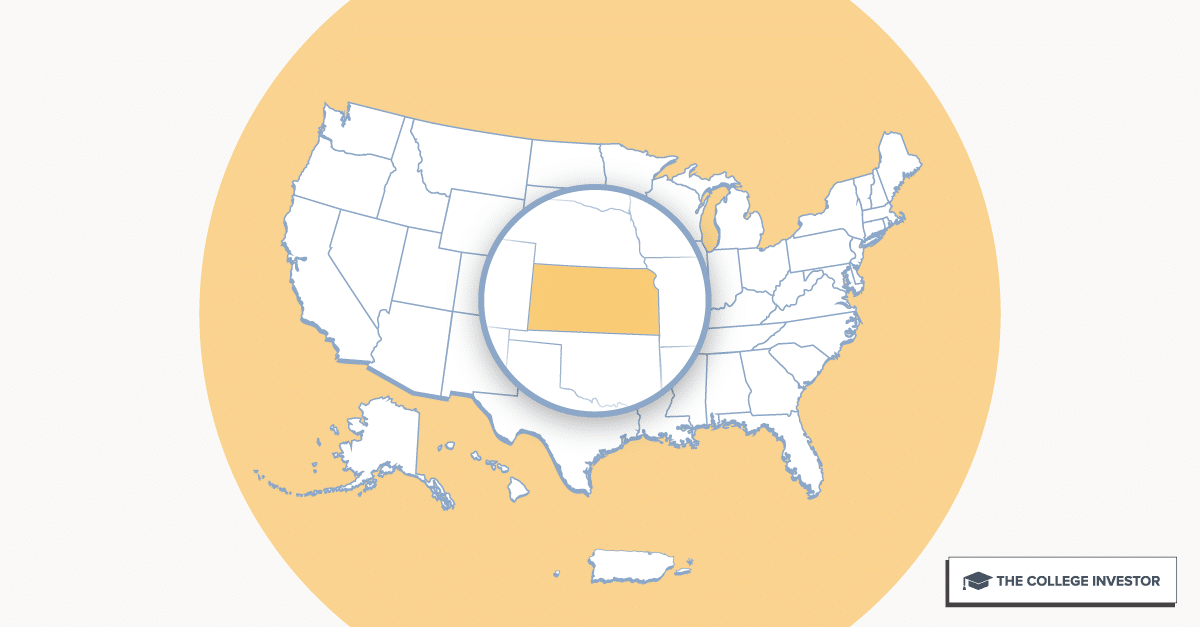
Kansas's 529 plan is Quest529, the renamed Learning Quest, and after its March 2026 fee cut it's one of the cheapest 529 plans in the country, so most Kansas families should open it. The Kansas deduction is generous in two ways: it's counted per beneficiary, so a grandparent with four grandchildren can deduct up to $12,000, and it applies to any state's 529 plan. The trap is the same-beneficiary cap, since 529 and ABLE contributions for one person share a single $3,000 ($6,000 joint) limit. If you're new to these accounts, start with how 529 plans work.
Kansas 529 Plans At A Glance
| Plan | Type | Annual Cost | Who It's For | Status |
|---|---|---|---|---|
| Quest529 Education Savings Plan | Direct-sold savings plan | 0.06%–0.10% on enrollment year portfolios; 0.00%–0.12% on all portfolios | Families who open and manage the account themselves | Open |
| Schwab 529 Education Savings Plan | Savings plan sold through Schwab | 0.07%–0.12% on enrollment year portfolios; 0.00%–0.56% on individual funds | Schwab clients who want more fund choices | Open |
| Learning Quest 529 Advisor Plan | Former advisor-sold plan | Accounts moved into Quest529 | Former advisor-plan owners | Merged |
Kansas taxpayers get a tax deduction of up to $3,000 per beneficiary ($6,000 joint) on the Schwab 529 plan. Enrollment year portfolios cost 0.07% to 0.12% a year, and there's no minimum to open.
Open A Schwab 529 Account »Kansas 529 Tax Deduction And Tax Rules
Kansas lets taxpayers subtract up to $3,000 a year for each beneficiary, or $6,000 for married couples filing jointly, for contributions to Quest529, Schwab 529, or any other state's 529 plan (K.S.A. 79-32,117). The same per-beneficiary cap also covers ABLE account contributions, and the deduction goes to any individual who files a Kansas return and contributes, not only the account owner (Quest529 Plan Description). Our state-by-state 529 tax deduction table shows how that compares with neighboring states.
Contributions made from January 1 through the return filing deadline can count for the prior tax year if you elect it when you file, and no contribution can be deducted in more than one year (K.S.A. 79-32,117). Kansas reports the deduction on Schedule S, line A16 (Kansas Department of Revenue), and our list of qualified 529 plan expenses covers what you can spend it on.
| Situation | Kansas Tax Treatment |
|---|---|
| Contribution to Quest529 or Schwab 529 | Deductible up to $3,000 per beneficiary, $6,000 per beneficiary for joint filers |
| Contribution to another state's 529 plan | Deductible under the same limit; Kansas has tax parity |
| Qualified college withdrawal (any accredited school, in or out of state) | Tax-free |
| K-12 tuition and expenses | Tax-free up to $20,000 per beneficiary per year starting in 2026; Kansas uses the federal definition of qualified expenses |
| Student loan repayment | Tax-free up to $10,000 lifetime per borrower |
| Registered apprenticeship costs | Tax-free |
| Non-qualified withdrawal | Previously deducted amounts added back to Kansas income, and earnings taxed |
| Contribute and withdraw right away (529 churning) | Allowed; no holding period, so the deduction applies even if the money pays a qualified expense soon after |
| Rollover from a Kansas plan to another state's plan | Not a non-qualified withdrawal under Kansas law, so no add-back |
| Rollover from another state's plan into a Kansas plan | Tax-free |
| 529-to-Roth IRA rollover | Free of Kansas income tax, per the plan; Kansas Department of Revenue hasn't published separate guidance |
Kansas doesn't require money to stay in a 529 account for any set period before you withdraw it. The statute allows the subtraction for amounts contributed and only adds money back for non-qualified withdrawals, with no holding period (K.S.A. 79-32,117), and the March 2026 plan descriptions for Quest529 and Schwab 529 add none (Quest529 Plan Description). That means Kansas families paying tuition out of pocket can route up to $3,000 per beneficiary ($6,000 joint) through a 529 first and still claim the deduction, a move states like Wisconsin and Montana have blocked, as our breakdown of 529 plan churning and withdrawal limits explains.
Federal law lets a 529 that's been open at least 15 years roll up to $35,000 into the beneficiary's Roth IRA, and Quest529 says rolled-over funds come out free of federal and Kansas income tax (Quest529). Kansas's own tax department hasn't issued a Roth-specific ruling, so keep records of the account's age and contribution dates. Read our 529-to-Roth IRA rollover rules before you move leftover money.
Kansas defines qualified expenses and rollovers by reference to federal section 529 "as amended," which is why the $20,000 K-12 limit, student loans, and apprenticeships carry over (K.S.A. 75-643). The Quest529 plan description lists postsecondary credential expenses as qualified too (Quest529 Plan Description). Our breakdown of the 2026 529 plan expansion covers what changed federally.
How Kansas's 529 Plan Ranks
Kansas ranks 12th of the 50 state plans in our best 529 plans rankings, which include Washington, D.C., with a 67.8% net return on investment. Our Net ROI score models $100 a month for 10 years at a 5% annual return, subtracts plan fees, and reinvests the value of the state tax break each year. Kansas's 2 basis point fee is among the lowest in the table, and its 5.6% tax break keeps it in the top quarter.
| State | Fees (Basis Points) | State Tax Break | Net ROI |
|---|---|---|---|
| Indiana (#1 overall) | 12.5 | 20% | 87.8% |
| Kansas (#12) | 2 | 5.6% | 67.8% |
| Oklahoma | 10 | 4.5% | 64.8% |
| Missouri | 15 | 4.7% | 64.4% |
| Nebraska | 14 | 4.6% | 64.4% |
| Colorado | 27 | 4.4% | 62.0% |
Kansas is a tax-parity state, so a resident can put money in another state's plan and still take the Kansas deduction (K.S.A. 79-32,117). That doesn't make this table a shopping list, because each score assumes a taxpayer in that state using its own plan, and few plans in our rankings undercut Quest529's 0.06%–0.10% enrollment year cost. The full rankings table lists all 50 state plans.
The gap with the top of the list comes down to the tax break. Kansas already charges almost nothing in fees, while Indiana's 20% tax credit is what puts it at #1, so a larger deduction is the lever that would move Kansas families up. If that matters to you, share these numbers with your state legislators, and use our 529 plan tax deductions by state table to show how other states reward savers.
Should Kansas Residents Use Quest529?
Yes, for most Kansas families. You'd get the Kansas deduction with any state's plan, but Quest529's all-in cost of 0.06% to 0.10% on its enrollment year portfolios is lower than most plans in our rankings (Quest529 Plan Description). Our 529 plan tax deductions by state table shows how few states give their break for any plan.
Families who already bank or invest with Schwab, or who want individual funds from Dimensional, Dodge & Cox, or Franklin Templeton, can open the Schwab 529 Education Savings Plan instead and keep the same Kansas deduction. Our Charles Schwab review covers the broker itself, and our list of the best brokers to open a 529 plan compares other options. Nonresidents can open either plan too, since neither has a residency requirement (Quest529), but they should first check where to open a 529 plan in their own state.
Four years at an in-state Kansas public university runs about $93,600 on campus, so the average Quest529 balance of about $25,700 covers a little more than one year. Our Kansas college costs and financial aid breakdown lists costs by school, and our 529 savings benchmarks by age show what to aim for.
Kansas 529 Plan Details
Both Kansas plans are administered by the Kansas State Treasurer and managed by TIAA-CREF Tuition Financing, which replaced American Century Investments on March 2, 2026 (Quest529). As of June 30, 2026, the two plans held $16.34 billion across 442,069 open accounts, and Kansas ranked 10th among the states in 529 assets (The 529 Network). Our 529 plan and college savings statistics show how that compares nationally.
| Kansas Plan (June 30, 2026) | Open Accounts | Assets | Average Balance |
|---|---|---|---|
| Quest529 Education Savings Plan | 96,349 | $2.47 billion | $25,662 |
| Schwab 529 Education Savings Plan | 345,720 | $13.87 billion | $40,125 |
| All Kansas 529 plans | 442,069 | $16.34 billion | $36,972 |
Quest529 Education Savings Plan (Direct-Sold)
This is the plan to open if you're managing the account yourself. Total annual cost runs 0.06% to 0.10% on the enrollment year portfolios, including the program management and state administrative fees, with no account, startup, or maintenance fees (Quest529 Plan Description). On a $25,662 balance, the plan's average as of June 30, 2026, that's about $15 to $26 a year, which our 529 balance by age benchmarks can put in context.
| Program manager | TIAA-CREF Tuition Financing, Inc. |
| Minimum contribution | None |
| Maximum account balance | $550,000 per beneficiary across all Kansas 529 plans |
| All-in annual cost | 0.06%–0.10% (enrollment year portfolios); 0.00%–0.12% (all portfolios) |
| Investment options | 10 enrollment year portfolios, 4 multi-fund portfolios, 6 individual fund portfolios |
| Fund families | Nuveen, Vanguard, and T. Rowe Price |
| Who can open | Any adult with a U.S. address and a Social Security or taxpayer ID number |
| Official source | quest529.com |
The Learning Quest 529 Advisor Plan was folded into Quest529 on March 30, 2026, so former advisor-plan owners now hold Quest529 accounts (Quest529). If you still pay an advisor, compare that fee with a flat-fee planner, since our 529 plan overview shows how little the plan itself now costs.
Schwab 529 Education Savings Plan
Schwab's plan is also a Kansas plan with the same deduction, but it offers a longer list of individual funds and costs a bit more. Its enrollment year portfolios run 0.07% to 0.12% all-in, and individual fund portfolios run up to 0.56% (Schwab 529 Plan Description). It's a natural fit if your other accounts are already at Schwab, and our Charles Schwab review covers the broker itself; you can open a Schwab 529 account here. Families comparing the two plans can use our 529 plan rollovers and transfers explainer if they want to move money later.
| Program manager | TIAA-CREF Tuition Financing, Inc.; distributed by Charles Schwab & Co. |
| Minimum contribution | None |
| Maximum account balance | $550,000 per beneficiary across all Kansas 529 plans |
| All-in annual cost | 0.07%–0.12% (enrollment year portfolios); 0.06%–0.14% (static portfolios); 0.00%–0.56% (individual fund portfolios) |
| Investment options | 10 enrollment year portfolios, 3 static allocation portfolios, 13 individual fund portfolios |
| Fund families | Schwab, Dimensional, Dodge & Cox, Franklin Templeton, T. Rowe Price, and Vanguard |
| Who can open | Any U.S. citizen or resident alien; no residency requirement |
| Official source | schwab.com/529-plan |
| Open an account | Schwab 529 Education Savings Plan |
Other Kansas College Savings Programs
Upromise. Upromise lets you earn money for your Quest529 account through rebates and rewards on everyday spending, and the Upromise credit card sends cash back straight into your child's 529 plan (Upromise). You can link a Quest529 or Schwab 529 account to your Upromise profile, so the rewards stack on top of the Kansas state tax deduction.
K.I.D.S. Matching Grant. Kansas families with income at or below 200% of the federal poverty level can get a dollar-for-dollar match of up to $600 a year on Quest529 contributions (Quest529). You must contribute at least $100 during the year, apply by December 1, and reapply every year, and the state deposits the match around January 31 of the next year. Our Kansas financial aid page lists the state's college grants.
Kansas ABLE. Kansas residents whose disability began before age 46 can save in a Kansas ABLE account run by the State Treasurer, and new accounts opened by December 31, 2026 can qualify for a $100 grant (Kansas State Treasurer). ABLE contributions share the $3,000 ($6,000 joint) per-beneficiary Kansas deduction with 529 contributions, which our 529 plan overview compares with regular college savings.
Leftover money. Families with money left after college can change the beneficiary to a sibling, pay down up to $10,000 of student loans, or roll to a Roth IRA. Our list of what to do with leftover 529 money covers each option, and Kansas graduates in teaching or health care should also check Kansas student loan forgiveness programs.
Frequently Asked Questions
What Is The Kansas 529 Plan Called?
Kansas's direct-sold 529 plan is Quest529, which was called Learning Quest until March 2026, and the state also sponsors the Schwab 529 Education Savings Plan. Both are managed by TIAA, and our 529 plans by state hub lists every state's plans.
Is The Kansas 529 Plan Tax Deductible?
Yes. Kansas taxpayers can deduct up to $3,000 per beneficiary a year, or $6,000 per beneficiary for joint filers, and contributions to any state's 529 plan qualify (K.S.A. 79-32,117). Our state 529 tax deduction table shows how that compares state by state.
Can Grandparents Get The Kansas 529 Deduction?
Yes, if they file a Kansas return and contribute. The deduction is available to any individual Kansas filer who contributes, and the limit applies per beneficiary, so a grandparent can deduct up to $3,000 for each grandchild (Quest529 Plan Description). Our breakdown of how 529 plans work covers who can own and fund an account.
Can I Use A Kansas 529 Plan At An Out-Of-State College?
Yes. Kansas doesn't tax the earnings portion of a qualified withdrawal, and qualified expenses follow the federal definition, which covers eligible schools in any state (Quest529 Plan Description). The list of qualified 529 plan expenses is the same no matter where the school is.
Can I Contribute To A Kansas 529 Plan And Withdraw Right Away?
Yes. Kansas has no holding period, so you can deduct a contribution and use it for a qualified expense shortly after (K.S.A. 79-32,117). Match the withdrawal to an expense paid in the same calendar year, and see which states restrict this in our 529 plan churning breakdown.
What Happens If I Withdraw Kansas 529 Money For Non-Qualified Expenses?
Kansas adds back any amount you previously subtracted, and the earnings are taxed on your Kansas return (K.S.A. 79-32,117). The earnings also face federal income tax and the 10% federal penalty, which our explainer on the 529 plan penalty shows how to avoid.
Can I Use My Kansas 529 Plan For Private K-12 School?
Yes. Starting in 2026, you can withdraw up to $20,000 per beneficiary per year for K-12 tuition and related expenses, and the Quest529 plan description lists the $20,000 limit (Quest529 Plan Description). Our walkthrough on using a 529 plan for private school covers the paperwork.
Related Kansas Resources
How We Sourced This Data
Plan details on this page come from the plan and the state: the Quest529 Plan Description (effective March 2, 2026) and FAQ, the Schwab 529 Education Savings Plan Description (effective March 2, 2026) and plan page, Quest529's January 2026 announcement of the TIAA transition and its transition page, The 529 Network 529 plan data as of June 30, 2026, and the Kansas State Treasurer's Quest529, K.I.D.S. and ABLE pages. Tax rules come from K.S.A. 79-32,117 and K.S.A. 75-643 and the Kansas Department of Revenue's 2025 individual income tax instructions. The college cost figure comes from our Kansas financial aid page, which draws on institutional cost pages and NCES IPEDS data. Read more about how we fact-check and update content.
Page refreshed annually in September, after Quest529 publishes its updated fee schedule, and reviewed in January for tax season. Last full refresh: September 24, 2026.
Editor: Clint Proctor Reviewed by: Chris Muller